The
enemy of excellence is greatness? True, generally – but not
when it comes to Bach’s Mass in B-minor (BWV 232) which would
be a masterpiece even in the least of performances. It is a
gift to humanity when performed as well as I’ve now had the
pleasure of experiencing thrice in short succession. First courtesy
of the Netherlands Bach Society and Jos van Veldhoven on Channel
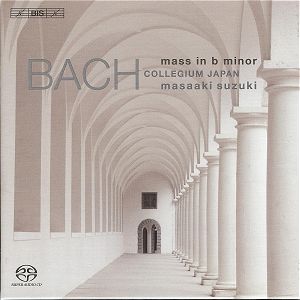
Classics, then as I received the newly released Masaaki Suzuki
recording on BIS, and finally just before Christmas when Ton
Koopman directed the Bavarian Radio Symphony Orchestra at the
Herkulessaal in Munich – which was also broadcast live
on radio.
When
the work was about to be published around 1820, Hans Georg Nägeli
announced it as “the greatest musical work of art of all times
and all peoples”. Publisher Nägeli may have aimed more at boosting
subscriptions rather than trying to divine the true ramification
of the rediscovery of the Mass in B-minor – but unwittingly
or not, he was pretty close. I am hardly alone in thinking of
the B-minor mass as one of the cultural pillars of Western Civilization.
Whether it is a complete patchwork or put together from pieces
with a design in mind - most musicologists strongly suggest
the latter - this music is, certainly metaphorically, possibly
literally, divine.
Now
I have two “HIP”
versions on my desk, both of them on hybrid-SACDs, and both
by renown Bach conductors. Jos van Veldhoven on Channel Classics
in the most luxurious CD box imaginable. The accompanying book
was produced in collaboration with the Museum Catharijneconvent
and boasts near 100 pictures, reprints, and illustrations. The
sturdy packaging with the golden imprint makes the space-saving
slim box of the Masaaki Suzuki recording on BIS look downright
humble.
Exteriors
and superficialities should not be underestimated – but ultimately
it is the content that matters. And here the two recordings
are more alike than different. The total timing of van Veldhoven
is 105 minutes; Suzuki clocks in at just over 107. That’s similar
to Harnoncourt (II), Brüggen, Rifkin, Koopman, and Gardiner
and just a tad speedier than Herreweghe’s wonderful second recording
on Harmonia Mundi. Junghänel is the fastest I am aware of, nearly
staying below 100 minutes. But it is a far cry from the 2-hour-plus
performances of Karl Richter, Celibidache, Scherchen, Jochum,
von Karajan, Shaw, or Klemperer
– and for all those who insist on their B-minor
masses big-boned and with mighty choruses, neither Suzuki nor
van Veldhoven with their two and three ripienists to a part
will do. That said, anyone who is not ruling out the “HIP” approach
but isn’t quite sold on it yet, will probably be converted by
either recording and agree that the historically informed approach
can offer some of the finest and most exciting music-making.
The
sound and impact of both recordings is similarly excellent,
their singers outstanding, and the choral parts that we love
in the Kyrie, the Sanctus, or the Gloria
come through with surprising opulence and splendor. Yet differences
in detail abound between Suzuki and Veldhoven – often a matter
of Suzuki taking a marginally more relaxed pace than his Dutch
colleague or sounding more restrained even when he is technically
a bit faster.
In
the Quoniam tu solus sanctus Suzuki uses the harpsichord
as the continuo instrument of choice - with his son, Masato,
playing - while van Veldhoven lets the strings free rein to
support the bass solo. There is little to choose between the
veterans Peter Kooij (BIS) and Peter Harvey (Channel Classics)
– the latter perhaps with a more open, regal voice. The horn
might be a tad more stable on the Dutch production (Teunis van
der Zwart) but clearer and more in front of the bassoons with
the Japanese band (Olivier Darbellay).
Dorothee
Mields is a lovely soprano for van Veldhoven. But the recording
of the Bach
Collegium Japan has Carolyn Sampson and there simply isn’t
anything better than her tasteful, lean, and full voice – whether
it is live (as with Koopman) or on record. The Christe Eleison
between Sampson and Rachel Nicholls - both also sing in the
soprano I and soprano II chorus parts, respectively - is one
of those moments that feel like Bach himself is smiling.
Similarly,
the countertenors Robin Blaze (BIS) and Matthew White (Channel
Classics) turn the alto-oboe duet Qui sedes ad dextram Patris
into something that might appease those who would rather hear
a mezzo-soprano in this role/ This might actually be historically
accurate, regardless of what the British-influenced Belgio-Flemish-Dutch
historical performance tradition has come to accept as the HIP-gospel.
Blaze has a slightly more nimble, more feminine voice – White’s
has a more dramatic ring to it. Masamitsu San’nomiya’s oboe-playing
meanwhile, devoid of extraneous noises, air, or hiss and full
of sweetness, is exemplary.
Ultimate
splendor is achieved in the Sanctus. Suzuki and the BIS
engineers make the fourteen and twenty instrumentalists involved
sound like a grand ensemble – and he gives his forces all the
time to draw on the sumptuous qualities of the zenith of the
Mass. Van Veldhoven and the audiophile crew of Channel Classics
achieve an equivalent impression. He’s given slightly more reverberation;
both have ample space around all musicians. Van Veldhoven does
it by pushing along at a brisk pace: different means but with
the result every bit as exciting.
The
tenors on either recording are without fault and make for a
impressive Benedictus with Gerd Türk (BIS) having a slight
edge over Charles Daniels through his effortless but strong
clarity. Türk also manages to hold his own against Sampson in
the Domine Deus while Charles Daniels collaborates with
Mme. Mields on a more even level. The combination of Sampson
and Daniels, who sang together in the Koopman performance, was
equally delectable. Kiyomi Suga’s clean Traverso-playing is
almost matched by her colleague on the Dutch production in these
two most prominent parts for flute – and Suzuki’s notably tighter
pace in the Benedictus only benefits her line.
The
Osanna in Excelsis is a great moment of trumpet, timpani
and chorus-imbued splendor – and a highlight among the string
of thrilling moments in the Suzuki recording. It may also be
one of the few miscalculations on van Veldhoven’s part because
his extraordinarily swift take might well be exciting but also
sounds rushed.
As
regards tempi in general, though, I could put it unkindly thus:
Wherever Suzuki is slower than van Veldhoven, he seems to drag
(in comparison, only!) – wherever Suzuki is faster, van Veldhoven
seems to have more momentum. It is this subtle impression that
I take away from the two issues more than any of the more obvious
little differences – and an impression I would never have gotten
from Suzuki had it not been for direct comparison. Either are
a match for the best of the HIP B-minor masses out there, whether
compared to Herreweghe (II) or Gardiner or whatever else your
current preference may be. There’s an embarrassment of riches
of great recordings of this work available now – but if pressed,
I’d rank both among the handful of best recordings made, regardless
of style. Among which should also be included the 1999
Rilling and the 1961 Richter recordings.
Jens F. Laurson


























 [52.58
+ 54:33]
[52.58
+ 54:33]