Editorial Board
MusicWeb International
Founding Editor Rob Barnett Editor in Chief
John Quinn Contributing Editor Ralph Moore Webmaster
David Barker Postmaster
Jonathan Woolf MusicWeb Founder Len Mullenger
Samuel
BARBER (1910-1981)
There’s nae lark (1927) [1:34]
The Beggar’s Song (1936) [2:07]
In the dark pinewood (1937) [1:55]
Bessie Bobtail Op. 2 No. 3 (1934) [2:51]
Hermit Songs Op. 29 (1952-53) [18:55]
Three Songs Op. 10 (1935-36) [7:39]
Mélodies passagères Op. 27 (1950-51) [9:40]
The Daisies Op. 2 No. 1 (1927) [1:04]
With rue my heart is laden Op. 2 No. 2 (1926) [1:13]
Nocturne Op. 13. No. 4 (1940)[3:19]
Sure on this shining night Op. 13 No. 3 (1938) [2:37]
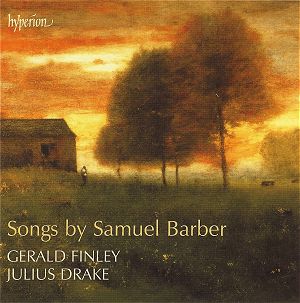
Dover Beach, Op. 3* (1931) [8:11] Gerald Finley
(baritone)/Julius Drake (piano)/*The Aronowitz Ensemble
rec. December 2005 and February 2007. Venue not specified
Texts and English translations supplied HYPERION CDA67528 [62:17]
The
Canadian baritone, Gerald Finley, has already given us a recital
of songs by Charles Ives. I haven’t heard that but it was favourably reviewed on
MusicWeb. Now he teams up again with Julius Drake for an exploration
of the songs of another American, Samuel Barber.
Barber
is perhaps the greatest of all American art song composers and,
indeed, one of the finest of all twentieth-century composers
in this genre. Like all the very best art song writers he combines
a strong melodic gift with an excellent and perceptive taste
in literature. And as Calum MacDonald puts it in his booklet
note, “Throughout his song output, he found ways of capturing
the poets’ thought in musical correlatives that were never merely
decorative, and developed an instinctive knack for embodying
words in a memorable vocal shape.” The selection of songs on
this present CD amply confirms that verdict.
Barber’s
songs are quite well represented on CD, including some recitals
devoted exclusively to his work. Pride of place amongst the
previous essays in the field must go to DG’s 1994 two-disc set
of the Complete Songs on which Cheryl Studer and Thomas Hampson
were partnered by no less an exponent of Barber’s piano music
than John Browning. That set, containing some 47 items, was
valuable not least for its inclusion of a number of unpublished
songs and the standard of performance and interpretation was
very high indeed. I think that Gerald Finley and Julius Drake
can hold their heads up high in that illustrious company.
One
habitual characteristic of Gerald Finley’s singing is his ability
to deploy, where appropriate, a warm and seamless legato. This
enables him to serve Barber very well. The very first offering,
the early There’s nae lark, with its gentle lyricism,
benefits accordingly. I also admired greatly Finley’s exquisite
delivery of the soft, undulating vocal line in In the dark
pinewood. In this latter song Thomas Hampson adopts a slightly
quicker, and therefore more flowing, tempo. Some may share my
preference for Hampson’s way with the song but, on its own terms,
Finley’s singing of the song is just as fine.
Finley
is in his element in the three songs that constitute Op. 10,
all of which are settings of James Joyce. The first one, Rain
has fallen, is built to a powerful climax by Finley and
Drake. This is followed by Sleep now. This is anything
but a conventional lullaby, especially in its central stanza,
and Finley puts it across very well. Best of all is I hear
an army. This is a magnificent song and Finley treats us
to a vehement account of it, his singing underpinned by some
powerful pianism from Drake. Hampson also gives a superb account
of this song but I find Finley even more impressive, though
perhaps the fact that his recording is cut at a slightly higher
level adds to the impact.
At
the centre of the recital is the collection of ten songs to
which Barber gave the title, Hermit Songs. These are
mainly short settings of English translations of medieval poems
attributed to Irish saints and mystics. The cycle was fist performed
in October 1953 by Leontyne Price, accompanied by Barber himself,
and an invaluable recording of the première can be found on
Bridge Records (Bridge 9156). Since the first performance the
cycle has tended to be the preserve of female singers – Cheryl
Studer sings it on the DG album – and, indeed, I can’t recall
hearing it sung by a man. However, there’s no inherent reason
why a man shouldn’t sing these songs since most of the texts
actually imply, at least, a male author and, of course, historically
the term “hermit” has generally been taken, rightly or wrongly,
to imply the male gender.
Finley
amply vindicates his decision to perform these songs. He has
the requisite command in the first song, At St. Patrick’s
Purgatory. A little later he’s rapt and confiding in the
central section of St Ita’s Vision, and the concluding
soft high note in this song is beautifully placed and controlled.
In The Crucifixion he’s deeply expressive with his ample
supply of vocal power put to good use when required. The best
known of the set is The Monk and his Cat. At the start
Finley sounds languorous, suggesting a cat curled up comfortably
in front of a fire. The piano part includes some wonderful witty,
syncopated figures which Julius Drake plays quite smoothly,
thereby imparting a real feline feeling, which I’m sure is apposite.
John Browning does something pretty similar but it’s interesting
to note that the composer himself articulates these rhythms
much more sharply. The last song of all, The Desire forhermitage,
is a marvellous piece. Finley sings it in such a way as to suggest
that in the title the word “longing” could be substituted for “desire”.
He’s very effective here. On the DG set Cheryl Studer’s approach
is not dissimilar though Leontyne Price, presumably schooled
by the composer, sounds more direct.
I
should also mention the performance of Mélodies passagères,
a set of five songs that Barber wrote for and dedicated to Pierre
Bernac and Francis Poulenc. How effortlessly Barber takes to
the milieu of mélodies. I’m sure Poulenc was delighted
by these songs and would have been happy to have written them
himself. The performance here is full of refinement, not least
in Un cygne, which benefits hugely from Finley’s enviable
legato and also from the appropriately liquid pianism of Drake.
Near
the end of the programme Finley sings The Daisies. Here
I think he’s perhaps a bit too suave and calculating for what
is essentially a quite simple song. That said, I find the same
traits in Thomas Hampson’s reading. In passing, I wonder why
the three songs that constitute Op. 2 were split up on the CD.
It would have made more sense to have grouped them together.
The final offering from Finley and Drake is Sure on thisshining
night, which I regard not just as one of Barber’s finest
songs but as one of the greatest of all twentieth-century songs.
Finley’s account of it is impressive.
For
the very last item on the disc Finley collaborates with members
of The Aronowitz Ensemble for Dover Beach. This gravely
beautiful setting of words by Matthew Arnold is justly admired
amongst Barber’s output. Indeed, he showed that he was no mean
singer in a very fine recording – the work’s first, I believe
- that he himself made in 1935 with the Curtis String Quartet.
Calum MacDonald refers to the “exalted pessimism” of Arnold’s
text. Barber brings that out in his music and Finley and his
collaborators respond readily. Finley brings out the expressive
nuances of the piece and projects it imaginatively. It’s a restrained
composition, requiring sensitivity and control from the performers.
This it receives here and as a result when the one climax arrives,
near the end, at the words “Hath really neither joy, nor love,
nor light …” It’s all the more arresting as a result of the
artists’ control up to this point. Thomas Hampson offers an
equally impressive account on DG and, to be honest, I find it
well nigh impossible to express a preference. Dover Beach makes
for a very satisfying conclusion to this Hyperion recital.
Throughout
the programme the recorded sound is good and clear. The booklet
includes a good note by Calum MacDonald and the texts of almost
all the songs, together with an English translation of the words
of Mélodies passagères. The exception is the Joyce songs,
which have been omitted for copyright reasons – though DG included
them. That’s a pity since Joyce’s words are not always the easiest
to comprehend. Actually, Hyperion’s usual high documentation
standards slip a little on this occasion. Very limited information
is supplied about the dates and venue of the recording. Also
there’s inconsistency about giving dates of the composition
of the various songs: some are missed out altogether while to
get the rest you have to flit between the track listing and
the notes. Readers should note also that often the date given
in the booklet is the date not of composition but of publication.
That can be misleading since some of the songs were published
several years after they were written. For the heading to this
review I have gone back to the DG booklet, which gives both
dates, and I have inserted the dates of composition. It’s most
unusual to find Hyperion just a little bit slack in the matter
of documentation.
However,
let not that caveat detract from an enthusiastic recommendation
for this new disc. All Barber enthusiasts will want the DG collection
not only on account of its excellence but also because it is
so comprehensive. However, those wanting a high quality single-disc
selection of Samuel Barber’s songs need look no further than
this fine offering from Gerald Finley.
John Quinn
Please support our advertisers below by clicking on the logos for further information.
























 Gerald Finley
(baritone)/Julius Drake (piano)/*The Aronowitz Ensemble
Gerald Finley
(baritone)/Julius Drake (piano)/*The Aronowitz Ensemble 