|
EXPLORE
Musicweb - CLICK
------------------
Message Board
Announcements
Twitter @MusicWebINt
------------------
RECORDING
OF THE MONTH
Shostakovich Symphony 8
RCO, Nelsons
RECORDING
OF THE MONTH

HALLÉ WALKURE
4+1CDs £22 post free
RECORDING
OF THE MONTH

Complete Orchestral Works

EMI Complete Ferrier

Storyteller

Mahler
Symphony 7
Bamberger Symphoniker
Jonathan Nott
................
RECORDING OF THE MONTH

Simone Young
RECORDING OF THE MONTH
Italia Nicola Benedetti

Only complete set
on the Market
35CDs £67

RECORDING
OF THE MONTH
Momentous!
BARGAIN
OF THE MONTH

Italian Cello Concertos
and Sonatas
3CDS £10.95

Brahms Symphonies Zinman
£26.85
RECORDING
OF THE MONTH
Beethoven Symphonies
Thielmann


Magic Moments of Opera
10 Operas Arthaus £95

Brilliant Classics 40CDs

Brilliant Classics 60CDs

9 Symphonies Chailly
£31.90

9
Symphonies C Davis
£18.70
BARGAIN
OF THE MONTH
Absolutely marvellous!
£5.99 post free

Bruch VC1 Gluzman
Quite the finest performance of the Bruch concerto
I have ever heard.

The best opera DVD of the year so far [ST]

Mahler Song Cycles
Katarina Karnéus
Available
again
The Raga Guide
4CDs + 196 page book
£33 post-free world-wide
15,000 copies sold
Editorial
Board
Classical Editor
Rob Barnett
Seen & Heard
Editor Emeritus
Bill Kenny
Editor in Chief
Stan Metzger
MusicWeb Webmaster
Len Mullenger
Assistant Webmaster
David Barker
|
 |
 |
|
alternatively
Crotchet
AmazonUK
AmazonUS |
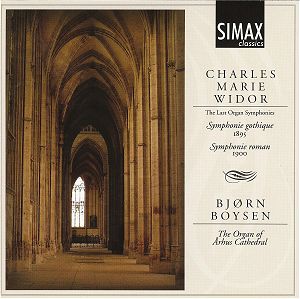
Charles-Marie Widor (1844-1937)
Symphony gothique (1895) [32:40]
Symphonie roman (1900) [32:20]
Bjørn Boysen (organ)
rec. Aarhus Cathedral, Denmark, 27-28 March 2006. DDD
SIMAX PSC1155 [65:00] |
|
If ever a composer is defined by a single
work it is Charles-Marie Widor. Talk
to the average blushing bride and she
and her mother will have at least considered
Widor’s Toccata; pronounced
“widdors tock-at-too”. She may eventually
settle on something by Andrew Lloyd
Webber or Queen – but it is likely that
she will have listened to at least one
recording of this famous - infamous?
- work.
Now up the ante a little and ask the
average music enthusiast about Widor.
If they are ‘into’ the organ they will
know that he wrote a number of Organ
Symphonies – but I guess not one
in twenty will have heard his Trio
for Piano and Strings in B flat.
And how many know that he wrote a Piano
Concerto? And thinking about the
organ- just look at the CD catalogue
– there are at present some sixty recordings
of the ubiquitous Toccata and
only one of the above mentioned Trio.
All food for thought.
This CD presents the last two major
works that Widor composed for his instrument.
And these two Symphonies are
very different from the first eight.
I would not reckon them as being amongst
my ‘favourites’ in the repertoire –
however that is purely a personal view.
And I guess that they will never be
as popular as the Fifth or the
Sixth Symphony with organ enthusiasts.
Yet it is clear that Widor was embarking
on a new direction with these two ‘liturgical’
works. They deserve to be listened to
just as much as the more popular ‘war
horses’. But we need to recognise that
they are different from what had gone
before. For one thing Widor began to
utilise musical material from the Roman
Catholic Liturgy. It was a practice
analogous to Bach’s use of chorales
in his organ and choral music.
The Symphonie gothique was
composed in 1895 and is dedicated to
the Church of Saint-Ouen in Rouen. This
is the home of one of the finest Cavaillé-Coll
organs in the world. In spite of his
new-found interest in plainsong, only
the last two movements of this work
are based on the plainchant from the
Christmas introit – ‘Puer natus est’.
The programme notes suggest that this
was because the work was written over
a long period of time. The earlier movements
were composed before Widor had met Schweitzer
who was responsible for introducing
the composer to a deeper understanding
of Bach’s use of ecclesiastical material.
Look out for the opening movement as
it works its course with an almost tortuous
exposition. This is ‘anguished’ music
that only occasionally seems to relax.
There is a harshness here that will
surprise listeners who only know the
‘warhorses.’ The last movement has been
likened to a historical trip through
organ music history culminating in a
‘toccata’ that is fairly and squarely
Widor’s own.
The Symphonie romane is
dedicated to Saint-Sernin of Toulouse.
Once again Widor makes use of plainchant
– this time it is the ‘Haec dies’ setting
from Easter Day, which is fundamental
to the entire composition. It is the
source of virtually all the melodic
material of this symphony. It could
lead to a degree of boredom or monotony.
Yet this is not the overall impression
given. Albert Schweitzer wrote that:
“When one Sunday (in 1900) still striving
with technical problems. (Widor) played
for the first time in St. Suplice the
Symphonie romane, I felt with
him that in this work the French art
of organ playing had entered sacred
art.” The variety of techniques that
Widor uses to build the Symphony
is impressive. Look out for Listzian
figurations, the chromatic sections
well contrasting with the inherently
modal plainsong and the ‘massive pedal
points’.
These two compositions are enormous
works that are different from the earlier
symphonies in both conception and sound-scape.
That does not mean that the listener
should enjoy them more or regard them
as a greater pieces – it is actually
a matter of opinion. But one thing is
certain – Widor had embarked on a sea-change
in his approach to writing organ music.
Bjørn Boysen is probably not well known
in the United Kingdom, yet he is rated
as one of Norway’s finest concert organists.
He regularly gives recitals in his home
country and does concert tours throughout
the rest of Europe. Since 1977 he has
been the resident organist at the Oslo
Concert Hall. Boysen is multi-talented
– not only is he an active recitalist,
but he also teaches music and is a consultant
on both new organ-builds and restorations
of older instruments. His excellent
programme notes deserve study.
John France
|
|
Advertising
Rates
Visitor
stats
MusicWeb
International
has over 40,000 Classical CD reviews on offer
Discs
received
Having a problem
Donating?

Gerard
Hoffnung Concerts &
The
Bricklayer Story
New
Releases

New
Releases


MusicWeb
sells the Polish
catalogue CDAccord
£10.50 post free W-W

MusicWeb sells the
Arcodiva catalogue
£12.00 post free W-W

£11.75
post-free world-
wide
MusicWeb
can now offer
you discs from the following catalogues:
Prices include postage
Musicweb
Special
Offers
Monthly
Best Buys
Google
Ads - for information about privacy matters, click here.
Amazon Musicweb International is a participant in the Amazon
EU Associates Programme, an affiliate advertising programme designed to provide
a means for sites to earn advertising fees by advertising and linking to Amazon.co.uk
and Amazon.com
|