Editorial Board
MusicWeb International
Founding Editor Rob Barnett Editor in Chief
John Quinn Contributing Editor Ralph Moore Webmaster
David Barker Postmaster
Jonathan Woolf MusicWeb Founder Len Mullenger
Dmitri
SHOSTAKOVICH (1906-1975)
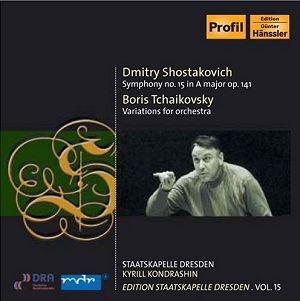
Symphony No.15 op.141 (1971) [42:38] Boris TCHAIKOVSKY (1925-1996)
Theme and Eight Variations for Orchestra(1973) [18:12] Dresden Staatskapelle/Kyrill
Kondrashin
rec. live, Radio GDR, Kulturpalast, Dresden, 23 January 1974
Edition Staatskapelle v.15 HÄNSSLER PROFIL PH06065 [60:50]
Vying for a spot in the mainstream limelight,
“Profil – Edition Günter Hänssler” has
been issuing more and more CDs from
old German radio tapes. Especially and
immensely impressive are some of the
more recent performances of the Staatskapelle
Dresden like Bernard Haitink’s Bruckner
6 and a Mahler 9 with Giuseppe Sinopoli.
This recording of Shostakovich’s 15th
Symphony with Kyrill Kondrashin joins
the list.
On
23 January 1974 – just a little over a year before Shostakovich
died – Kondrashin conducted his favorite German orchestra in
a concert celebrating the 425th anniversary of the orchestra,
the 50th anniversary of the christening of St. Petersburg as
Leningrad, and the 30th anniversary of the breaking of the German
siege of Leningrad.
The
latest and last symphony of the great composer from St. Petersburg
made a logical choice but it wouldn’t have escaped Kondrashin,
or the Dresden audience, that it is uniquely unsuited to venerate
the Soviet — or any communist — regime. After vocal symphonies
13 and 14, Shostakovich, fatally ill and well aware of it, returned
to the almost classical form of the symphony.
In
the essay that accompanied the recording of Maxim Shostakovich
- said to be the best performance of Shostakovich’s son on record
but to my knowledge not available on CD - Shostakovich spoke
of the first movement Adagietto as a “toy-shop with plenty
of knick-knacks and trinkets – absolutely cheerful”. No listener
will get away from the first movement without doubting the composer’s
own words. If it is a toy-shop at all, it’s one that sells little
tanks, toy-guns, and junior’s first water boarding-kit. It’s
a romp with its share of plink and delicate chirping, but this
collection of trivialities amid intensity, with crashing marching
bands and ballerinas, sounds like a sugarplum fairy-cum-guerilla
fighter. There are moments that remind one of the 2nd and 9th
Symphonies, and it’s always interrupted by the seemingly random William
Tell overture excerpt that all American audiences can identify
as the “Lone Ranger” theme.
It’s
not impossible that Shostakovich knew the Lone Ranger and his
heroic deeds - or his appeal to children, which would go with
the toy-shop story – but it’s more likely the Rossini original
that inspired him. And that’s telling enough: A story about
a man who is coerced to use his skill, archery, in Tell’s case,
according to the bidding of a despot – who then uses that skill
to fight against tyranny. If anything it seems that Shostakovich,
in hospital while composing this movement, had dispensed with
being subtle in his political statements.
The
strange giddiness of the first movement is immediately subdued
by the grave brass chorale that opens the dark second movement.
Phases of question and answer and the cello’s lamenting song
lead into trombone and violin statements that are anything but “absolutely
cheerful”. Trombone glissandi - the ones that enraged Stalin
in Lady Macbeth - are employed and eventually the subdued
movement wakens and rises slowly to a big orchestral thrashing-about.
It’s much like the Shostakovich from Symphonies 4, 7, 8, and
11 but with an incredible efficiency of means, almost chamber-like
in proportion and scoring.
The
little, friendly third movement (Allegretto) has moments that
are nearly Haydnesque before the fourth movement takes over
with another blatant musical quotation; this time Wagner’s ‘ensuing
death’ (or “fate”) motif from the Ring, already foreshadowed
in the Adagio of the second movement. The yearning opening of Tristan
und Isolde also appears several times, completing the atmosphere
of resignation and departure. More difficult to hear, if you
don’t know about them, are references or quotations of a Glinka
song, twelve-tone rows (“bourgeois decadence!”), Strauss’s Heldenleben (the “adversaries” phrase,
third movement), and many others that I will have missed completely.
In this fourth, as in the second movement and in so many of
his other symphonies, there is the gathering of momentum, the
orchestral outbreak, the swoop up … here leading to a Passacaglia.
Then the symphony dithers away in a morose mood over ghastly
tic-tocs of a clock and a last, faint glimmer of percussive
hope.
Especially
the Wagner quotations - himself once Hofkapellmeister in Dresden
- would not have escaped the sophisticated Dresden audience
at this performance, the last with Kondrashin. And what an extraordinary
performance it was. It is better in every regard than Kondrashin’s
earlier recording (Melodiya/Aulos): The playing is finer, indeed
flawless. The sound, with a little artificial reverb, is excellent
from the GDR’s radio-broadcast recording crew. Lasting about
42 minutes, the tempi are marginally more relaxed than in the
Moscow recording, but still very much on the fast side which
means that no moments are allowed to sag or lumber along. I
have not heard the mythical first Maxim Shostakovich performance
- and I'm not sure how many of those who sing its praises have,
either - but among the interpretations I know (Barshai,
Caetani,
Haitink,
Järvi,
Kitajenko,
Kondrashin/Moscow,
Ormandy,
and especially the favorite Sanderling/Cleveland), this one goes to the very top.
The
Theme & Eight Variations by Boris Tchaikovsky (not related)
was written for this concert and the work is heard in its world
premiere. It has only reinforced my curiosity about - and appreciation
of - a composer that has long been recommended to me.

























 Dresden Staatskapelle/Kyrill
Kondrashin
Dresden Staatskapelle/Kyrill
Kondrashin 