Giovanni Pacini was
born eighteen months before his compatriot
Donizetti. His father, Luigi, was a
singer who later created Geronio in
Rossini’s Il Turco in Italia.
The young Giovanni studied singing and
composition from the age of twelve and
his second opera was staged in 1813
when he was seventeen. He continued
to produce mainly comic operas over
the next few years with the speed of
a typical primo ottocento composer and
all very much in the Rossini style.
The latter quality perhaps helped when
he was called upon to assist the great
man with three numbers for Matilde
di Shabran premiered in Rome in
February 1822 (Review).
By then Pacini had made an impact in
Milan and when the invitation to Naples
came it was to the San Carlo, the Royal
Theatre widely regarded, alongside La
Scala, as the leading house in Italy
at that time with its superb stage facilities
and professional orchestra. Donizetti
had had to earn his spurs in Naples
at the small Teatro Nuovo with his opera
La zingara of 1822 before an
invitation to write for the San Carlo.
Whereas Donizetti did not have a success
at his first effort for the San Carlo,
Pacini’s Alessandro nell’Indie, after
a rocky first night on 29 September
1824, had a resounding success. The
audience was always aware if the Bourbon
King of Naples, Ferdinand IV was present
in the theatre and awaited his response
before making theirs. There had been
hissing at the first night, but the
King, who had taken an admiration for
the leading lady applauded her opening
aria warmly (CD 1 trs 3-5). As this
follows directly after the short opening
sinfonia (Tr 1) and longer chorus (tr
2) Alessandro nell’Indie was
from that moment a success, at least
in Naples; According to Pacini, in his
autobiography published much later in
his life, and supported in Jeremy Commons’
informative introductory essay, it ran
for 70 consecutive performances. The
opera was less successful when revived
in Milan in the carnival season of 1826-1827
and for which Pacini made amendments.
Meanwhile, in Naples two months before
the premiere of Alessandro nell’Indie
and at the small community Teatro Nuovo,
Donizetti’s melodic Emilia di Liverpool
had bitten the dust after a mere eight
outings. The more fortunate Pacini lived
to seventy years of age. Despite a mid-life
compositional crisis in early 1835 when,
after the failure of his Carlo di
Borgogna, he felt overtaken by Donizetti
and Bellini. After much introspection
and radical change of style he returned
to opera five years later. He composed
over seventy operas as well as much
other music.
The magnificent San
Carlo Royal Theatre had premiered all
but one of Rossini’s nine opera seria,
composed when he was music director
with Barbaja as impresario. The missing
one of the nine was performed at the
smaller Royal Theatre of the Fondo because
the San Carlo had been destroyed by
fire. Its rebuilding involved the very
best stage facilities that matched its
renowned musical standard. At its reopening
in 1817, and keen to show off the new
facilities, Barbaja demanded a spectacular
opera from Rossini. Above all he wanted
a work utilising the new facilities
of the refurbished theatre in terms
of scenic effect and dance. Rossini
produced his most romantic effort to
date in terms of the opulence of the
music with his opera Armida based
on Torquato Tasso’s Gerusaleme liberata
about the First Crusade (Review).
The libretto called for lavish staging
including Armida’s palace and enchanted
garden. There was to be much in the
way of comings and disappearances as
well as dances by nymphs, cherubs and
dragons. The lovers Armida and Rinaldo
descend on a cloud that becomes her
chariot and, as she waves her wand,
turns into her castle. Despite the spectacle
of the production, the opera was only
moderately well received but it set
a standard to be followed. If Alessandro
nell’Indie doesn’t didn’t quite
make the same demands on the theatre’s
facilities it did not lack in grandeur
of scenery if the stage book is anything
to go by as exemplified by the descriptions
of the scene requirements contained
in the Opera Rara libretto.
Alessandro nell’Indie
has only three principal roles. In this
respect Pacini was perhaps influenced
by the fact that he had three of the
finest singers of the day at his disposal.
This trio included the renowned baritonal
tenor Andrea Nozzari who had created
roles in all the opera seria Rossini
had created for the San Carlo. Alessandro
nell’Indie is set in India and boasts
several exotic scenes making appropriate
demands on the San Carlo facilities.
The text of Alessandro nell’Indie
was originally by Metastasio, the great
dramatist of a century earlier and whose
works were enjoying an Indian summer
in advance of the heady delights of
approaching romanticism. Alessandro
nell’Indie did not follow the earlier
operatic treatment of Metastasio’s work
which had involved long sections of
secco recitative and solo arias. Rather
he adopts more variety with duets, ensembles
as well as solo arias and, above all,
fast-closing sections. Whilst the librettist
modifies whole sections of Metastasio’s
text, the plot and sequences remain
the same. The plot is a basically one
of simple clemency and the benevolence
of a despot, in this case Alexander
The Great, all against the backdrop
of his conquest of India.
The clemency theme
litters many opera libretti from the
previous century including those by
Mozart. Whilst Pacini’s basic musical
structures differed from the earlier
works of this type, he makes no effort
at reflecting the venue or local colour
in the music. In fact it is very penny
plain and can be considered simply as
a vehicle for his star singers with
the background of spectacular scenery.
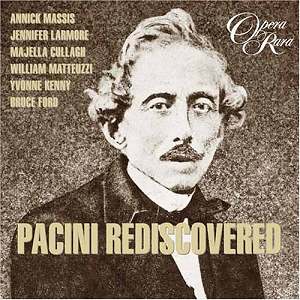
In the Opera Rara single disc titled
Pacini Rediscovered (Review)
there is a track of the terzetto, Che
fai fellon'... Ciel! d'una misera,
that Pacini added for the Milan revision.
In that performance Majella Cullagh
sings Cleofide with a dramatic conviction
that I do not find as convincing in
the American soprano Laura Claycomb’s
interpretation. Yes, her voice is appropriately
flexible and even, but she fails to
add enough colour and, allied to poor
diction, her overall characterisation
leaves me unmoved (CD 1 trs.3-8). Whilst
Bruce Ford has never been the most tonally
grateful and mellifluous of tenors,
I find his characterisation wholly convincing
in a generally pleasing account (CD
2 tr.2. and CD 3 trs.9-10) despite moments
of dry tone. Jennifer Larmore, as the
Indian king Poro, is not at her best,
lacking that creaminess of timbre that
has illuminated her bravura singing
in so many Opera Rara recordings, not
least the recital titled Bravura
Diva (Review).
I also compared her act one aria Se
possano tanto (CD 1 tr.14) with
her Tacete! Ohime, quei from
his 1823 Temistocle on the Pacini
Rediscovered disc and wondered where
that creamy colour had gone. Is her
voice rising towards the soprano I wonder?
Lower sonority and power is also lacking
in Dean Robinson’s voice as Timagene,
Alessandro’s confidante. In compensation,
Mark Wilde as Gandarre, General of Poro’s
army, sings strongly with clear lyric
tone and more than a touch of Italianate
squilla to go with his good expression.
The other main protagonist,
and in quite a big way, is the chorus.
Whilst Pacini’s music for the chorus
has no echoes of early Verdi, its regular
involvement as Indians or Greek warriors
or priests is important to the story.
There are no fewer than seven substantial
choral contributions including the introduction
immediately following a short sinfonia.
In this approach Pacini was perhaps
influenced by Rossini who used the procedure
to set the drama under way in La
donna del lago (CD
and DVD
review). Jeremy Commons is more flattering,
suggesting that the construction of
this chorus is such that it becomes
a choral overture (CD 1 tr.2). Again,
as Commons suggests, this may have been
Pacini seeking to impress the audience
with his grasp of harmony and counterpoint.
It certainly launches the work most
impressively. Unfortunately his creativity
hits the doldrums later on, when there
is a distinct and mundane rum-ti-tum
quality to the choral writing as in
the opening chorus of act three. Be
that as it may, the Geoffrey Mitchell
Choir, as so often on Opera Rara recordings,
give the choral contributions their
considerable all. However, like the
three main soloists they cannot disguise
Pacini’s flagging inspiration as the
opera progresses. I went back to an
extract on the Pacini Rediscovered
disc to see where the composer had
got to in 1829 in his Il contestabile
di Chester and compared it to Donizetti’s
evolution with his 1828 revision of
Emilia di Liverpool. The younger
man had, in my view, moved on considerably
by comparison with Pacini in terms of
musical and compositional maturity.
It is the difference between the good
and the great, a fact that Pacini was
himself to recognise when he withdrew
from composition for his period of self-analysis,
returning later to the fray with a significant
change of style.
Opera Rara have championed
Pacini with recordings of his Carlo
di Borgogna of 1835 (ORC 21) and
Maria, regina, d’Inghilterra
of 1843 (ORC 15) as well as other extracts
in recitals. In doing so they enable
opera enthusiasts to investigate, enjoy
and criticise Pacini and various otherwise
forgotten and neglected composers from
the primo ottocento - a period of plenty
and from which we know too few. Despite
my caveats, I welcome this opportunity
to hear Pacini’s music from Opera Rara,
supported by the Peter Moores Foundation.
The quality of the recording in dynamic,
balance and clarity is first rate in
either format on my reference system.
Robert J Farr
see also review

























 Alessandro – Bruce Ford (tenor); Poro, King
of part of India and in love with Cloefide
– Jennifer Larmore (mezzo); Cleofide, Queen
of another part of India – Laura Claycomb
(soprano); Timagene, Alessandro’s confidant
– Dean Robinson (bass); Gandarre, General
of Poro’s army – Mark Wilde (tenor)
Alessandro – Bruce Ford (tenor); Poro, King
of part of India and in love with Cloefide
– Jennifer Larmore (mezzo); Cleofide, Queen
of another part of India – Laura Claycomb
(soprano); Timagene, Alessandro’s confidant
– Dean Robinson (bass); Gandarre, General
of Poro’s army – Mark Wilde (tenor) 