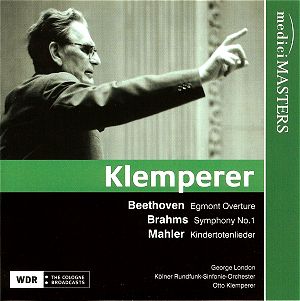
These live performances
were recorded in the studios of WDR, Cologne. It’s unclear if
an audience was present – I suspect not – but though audience
noise is absent the tension, and occasional roughness, associated
with live performance certainly is present. These all show Klemperer
in characteristically trenchant mood.
The opening to the
Beethoven overture sounds gaunt and implacable. One gets an
almost tangible sense of the Netherlands under the yoke of the
occupying Spaniards. When the main allegro arrives Klemperer
adopts a pace that is quite steady and the music makes its effect,
seemingly, through patience and perseverance. I have to say
I found it just a little unbending. The coda is fiercely energetic.
Excitement is conveyed but I missed the sense of release and
exultation that other conductors have conveyed. Still, in his
own way Klemperer conveys the drama of the piece as a whole.
The other two items
come from the same programme, given just a few months later
in the same year. In the Mahler the soloist is the great baritone,
George London. Personally I prefer a female voice in these songs
but a male voice is perfectly valid. London does them well,
though the intimacy of much of the music is a challenge for
a big voice such as his. The annotator, Michael Jameson, describes
the performance as “searching and grimly argued”. How much this
is due to London or to Klemperer I can’t speculate. The orchestra
is rather exposed in the stark accompaniment to the first song
and it takes a little while to settle but thereafter the accompaniment
is good.
London gives us
some finely controlled singing in the second song, ‘Nun seh
ich wohl, warum so dunkel Flammen.’ Indeed throughout the cycle
I was impressed with the way he fines down his voice so as not
to sound overbearing. He’s very emotional, perhaps a touch histrionic,
at the start of the fifth song, ‘In diesern Wetter’. However,
when the music quietens (around 3:02) and Mahler adopts a mood
of calm resignation London responds sensitively and deploys
an excellent legato. In summary, this may not be a first choice
performance – but it was never intended for posterity – yet
it has much to offer and I don’t know that either singer or
conductor recorded the work commercially, so this is a valuable
issue.
The main work is
Brahms’s First Symphony. To my ears Klemperer is pretty uncompromising
here. The very opening displays massive purpose and strength,
with pounding timpani providing a solid foundation. Klemperer
makes the music sound dark, even tragic. He leads a stirring,
steady account of the main allegro and his audible grunts
and groans add to the sense of stress. The performance exudes
integrity and while it may lack the warmth that other conductors
have brought to the work one can’t help but admire Klemperer’s
purposeful vision. He keeps the rhythms taut and his direction
is clear-eyed at all times. There’s little lingering over expressive
points and for myself I would have welcomed a few bits of rubato
to make the music sound more humane.
This directness
of approach carries over into the second movement. Frankly,
I didn’t warm to this view of the movement. I like more give
and a willingness to relax. There’s a total absence of geniality
and everything sounds just a bit pressed and even fierce at
times. This is Brahms shorn of any sentiment. Perhaps the 1950s
mono sound, which is perfectly acceptable but lacking the depth
and roundness of today’s recordings, adds to this impression.
In the concluding pages the solo horn and violin are satisfactory
but by no means as poetic as one has heard in many other readings
– or perhaps the players were not allowed to be poetic.
The third movement
sounds quite brisk but in fact when I checked against some other
recordings in my collection I found that Klemperer, who weighs
in at 4:31, is pretty much average here. I’d say the chosen
tempo is a notch higher than I’d expect for an allegretto
and in Klemperer’s hands the music doesn’t really sound
‘grazioso’. Indeed, this struck me as a pretty forthright account
of the movement, almost tending to brusqueness.
It’s in the finale
that Klemperer really comes into his own. He makes the introduction
brooding and intense. The horns are a touch fallible when their
Big Moment arrives and I find their tone at this point – though,
oddly, not elsewhere - a bit of an acquired taste; I wonder
if they were over-blowing? The great tune is sturdy and dependable
and Klemperer also keeps it moving forward purposefully, which
I like. The main allegro is fiery, propulsive and exciting.
All in all this is a dramatic and very exciting account of the
movement. The performance of the symphony as a whole won’t be
to everyone’s taste and I hope I’ve given a flavour of what
you can expect. It’s a valid, if rather severe view of the symphony.
As I’ve hinted,
the sound is somewhat lacking in front-to-back perspective.
It’s a rather typical studio sound, typical of the period, and
perfectly acceptable. Klemperer’s penchant for prominence for
the woodwind is also evident. The notes are serviceable but
no texts are provided.
John Quinn

























 George London
(baritone) **
George London
(baritone) **