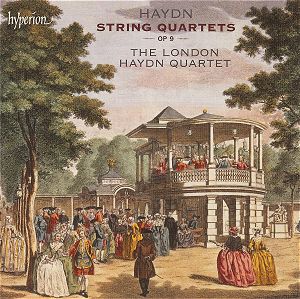
There
are still many books in circulation that describe Haydn as “the
father of the symphony”. Nowadays it is apparent that what with
the Mannheim school headed by Johann
Stamitz and composers like Richter and Wagenseil who all precede
Haydn, that the claim for Haydn does not stack up. However if
we describe him as ‘Father of the string quartet’ we are not
so far off the mark.
Other
composers had written the occasional quartet but the combination
does not seem to have attracted the attention of many. What
it was that sparked Haydn to write his first group one can’t
say except that he obviously found it a pleasing and worthwhile
form and Prince Esterhazy joined in. In addition he had, for
a while, an excellent first violin: one Luigi Tommasini (1741-1808)
who, after 1802, took over from Haydn as director of Chamber
Music.
These
Op. 9 Quartets mark the true beginning of Haydn’s long ‘quartet’
journey but they had been preceded by some interesting examples
of the genre in Opp. 1 and 2 and these have of course been recorded.
Let’s
take the Opp. 1 and 2 quartets. As Haydn worked the form he
began with the idea of the divertimento that is five movements
with two minuets framing a middle Adagio or Lento. The outer
movements are fast but are also the shortest ones. For example
Op. 1 no. 5 has an opening movement a third the length of the
slow third movement. The 1st Violin is predominant
with a considerably lesser role for the others, a situation
only found in Op. 9 with the first movement of number 3. These
early works probably date from c.1757-62.
One
can almost say that these quartets mark Haydn’s ‘coming of age’
because by the time we reach Op. 9 the formal emphasis is totally
different. There are now the usual four movements as we have
come to expect, with the first one by far the longest. Op. 9
no. 2 has an opening movement which is almost half the length
of the entire work. This first movement is in what we now call
Sonata-form or as Haydn would have called it, ‘First movement
form’, with two subjects, a development and a recapitulation.
There are repeat marks just before the development so that the
exposition is heard twice. Then there are further repeat marks
meaning that the development and recap are also heard twice.
This is how the movements are played here, but it’s not quite
as simple as that. It depends whether the performers or indeed
you the listener hear a sonata-form structure as either ternary
(ABA)
or Binary (AB) form. If both repeats are meticulously observed
then you hear sonata-form as a sort of advancement of binary
form. If the repeats are not observed then the three sections
- exposition, development and recap - are clearly heard in succession
so then it is an advancement of ternary form and the movement
length is consequently shorter. The first movement then may
become of equal length with at least two of the other movements
or just a little longer. What really isn’t acceptable in this
scenario is the observing of the first repeat and not the second.
With
these performances you get all of the repeats. If you do not
want that then you should look elsewhere possibly at the Naxos recordings on modern instruments with the Kodaly
Quartet. The London Haydn Quartet plays on original instruments.
Normally I love the sound of such instruments but here I find
the sound rather strained and febrile. No amount of turning
down the treble has really helped. One does get used to it after
a while but some friends who like Haydn told me that they felt
the vibrato-less sound of the players to be “lacking in warmth
and rather shrill”.
In
Op. 9 Haydn places the minuet second. He continued to do this
right up to Op. 74 composed in the early 1790s. At that point
he finally copied the order of his symphonies which had had
the Minuet coming third since as early as the 5th
Symphony. The effect is that the listener is really ready for
the slow movement as he/she was in the earlier Opp. 1 and 2
divertimento-inspired pieces. All of the Op. 9 slow movements
are lyrical and memorable. My favourite is from No. 2; the booklet
writer seems to prefer that from No. 3. The minuets are all
quite different; some as in No. 3 are rather influenced by gypsy
or peasant music with drone-like accompaniments and dancing
fiddlers.
The
4th Quartet, which is probably the most performed,
‘turns on the dark side’ as Michael Tippett might have said.
After three light works we turn to the minor and to the serious.
Richard Wigmore in his notes reckons that this quartet was the
first to be composed, although he fails to say why. My gut reaction
for what it’s worth, is that it seems to be a more mature and
concentrated piece especially the first movement. It speaks
as the product of a very experienced composer. Even the minuet
is intense and one is reminded of the influence of C.P.E. Bach
(born 1714) and his concept of ‘empfindsamer Stil’ or ‘heightened
sensibility’ which we also find in the later Haydn symphonies
like Nos. 44 and 45 which date from the early 1770s.
The
5th Quartet in B flat is, despite the key, a thoughtful
but lighter work which opens with a Theme and Variations and
a delightful melody rather inelegantly captured by Catherine
Manson I feel. The final A major quartet also has the feeling
of a mature and important statement but neither work is portentous
or stirring, like the extraordinary D minor. The slow movement
of No. 5 is the longest of the set and is magically captured
by these performers.
The
Quartets are presented not in numerical order, as already said
number 4, which comes first, may have been written first. We
are told, in a brief ‘Note from the performers about the editions’,
that the sequence has been presented in the printed order of
a 1790 edition and in Haydn’s Entwurf-Katalog’. I don’t know
about you but I would not listen to six or even three Haydn
quartets consecutively and naturally have heard them in numerical
order as and when I wanted.
As
you can possibly tell, I have slightly mixed feelings about this
disc but I will certainly play it again as the music is of such
value and enchantment. I might however search out another version
one day.
Gary
Higginson