‘The
Chopin of the Creoles’ was his soubriquet, at least among his
friends in New Orleans. S. Frederick Starr, leading authority
on Louis Moreau Gottschalk, also dubs him ‘the Crescent City’s
Schubert’, due to his double capacity of writing superbly well
for both the piano and the human voice. Whichever predecessor
one chooses – he actually studied with Chopin – the comparison
could be brought a step further in that he never reached similar
heights as a composer for orchestra. There are a handful of
Schubert symphonies that are among the most played in the whole
symphonic repertoire, but not until the great C major symphony
did he produce a really great orchestral work. This is a strictly
personal point of view, I love the ‘Unfinished’ and the fifth
and the C minor and … - so don’t start writing complaints to
our Bulletin Board.
Returning
to Gottschalk I have been fond of his piano music ever since
I stumbled over an LP with Leonard Pennario ages ago in a record
sale. Fresh, rhythmic and melodically appealing I felt that
here was someone who pointed forward two or three generations.
Ernesto Lecuona, to pick another composer I like, owes a lot
to Gottschalk. Later I bought a double CD with Eugene List,
which included a couple of orchestral pieces, the Tarantelle
and A Night in the Tropics. I found the latter attractive:
the first movement growing from a mysterious nightly atmosphere
to a climax of colours and then back to the gossamer light nocturnal
mood. The second movement’s samba rhythms are stirring. The
Tarantelle I have always found rather monotonous. There
is no real development, just a long ostinato.
On
the present disc Gottschalk’s manuscripts have been painstakingly
reconstructed by Richard Rosenberg. The liner notes by Mr Starr
as well as Rosenberg’s own commentaries to the individual pieces
make for fascinating reading and I do admire the devotion and
the stamina to carry through such work.
About
the compositions I am less convinced. Gottschalk might have
become a great composer, had he only been able to settle down
and work under orderly conditions. However, his life was spent
in hectically travelling and giving concerts. It is a marvel
that he found the time to write music down at all. It may be
that his life style is also mirrored in his music. It is hectic,
pompous, not to say bombastic and there is that repetitiveness
that begins to jar after a while. Was Gottschalk an early minimalist?
Of
the music here, besides the two works I have already mentioned,
the Symphony No. 2 is among the best with a majestic
second half of the second movement – but maybe it’s really too
much of a good thing.
He
wrote several operas but they seem to have been lost, apart
from Escenas Campestres Cubanas, which consists of four
numbers, of which the opening dance is repeated at the end.
In between there is a fairly long scene for three soloists –
again with that minimalist repetition. The soloists are good
and the soprano needs the range and virtuoso of a Queen of the
Night. She also has a short, catchy aria all by herself, where
she displays some edginess. The texts are printed in the booklet
as well as English translations.
The
Variations de concert sandwiches pompous orchestra and
virtuoso piano, but there is a lyric-romantic section in the
middle of the piece, which redeems some of the emptiness.
Ave
Maria, arranged for voice and orchestra by Richard Rosenberg,
is a beautiful song that I wish other singers would add to their
repertoire. It is sung here with disarming simplicity and a
vibrato-less tone that made me wonder if it was a boy treble.
But the singer is Melissa Berrick, an artist at home in baroque
as well as contemporary music.
La
Casa del Joven Enrique (Young Henry’s Hunt)
is based on Méhul’s overture. It was recast from an older composition
for a ‘monster concert’ in Havana. It was never completed and
never performed – due to the abnormal forces required, no doubt:
Gottschalk wanted forty pianists plus a gigantic orchestra.
In practice though there are only five separate piano parts.
When it was first performed – the manuscript was not found until
2003 – the orchestra numbered ‘only’ 112 players – as on this
recording which was made just days later. The hunt of the title
is clearly depicted and there are repeated brass signals, lending
a martial atmosphere to the piece.
My
reception of the disc may seem lukewarm, but I and hopefully
the rest of the musical world have reasons to be immensely grateful
to Richard Rosenberg and his enthusiastic musicians for bringing
into the sunshine something as close as possible to what Gottschalk
had in mind when he wrote the music.
Göran
Forsling
see
also Review
by Dan Morgan
























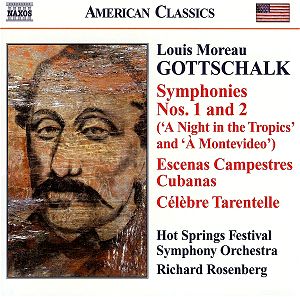

 Michael Gurt
(piano) (2, 4), Melissa Barrick (soprano) (5), Anna Noggle (soprano),
Darryl Taylor (tenor), Richard Ziebarth (bass-baritone) (3), John
Contiguglia, Richard Contiguglia, Angela Draghicescu, Chin-Ming Lin,
Joshua pepper (piano) (6); Hot Spring Festival Symphony Orchestra/Richard
Rosenberg
Michael Gurt
(piano) (2, 4), Melissa Barrick (soprano) (5), Anna Noggle (soprano),
Darryl Taylor (tenor), Richard Ziebarth (bass-baritone) (3), John
Contiguglia, Richard Contiguglia, Angela Draghicescu, Chin-Ming Lin,
Joshua pepper (piano) (6); Hot Spring Festival Symphony Orchestra/Richard
Rosenberg