If the name Fitzenhagen
is familiar to you then it’s almost
certainly in connection with his editing
of Tchaikovsky’s Rococo Variations.
He was born in Seesen in 1848 and studied
with Grützmacher, one of the leading
players of the time. By his early twenties
he was in high demand – Liszt wanted
him as solo cellist in Weimer and Nikolai
Rubinstein offered him the Cello Professorship
at the Moscow Conservatory. He chose
Moscow. And here he remained, one of
the most influential figures in Russian
string teaching and playing until his
early death in 1890.
But he also earned
a measure of success as a composer.
He had four cello concertos to his name
as well as the expected morceaux and
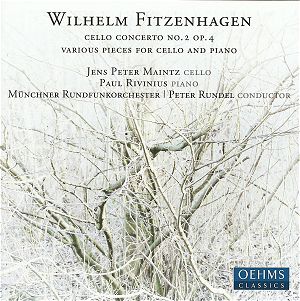
smaller genre pieces. Oehms has combined
these twin facets of his compositional
life in the shape of the Second Concerto
and a selection of smaller pieces for
cello and piano. None is dated in the
notes.
The overriding influence
on the Concerto is Schumann. In fact
it’s strongly modelled on Schumann’s
own concerto for the instrument even
to the extent of being through-composed.
It’s rather more showy however as one
would perhaps expect of an executant-composer
and more overtly virtuosic and less
introspective. The first movement cadenza
sounds especially tricky – doubtless
Fitzenhagen owed his command to the
intense demands made by Grützmacher,
notoriously scrupulous when it came
to the acquisition of technique - but
in the second movement he relaxes nicely.
There are, it’s true, elements of salon
style here – the supportive harp tissue
is rather too domestic for so ostensibly
extrovert a work for instance. And the
orchestration is sometimes a little
too sketchy. Still, the finale is enjoyable,
sprightly, sports another tricky cadenza
and ends well. The work is as complete
an example as I know of Schumann’s pervasive
influence on another composer.
The smaller pieces
are splendidly written for the instrument,
which surely won’t come as a surprise.
The Elegie is a warm and effusive opus
in the style of Tchaikovsky. The Capriccio’s
more propulsive and finger-busting tendencies
are relieved by a lyric "B"
section – and it also opens like a snippet
of The Barber of Seville. The very Slavic
Gavotte takes the player up very high
and tests his bowing arm into the bargain
to a considerable degree. Fitzenhagen
must have had excellent intonation.
The Impromptu cleaves more to the Schumann-Mendelssohn
axis and there are two versions of Ave
Maria – one with piano and the other
harmonium. The former, predictably,
is warm whilst the latter is slightly
pious. There is also an extensive Dämonenfantasie,
after motifs from the Anton Rubinstein’s
opera Dämon. The piano part
is demanding and sometimes portentous,
the cello writing lyric and equally
tough. The piece itself is a kind of
dual tribute to Rubinstein and Tchaikovsky
– and it includes a variation theme
based on the Rocco Variations.
Performances are generous
and attractive; Jens Peter Maintz is
a fine player and an imaginative one
as well. The booklet notes have some
excellently reproduced period photographs
of the heavily bearded Fitzenhagen and
the disc is a worthy and worthwhile
salute to his memory.
Jonathan Woolf
























 Jens Peter Maintz (cello)