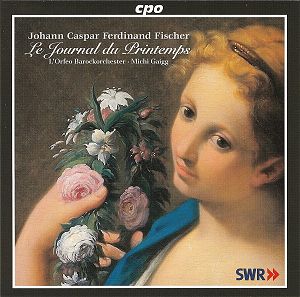
German
music in the late 17th and early 18th century was dominated
by the Italian and the French styles. Most composers aimed at
a blend of the two, producing what was called the 'mixed taste',
usually under the common French term 'goût réuni'. Some German
composers were so strongly attracted to the French style that
they aimed at copying it in their own works. They were called
'Lullists', after Jean-Baptiste Lully, the Italian-born composer
who dominated music in France in the second half of the 17th
century. Some of them even went to Paris to study with Lully,
like Johann Sigismund Kusser (1660-1727), who published six
suites in French style in 1682. Another composer who had been
in Paris was Georg Bleyer (1647-after 1694). It is probably
through him that Fischer became acquainted with the French style
as Bleyer was a member of the court chapel in Schlackenwerth
(Ostrov) in Bohemia, where Fischer, born in Schönfeld (Krásno),
spent his youth.
Fischer
worked the largest part of his long life in the service of elector
Ludwig Wilhelm of Baden in Rastatt. He was appointed 'Kapellmeister'
somewhere between 1791 and 1793. He composed instrumental pieces,
sacred music and works for keyboard. His first printed music
was a collection of eight suites for orchestra, published under
the title 'Le Journal du Printemps' in Augsburg in 1695. These
are written in purely French style, but there is no proof Fischer
had ever been in Paris. It is interesting, though, that - apart
from Cavalli's opera 'Serse' - these suites are the only music
by a non-French composer represented in the 'Collection Philidor',
a collection of scores which were popular at the French court
and regularly performed there. This suggests that either Fischer
had been in Paris after all or that there was some kind of contact
between the composer and the French court. It is also an indication
that Fischer's music was indeed considered 'French'. Although
many suites 'in French style' were composed in Germany in the
decades around 1700, most of them wouldn't be recognized as
French by a French audience. Fischer's suites were an exception.
All
suites begin with an overture, which is followed by a series
of dances. Most suites also contain a passacaille or chaconne,
ground-basses which French composers frequently included in
their works. Pieces which often appeared in the French 'tragédie-lyrique'
are also represented, like an 'Entrée' (Suites 4 and 8), a 'plainte'
(Suite 2), a 'marche' (Suite 1) or an 'air' for a group of characters
(here the 'Air des Combattans' in Suite 1). The scoring in five
parts reflects the French taste too: the orchestra is divided
in 'dessus', 'haute-contre', 'taille', 'quinte' and 'basse'.
As these suites were published in Augsburg, Fischer had to adapt
his works in some respect to the possibilities of most German
court orchestras. For instance, the 'haute-contre' part is higher
than in Lully's music, which makes it possible for them to be
played by a violin rather than a viola. The performance on this
disc also reflects German habits in that the pitch is a=415'
rather than the lower French pitch (a=392'). As was common in
France, oboes are playing colla parte with the strings.
Occasionally two recorders are used, and in Suites 1 and 8 two
trumpets are added which also play colla parte - something
never practised in France. In this recording two 'basses de
violon' are included in the bass section. These were the common
string basses in French orchestras, but I wonder how many court
orchestras in Germany would have had access to such instruments.
Fischer's
collection of suites is quite often referred to in books and
programme notes, but not very often played or recorded. To my
knowledge this is the first next-to-complete recording of these
suites; Suite No. 5 had to be left out because of a lack of
space on the disc. And fortunately they get the best possible
performances. L'Orfeo Barockorchester is a very fine ensemble,
which - as the list of recordings in the booklet shows - has
a preference for neglected repertoire. But even if there was
competition in this music they need not fear, as they give a
splendid account of Fischer's suites. The playing is vivid and
colourful, powerful when needed (for instance in Suite 1) and
introverted and tender when required (Suite 2: plainte; Suite
6: sarabande). In some movements percussion is added, which
strengthens their rhythmic pulse, and which is fully in line
with the performance practice in Paris in Lully's time.
I
have greatly enjoyed this recording, both because of the quality
of the music and the level of performance. I hope it will be possible
to record the remaining suite at some time. I recommend this disc
which shows the influence of the French style outside France in
a most impressive way.
Johan van Veen