Editorial Board
MusicWeb International
Founding Editor Rob Barnett Editor in Chief
John Quinn Contributing Editor Ralph Moore Webmaster
David Barker Postmaster
Jonathan Woolf MusicWeb Founder Len Mullenger
Janos
FUSZ (Johann Evangelist FUSS) (1777–1819)
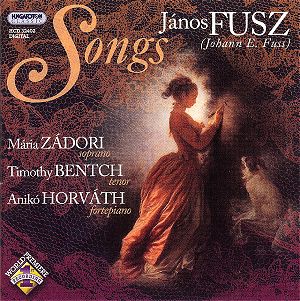
Sechs Neue Lieder Op. 6 No. 1, 3, 5 & 6 (1808) [9.42] Der Weg von Freundschaft bis zur Liebe, Op. 24 [5.04] Gesänge, Op. 16 No. 1, 3, 4 & 5 [14.31] Der Traum, Op. 21 (1815) [2.21] Gesänge, Op. 22 No. 1, 3 & 5 (1815) [9.05] Gesänge, Op. 23 No. 1, 2, 4 & 5) [13.10] Elysuim, Op. 29 [7.49] Beruhigung, Op. 31 (1817) [6.40] An Emilie, Op. 32 (1817) [4.13] Das Lied der kleinen Anna (1812) [2.27] Maria Zadori
(soprano)
Timothy Bentch (tenor)
Aniko Horvath (fortepiano)
rec. Hungaroton Studios, 4-10 October 2005 HUNGAROTON
HCD32404 [75.48]
Composer
Janos Fusz’s main claim to fame seems to be that he came to
Beethoven’s notice, albeit in unfavourable circumstances. Czech
composer Vaclav Jan Tomasek’s diary records that Beethoven made
some disparaging remarks about Fusz. At the time, Beethoven
had been hoping to bring to fruition his scheme for his opera ‘Romulus
and Remus’ but this was frustrated by the fact that Fusz had
already written an opera on the subject. Needless to say, Beethoven
saw to it that Fusz’s opera was never performed in Vienna.
Fusz
was very much a minor master, one of many on the Hungarian musical
scene. He was born in Hungary to ethnic German parents and started
his musical career in the employment of the music-loving Vegh
family. He went on to hold the post of opera conductor in Pozsony
(now Bratislava). In 1804 he went to study with Albrechtsburger
in Vienna. Albrechtsburger was one of the most famous composition
teachers of the time and he regarded Fusz as one of his favourite
pupils. His most productive period as a composer was his time
in Vienna from 1809 to 1814 when he published songs, piano pieces,
chamber music and several works for the stage.
Only
one fragment of Fusz’s Romulus and Remus survives and
this, a canonic trio, seems to have been inspired by the canon
in the finale of Act 2 of Cosi van tutte; we thus have
good grounds for presuming that Fusz knew Mozart’s operas. It
is the spirit of Mozart that hovers over the songs on this new
disc. Fusz’s published works were possibly known to Schubert,
but Fusz never really reaches the complexity of Schubert.
Fusz’s
first published set of songs, Sechs neue Lieder (Op. 6) breaks
no new ground. Each song remains charmingly in the simple strophic
form, though the piano part is not insignificant and adds musical
interest. Fusz continues in this vein in his Opp. 16 and 23
songs. Though he alters the musical form by writing “varied
strophic” songs, the subject matter remains firmly in the realms
of the familiar. The last song of the Op. 16 set Bitte beim
Abschied uses the form of an opera scena, with a recitative
and a da capo aria, albeit with relatively straightforward piano
accompaniment. Both Beruhigung, Op. 31 and An Emilie,
Op. 32, which date from his last years, return to this form,
using almost the same devices as the earlier song.
In Der
Traum, Op. 21 and Das Madchen am Bach, Op. 22 Fusz
tries other means to create a more complex, through-composed
form. Both extend and stretch the strophic form to its limits
with significant modulations and key structures. In Die
Ercheinung, Op. 23 the vocal line is substantially strophic
but the piano part is through-composed and boldly illustrative.
After
1813 the composer was ill and so his songs often deal with death
and mortality in their subject matter. Some of these, such as Elysium,
Op. 29 are his most significant despite the fact that he forgoes
first rate poetry for that by lesser masters.
On
this disc, the selection of songs is shared between Maria Zadori
and Timothy Bentch. Zadori was familiar to me mainly through
her recordings of Handel and other early music. Her voice has
the focus and brilliance of her early pieces and is by no means
a Romantic instrument. Instead she gives us clear, beautifully
shaped accounts of the songs where every word and phrase tells.
Timothy Bentch has an attractive lyric voice. His rather more
Romantic instrument contrasts nicely with Zadori’s and he certainly
holds his own. Bentch sings all of the Op. 23 songs on the disc
and Zadori the Op. 22 ones. The remainder are split between
them, giving each a balanced mixture of both the early strophic
songs and the later more sophisticated ones.
The
singers are well supported by Aniko Horvath on a modern copy
of Anton Walter’s Viennese Fortepiano. I did wonder whether
the recording engineers had rather too favoured the voices in
the balance but this is not a grave fault.
All
the songs are sung in German and given that Fusz’s origins were
German I presume that this was his native language. The booklet
provides all of the song texts in German, Hungarian and English
along with an informative essay.
Fusz’s
songs are by no means masterpieces but the least of them is
charming and the best are fascinating in their attempts to extend
the form, within the composer’s limits. In these fine performances
they give us a glimpse into the world of the Kleinmeister at
the time of Beethoven and Schubert.
Robert
Hugill
Please support our advertisers below by clicking on the logos for further information.

























 Maria Zadori
(soprano)
Maria Zadori
(soprano)