This CD is something
of a trap for the unwary, for those (like me) who put the disc
on without reading the liner-notes properly. The first track
consists of the first movement of Schumann’s Sechs Lieder,
Op. 33 for four-part male-voice chorus. At the end of the movement,
Schumann’s final phrase repeats accompanied by a rasp of percussion.
This continues and develops until we are in an entirely new
world.
At this point your
reviewer returned to the liner-notes and read them properly.
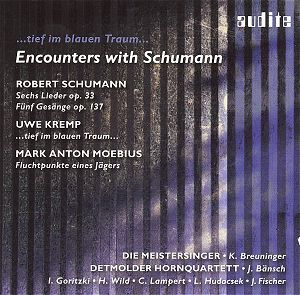
The disc by Die Meistersinger and Detmolder Hornquartett consists
of Schumann’s Sechs Lieder, Op. 33 and his Fünf Gesänge,
Op. 137 for four-part male-voice chorus and four horns. In addition
they perform Uwe Kremp’s ‘…tief im blauen Traum…’ four-part
male voice chorus and two percussionists and Mark Anton Moebius’s
Fluchtpunkte eines Jägers for four-part male-voice chorus,
baritone solo, cor anglais and horn. The point to understand
from the notes is that the movements of the Uwe Kremp piece
are interleaved with the Op. 33 lieder, so that the effect I
perceived at the end of the 1st Schumann movement
was deliberate. Similarly Moebius’s piece is interleaved with
the movements of Schumann’s Op. 137.
Die Meistersinger
is a male voice choir which has its origins in the Gächinger
Kantorei. The ensemble was founded in 1998 and has been conducted
by Klaus Breuninger ever since then. They have made a number
of discs but this fascinating one seems to be their way of trying
to re-vitalise the tradition of the male-voice chorus.
Schumann’s works
in this genre date from 1840 and seem to have been written for
the Leipzig Men’s Choir Association for whom Mendelssohn’s Op.
50 Lieder were written. We know that in 1836 Schumann, Mendelssohn
and friends tried out Mendelssohn’s four-part male voice choir
pieces - presumably singing one to a part - and Schumann’s letters
suggest that this might be the case also for his own pieces.
This would make sense as we know that Mendelssohn tried out
some of Schumann’s solo songs before their publication.
The resulting pieces
have a robust charm and their particular genre has an atmosphere
redolent of the men’s associations, glee clubs and the like.
I know that Schumann’s pieces are far more sophisticated than
glees, but the very particular sound of the male voice chorus
does give rise to these thoughts.
It is thus understandable
that the performers should seek to vary the diet by interspersing
Schumann’s Six Lieder with Uwe Kremp’s Intermezzi.
Kremp studied composition in Karlsruhe with Mathis Spahlinger
and Wolfgang Rihm. Kremp’s Intermezzi use fragments of
Schumann’s texts, usually taken from the previous verse, to
create a dream like extension of the Schumann pieces. Gradually,
as the Intermezzi proceed, Kremp dismantles the linguistic
elements so that by the end the choir are just singing sounds,
not sense. Into this mix, Kremp adds two percussionists “to
create an additional resonance space for the noise-like aspects
of the consonants in language”.
The results are
fascinating and make for an interesting mix; we end up listening
to the Schumann pieces with new ears. I am not entirely sure
that the experiment works completely, but it is certainly worth
making and very much worth listening to.
Schumann’s Op.137
songs for male-voice choir and French Horns are directly related
to the Forest Scenes Op.82. The texts come from Heinrich
Laube’s Hunting Breviary and the pieces inhabit that
Romantic huntsman’s world which was tapped into by Weber and
others. Mark Anton Moebius’s Fluchtpunkte eines Jägers (Vanishing
Points of a Hunter), uses a combination of voices, horn and
cor anglais to link the Schumann items.
Moebius uses a text
taken from Rilke’s Eight Duino Elegy to create a series
of pieces which meditate on the confrontation between man and
animal, his intention being to illuminate the moment when the
hunter looks the animal in the eye and recognises himself in
it. Like the Kremp/Schumann combination, this is a potent mix
which allows us to view and hear the Schumman pieces differently.
The solo part requires the singer to mix both baritone and counter-tenor
registers, something Hubert Wild does brilliantly.
Not everyone will
like this experiment. Kremp and Moebius’s pieces can be difficult
but are quite approachable, but their alternation with Schumann’s
music will not be to all tastes. Personally I found it intriguing
and fascinating, but would sometimes be tempted to re-programme
my CD player so that I could get the Schumann pieces on their
own.
Die Meistersinger
under their conductor Klaus Beuninger are excellent, managing
to perform both the Schumann and the contemporary piece as if
they had been performing them all their lives. There was so
sense of disjunction between the performances of the Schumann
and the modern works, which is quite an achievement.
This is a fascinating
disc and if you are open to experiment then you are sure to
find much here, especially with such confident performances.
Robert Hugill

























 Hubert Wild
(baritone/counter-tenor) (1)
Hubert Wild
(baritone/counter-tenor) (1)