Editorial Board
MusicWeb International
Founding Editor Rob Barnett Editor in Chief
John Quinn Contributing Editor Ralph Moore Webmaster
David Barker Postmaster
Jonathan Woolf MusicWeb Founder Len Mullenger
Edward ELGAR (1857-1934)
Symphony No. 1 in A flat major op. 55 (transc. for solo piano by Sigfrid
Karg-Elert (1908)) (I Andante Nobilmente e semplice [21.16];
II Allegro Molto [8.23]; III Adagio [11.57]; IV Lento, Allegro [13.21])
[55:47] Alan BUSH (1900-1995)
Piano Sonata in B minor op. 2 (premiere recording) (1921) [11:47] Mark Bebbington
(piano)
rec. 21-22 August 2006, Symphony Hall, Birmingham. DDD
Recorded with financial assistance from the Alan Bush Trust SOMM SOMMCD069 [66:47]
I am not sure how, or to what purpose, we are offered this Elgar
disc. It can be a collectors’ item, a virtuosic demonstration or
an academic exercise. One thing is certain, this difficult transcription
by Karg-Elert scarcely suits the purpose for which it was intended:
that is to provide access to music that could normally only
be heard very seldom. Alternatively - and here each listener
will have his or her own views – it could well be listened to
merely for the music’s sake.
Although the soloist Mark Bebbington makes an excellent case for any
or all of these purposes the transcription fulfils most nearly,
with the notes and analysis, an academic exercise which the
average listener may find hard to follow.
The opening passage, that “great and glorious tune”, is shorn of its
dark majesty in the shadowy voice of the keyboard. This is especially
the case when one recalls Basil Maine’s evocative description
of that ‘nobile e semplice’ as “quietly and gravely sung by
that most serene choir of voices, woodwind and violas”.
The task of reproducing on the keyboard the very personal subtleties
of Elgar’s orchestral voice is a formidable one. Bars 37 and
39 in the first movement are a case in point. Fig 18 also emerges
rather like a barrel-organ. Yet I fancy Lady Elgar might yet
hear at fig 66 2nd movement ‘the sound of rushes
by the river’. The overall architecture of the Symphony – remarkable
for its time – is held together well by this bold young pianist.
It is after all a glorious piece of music!
It is tempting to wonder just what the result might have been had
Karg-Elert chosen to transcribe the work for organ where resonance
and depth of tone might have been preferable to the comparatively
limited resources of loud (fff) and soft (ppp) available to
the pianist. Bebbington however argues Karg-Elert’s case with
carefully chosen illustrations and it is worth following the
argument. The purely technical musical argument may be of less
interest to the average listener. Nevertheless the complexities
of ‘transcription’ are worth penetrating and far preferable
to the appalling trend today of ‘easy’ simplified ‘arrangements’ which
cater for the uncritical.
This is a curious coupling. The nobilmente Elgar and the Marxist
Bush. Neither is quite as it seems however for in these pairings
Elgar seems the more revolutionary against the conservative
Bush sonata. The Sonata is an early work - op. 2, written at
the age of 21. A recording for comparison with his A flat major
Sonata of 1971 would yield much. Yet why he decided to wthdraw
it from publication is a mystery. It was in fact printed but
unissued and apparently the publishers have no archive score.
This makes this recording doubly welcome. The Sonata impressed
Frederick Corder, who pronounced it a worthy successor to the
youthful Benjamin Dale sonata! It shows several influences – all
of which you would expect from a 21 year old at the Royal Academy – though
Bush later repudiated the influence of Wagner, which is certainly
there in the rhapsodic middle pages!
The other main influence
is that of John Ireland, although Bush did not come to study
with Ireland until 1922. He voiced a rather simplistic view
of the form (piano sonata) while at college: “I chose a Sonata … it
suggests a composition of some magnitude” (‘The British Piano
Sonata’, Lisa Hardy, Boydell Press, 2001, p.178). But there
is nothing grandiose about this very attractive work. It is
in one movement, opening Allegro deciso with a brusque
and challenging Schumannesque figure. Its progress is punctuated
by breathless hesitations of the rhythm leading, via an attractive
little cadential passage, to a lyrical, equally hesitant chorale-like
six bars. This is developed in Ireland-style 6ths until, after
recapitulation, comes the heart of the work. Andante Tranquillo,
a falling figure - rather reminiscent of the Bruch Violin Concerto
- leads into the final pages. There few, I think, could dispute
the influence of the rhapsodic strains of Wagner - a ‘love poem’ despite
the somewhat bombastic final cadence!
























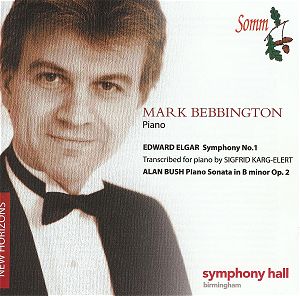

 Mark Bebbington
(piano)
Mark Bebbington
(piano)