Editorial Board
MusicWeb International
Founding Editor Rob Barnett Editor in Chief
John Quinn Contributing Editor Ralph Moore Webmaster
David Barker Postmaster
Jonathan Woolf MusicWeb Founder Len Mullenger
Arnold
BAX (1883–1953)
String Quartet No.1 in G [23:12] Edward ELGAR (1857-1934)
String Quartet in E minor, op.83 [26:12] Pavão Quartet
(Kerenza Peacock (violin); Jenny Sacha (violin); Natalia Grimes
(viola); Bryony James (cello))
rec. St Mary’s Church, Hanwell, June 2007 DISCRETE RECORDINGS
DISC0701 [49:24]
What a sensible coupling this is! Both written in 1918, by
future Masters of the King’s Musick, the younger man’s work dedicated
to the older. And how well they sit together, Bax’s work full
of youthful spirits, Elgar’s autumnal peace. I use the word ‘peace’ in
light of Elgar’s response to the war.
In 1901 the Bax family went to Malvern on holiday and it was there
that the two composers met. Bax had a friend, George Adler who
lived nearby and knew Elgar. It was he who suggested that they
pay the older man a visit. They walked to Birchwood to find
that Elgar was out but were invited to wait in the garden where
they were met by Mrs Elgar (as she then was). “Almost at once
she began to speak enthusiastically and a little extravagantly
about her wonderful husband and his work. ‘Oh, here he is!’ cried
Mrs Elgar, and I rose and turned with suddenly thudding heart
to be introduced to the great man … He was not a big man, but
such was the dominance of his personality that I always had
the impression that he was twice as large as life … He was still
sore over the Gerontius fiasco at Birmingham in the previous
autumn, and enlarged interestingly upon the subject ... ‘Critics’ snapped
the composer with ferocity. ‘My dear boy, what do critics know
about anything?’ Knocking out his pipe, he suggested that we
might like to have a glance at a huge kite that he had recently
constructed … On being told that I intended to devote myself
to composition Elgar made no comment beyond a grimly muttered ‘God
help him!’” (Arnold Bax: Farewell My Youth (Longmans,
Green and Co, 1943)).
Bax dedicated his Quartet to Elgar in remembrance of the 1901
visit, describing it as “an unforgettable day” and making mention
of “all the pleasure your music has given me.” Elgar responded
positively, saying that he “liked the look of it.”
I’ve often wondered why Bax dedicated this work to Elgar, except as
a sop, because the music has nothing whatsoever to do with Malvern,
but is filled with Bax’s beloved Ireland; the slow movement
is surely a lament for the dead of the 1916 rising and the finale
is an unashamed reel. It’s a superb work and it comes as no
surprise to discover that it was recorded twice, during the
composer’s lifetime, on 78s (Marie Wilson Quartet (National
Gramophone Society NGS 153/155) and the Griller Quartet (Decca
K1009/12)) and between its publication, in 1923, and World War
2 it was one of the most frequently played British quartets.
Elgar’s three late chamber compositions – the Violin Sonata, op.92,
the Piano Quintet, op.84 and this String Quartet, op.83 – and
the Cello Concerto, op.85, are filled with nostalgia. The war
had changed Elgar’s perception of people and the world in general.
He’d also had a tonsillectomy – his doctor suspecting Menière’s
Disease (now accepted to be an incorrect diagnosis). Recuperation
took time, and Alice’s health began to fail, starting simply
with colds but getting worse until her death in 1920. Taking
a cottage at Brinkwells in Sussex, away from the hurly-burly
of wartime life in London, Elgar revelled in carpentry and living
the life of a man of the land, which, despite what he said and
did, he wasn’t; certainly not in the way he would have liked.
He was a composer and the urge to write music slowly returned
to him. I have the feeling that these final four major works
are, in some ways, connected. Three of them are in E minor -
the Quintet is in A minor. There is a restrained quality
to all the music. Even when he seems to be in high spirits there’s
a sadness behind the jollity - the opposite of the clown who
wants to play Lear, perhaps. There’s also a hesitancy, a new
maturity, based on what I believe to be Elgar’s perception of
himself as a failure. This was brought about through self doubt
and a failure to understand that in reality he was a man fully
in command of his abilities but one who was always at the whim
of his own feelings.
This all reminds me of the famous story told of the clown Grimaldi,
which was later also told of Grock, about the man who goes to
his doctor as he is overwhelmed by a sadness and believes that
he will never recover from this malady. The doctor tells the
man that he should do something to make him happy, such as go
to see Grimaldi/Grock as that would certainly cheer him up,
whereupon the man sorrowfully tells the doctor, “But I am Grimaldi/Grock!”
Elgar was truly a man tormented by his lot and these minor key works
are imbued with these feelings. The Quartet is hesitant in its
starting; the music slips, almost imperceptibly, into our consciousness.
There are no grand gestures here, just the steady, and inevitable,
working out of musical ideas. Indeed, this is one of the most
classical of all Elgar’s opening movements, understated and
wistful. The slow movement is a simple and songlike affair,
described by Alice as “captured sunlight”. Some time later when
listening to a recording of the work, Troyte Griffith said to
Elgar “Surely that is as fine as a movement by Beethoven”, to
which the composer replied, “Yes it is, and there is something
in it that has never been done before.” Troyte asked what this
was and Elgar, always one to hide his genius under a bushel,
replied, “Nothing you would understand, merely an arrangement
of notes.” (Jerrold Northrop Moore, Edward Elgar - A Creative
Life (Oxford University Press, 1984)). How easily he could
write off his subtle and complicated way of composition. The
music, and fair copy, of this slow movement was completed a
fortnight after the Armistice, and two weeks after that Alice
had to be taken to London to see a specialist. A few days after
their return home Elgar began the finale. Although a fast movement,
with jagged, agitated, figures, there is a feeling of resignation,
gone is the forward thrusting momentum so usual in Elgar’s final
movements. The whole work is tinged with melancholy – it is
truly a work of autumn - and the Pavão Quartet bring out all
the pathos and world-weariness Elgar pours into his only work
in this medium.
Neither of these works have been given their true due, despite each
having at least four recordings over the years. The Elgar also
receives relatively regular live performances. It is to be hoped
that this excellent new disk will go some way to showing us
exactly what a treasure trove of fine music is hidden under
the seemingly innocuous title of ‘string quartet’.
The photograph of the players on the booklet is amusing. The members
of the quartet are made up in a kind of pre-Raphaelite way suggestive
of chastity. Considering Bax’s lustiness with the ladies and
Elgar’s flirtatious manner this seems most inapt! Also, beware
the notes in the booklet. Good though they are, the printing
is so small that even with the aid of my reading glasses it
was a strain to see them. But it’s the music which truly matters,
and musically, this disk is an unqualified success. A truly
fabulous disk! A real must-have! A record of the year. I think
you understand me.
Bob Briggs
Please support our advertisers below by clicking on the logos for further information.
























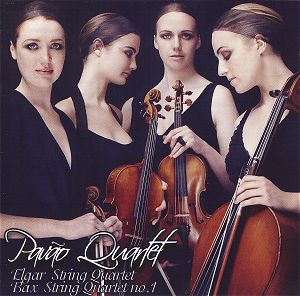

 Pavão Quartet
(Kerenza Peacock (violin); Jenny Sacha (violin); Natalia Grimes
(viola); Bryony James (cello))
Pavão Quartet
(Kerenza Peacock (violin); Jenny Sacha (violin); Natalia Grimes
(viola); Bryony James (cello))