Editorial Board
MusicWeb International
Founding Editor Rob Barnett Editor in Chief
John Quinn Contributing Editor Ralph Moore Webmaster
David Barker Postmaster
Jonathan Woolf MusicWeb Founder Len Mullenger
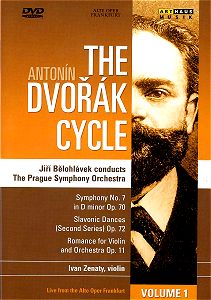
Antonín DVOŘÁK (1841-1904) The Dvořák Cycle - Volume 1
Symphony No. 7 in D minor Op 70 (1884-5) [38:24]
Slavonic Dances (second set) Op 72 (1886) [38:58]
Romance for violin and orchestra Op 11 (1873-79) [14:46] Ivan Zenaty (violin)
Prague Symphony Orchestra/Jiří Bĕlohlávek
rec. live, Alter Oper, Frankfurt, 1993
directed by Rodney Greenberg. ARTHAUS MUSIK
102135 [100:00]
It is easy to be
cynical about claims that musicians from the same country as
the composer have some special insight into that music, but
this DVD provides strong evidence that it might be true. These
are not especially glamorous performances, nor particularly
glamorous musicians - several of their instruments look as if
they have been kept in a shed for many years. However they play
with an understanding of the music that is surely the result
not merely of long years of exposure to it but of a feeling
for the shape of its phrases as well as of the pieces as a whole. Perhaps
it is a question of language, but whatever it is, for once,
Dvořák’s many instructions are neither ignored nor exaggerated. They
simply fall apparently naturally into place. The wind and brass
have an earthy quality which is the opposite of the kind of
organ-like sonority that some conductors seek, but which admirably
suits the way that Dvořák scores. The strings may not
play with the sheen that some orchestras can provide but they
articulate the music in a way that brings it immediately to
life.
In addition Rodney
Greenberg, the director, treats his audience as intelligent
adults, not needing the kind of hyperactive movements which
have spoiled too many BBC broadcasts in recent years. The camerawork
is by no means static - it follows the musical ebb and flow. In
the repeated sections of the fourth Dance, for example, the
camera shows different instruments each time, emphasizing the
complexity
of Dvořák’s writing. At times, but not enough to annoy,
the director seems to have a fixation with the triangle but
fortunately it is not balanced unrealistically loudly. It cannot
be said that the Prague Symphony Orchestra is the most exciting
of orchestras to watch, but they are clearly good musicians
engaged in a serious and involving task, and as a result we
become involved also. I am sure from seeing this that it must
be a great pleasure to play with Jiří Bĕlohlávek. His
beat is clear and inclusive of the changing character of the
music and of its phrasing. He conducts the main items from
memory although quite correctly he has a score for the Romance – soloists
tend to worry if neither they nor the conductor have one available! In
that very lovely piece Ivan Zenaty plays gently - and quietly
when required – in a style which has nothing of the show-off
soloist about it. Although it is last it is in many ways the
highlight of the concert.
The items have clearly
been filmed at more than one concert, and are presented in the
order shown above, which is perhaps not ideal for viewing in
sequence. But it is better in any event to savour the three
items individually. The concert hall in which the performances
take place is large but only the orchestra and front rows of
the audience are visible, along with some impressive organ pipes
at the rear of the orchestra. Presumably because of the number
of string players employed, the woodwind are doubled in the tuttis of
the main works. The first desk players play with immense character
in the solo passages, and there is particular pleasure to be
obtained from the gentle vibrato of the horn players. Not as
much as used to be the case with Russian orchestras, but enough
to give them a very distinct character which suits the music
well.
There are very few
complaints. The booklet contains several pages of interesting
notes about the music but these do contain a few factual errors. For
instance contrary to what they say the Dances are scored with trombones,
as we can see right from the first Dance. My main complaint
concerns the seating of the orchestra, which follows the “normal” arrangement
of having the violins massed on the conductor’s left. The alternative
of having first and second violins on opposite sides is preferable
in almost all music of this period. Without it the many answering
phrases in, for example, the third and fourth movements of the
Symphony sound as though they are played by the same players,
turning from a dialogue to a monologue, with some loss to the
character of the music. This is however a complaint that could
be made about most orchestras in 1993 and now. There are a
few minor slips of ensemble and intonation but none worthy of
mention or likely to be too irritating on repetition.
What matters is
that here we have three of Dvořák’s best works played
idiomatically and very enjoyably, and presented visually in
a way that enhances that enjoyment. I understand that this
is intended as the first of a cycle of recordings of Dvořák’s
main works, and I look forward with eager anticipation to its
successors.
John Sheppard
Please support our advertisers below by clicking on the logos for further information.

























 Ivan Zenaty (violin)
  [100:00]