Editorial Board
MusicWeb International
Founding Editor Rob Barnett Editor in Chief
John Quinn Contributing Editor Ralph Moore Webmaster
David Barker Postmaster
Jonathan Woolf MusicWeb Founder Len Mullenger
John
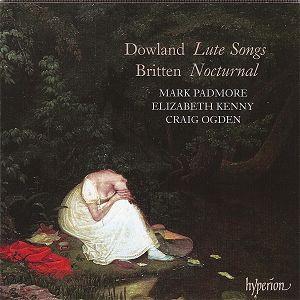
DOWLAND (1563-1626) Unquiet thoughts (1597) [3:46] 1,2 Say, Love, if ever thou didst find (1603) [1:54] 1,2 Sorrow, stay! (1600) [4:06] 1,2 Away with these self-loving lads (1597) [2:35] 1,2
Fantasia No. 7 from ‘A Varietie of Lute Lessons’(1610) [3:44] 2 Come again! Sweet love (1597) [4:56] 1,2 Sleep, wayward thoughts (1597) [1:22] 2 Come, heavy Sleep (1597) [4:28] 1,2 Benjamin BRITTEN (1913-1976) Nocturnal after John Dowland, Op. 70 (1963) [17:55] 3 John DOWLAND Flow, my tears (1600) [4:28] 1,2 I must complain (1603) [4:50] 1,2 If my complaints could passions move (1597)[3:04] 1,2
Captain Digorie Piper’s Galliard (before 1597) [1:42] 2 What if I never speed? (1603) [2:22] 1,2 To ask for all thy love (1612)[2:23] 1,2 Now, O now, I needs must part (1597) [6:12] 1,2 In darkness let me dwell (1612) [4:25] 1,2 Mark
Padmore1 (tenor), Elizabeth
Kenny2 (lute), Craig Ogden3 (guitar)
rec. All Saints Church, East Finchley, London, 5-7 February 2007. DDD
Booklet includes sung texts. HYPERION CDA 67648 [75:25]
Dowland
begins his ‘First Book of Songs’ with Unquiet thoughts and
so do Mark Padmore and Elizabeth Kenny on this CD. Padmore’s
delivery is direct and engaging, to which Kenny provides an
elaborate, dense and full-textured backing. Padmore varies
the repeats of the second strain, with a little ornamentation
in the outer verses and a quieter delivery in the central
section.
Say,
love, if ever thou didst find shows
Padmore excited in infatuation. The vibrancy of his delivery
sometimes approaches parlando. Yet he also points
the contrast in the music. This can be heard in the second
phrase’s simple three-note rise followed by lute echo, which
he makes slower and more contemplative, as he does ‘See
the moon’ in verse 3 and ‘Love is free’ in verse 4. Emma
Kirkby’s 2004 recording with Anthony Rooley (Bis BIS-SACD-1475)
makes the same contrast. In place of Padmore’s excitement
she brings a beguiling poise and coyness. The dramatic ambivalence
of Sorrow, stay (tr. 3), wanting sorrow but not despair,
is intimately presented by Padmore, which makes the stronger
turn of expression from time to time all the more powerful.
The plea, “Pity, pity, pity” (1:37) is an unexpected and
moving moment of declamation.
Away
with these self-loving lads is
sung by Padmore with infectious eagerness and relish for
its raciness, but still smoothly phrased, especially in
the first verse. Above all there’s a wonderfully lively
realization of the projection of the words achieved by subtle
variations in rhythm and delivery to suit the particular
text. The bass David Thomas with Anthony Rooley in 1976
(L’Oiseau-Lyre 475 9114) has an engaging directness and
is a little more reflective, with generally quieter repeats.
But the song’s light, wry tone is better suited to Padmore’s
tenor. At this point Elizabeth Kenny demonstrates the special
lightness and airiness which characterizes the lute in the
Dowland Fantasia in his son’s ‘A Varietie of Lute Lessons’,
a piece sunny and relaxed. You can also admire Kenny’s dexterity
in revealing the many echoing phrases and closing sustained
line above a lively, percussive bass.
Come
again! sweet love is intimately
conveyed by Padmore with sheer joy in the words and mounting
excitement mirroring that of the melody of the refrain.
Martyn Hill with Anthony Rooley in 1976 (L’Oiseau-Lyre)
gives a fresh, more straight, presentation, emotion recollected
in tranquillity, not Padmore’s present emotion.
Sleep,
wayward thoughts appears here
in its lute arrangement form. It establishes a kind of beaming
blessing without the ambiguities of its text and leads soothingly
into Come, heavy Sleep. This is presented essentially
as a transparent invocation to sleep and has a beautifully
sustained line. A little more ornamentation in the second
verse suitably reflects its greater focus on the phantasmagoric
qualities associated with the sleep process and its links
with death. Throughout there’s a contrast between the serenity
of the melodic line and the unquiet circumstances which
are its context. Padmore catches this perfectly in his beauty
of line and tone but also his projection, life, clarity,
rhythm to the words and ornamentation. This is further developed
in the second verse, to sketch the underlying alarm. Emma
Kirkby’s 1976 L’Oiseau-Lyre recording with the Consort of
Musicke has pearly vocal purity and the song here has the
character of a plaintive elegy. Padmore shows more present
emotion yet his more expansive treatment of the second verse
refrain and quieter repeat resolves the tension into a musing
distillation.
This
links neatly with the musing opening of the unique feature
of this CD, the placing alongside the Dowland settings of
Britten’s Nocturnal after John Dowland. The sections
of this work, helpfully separately tracked, are in effect
a sequence of variations for solo guitar. They use parts of
the melody or accompaniment of Come, heavy Sleep with
titles that indicate the various aspects of sleep which are
Britten’s focus. Only at the end does Dowland’s song appear
in its pure and complete form. Craig Ogden begins the first
section, entitled ‘Musingly’ (tr. 9) as a measured and intent
gaze, after which, the second section, ‘Very agitated’ (tr.
10) seems quite wild. In the third section, ‘Restless’ (tr.
11), Ogden’s forward pulse adds to the character sought. Section
4, marked ‘Uneasy’ (tr. 12) is heavily articulated in nightmarish
fashion. Section 5, ‘March-like’ (tr. 13) Ogden makes both
dolorous and indolent in nature, with a clear focus on its
sinister dourness. This is contrasted with the gaudy swagger
of the insistent march rhythm. Ogden’s Section 6, ‘Dreaming’ (tr.
14) has a calm musing nature with the artificial harmonics
unearthly (0:11). His Section 7, ‘Gently rocking’ (tr. 15)
successfully conveys both gentleness and activity.
In
the final and most extended section, ‘Passacaglia’ (tr. 16)
Ogden well conveys an increasing presence in the recurring
bass, enhancing the sense of expectancy already created by
the growingly purposeful melodic shape above. Finally, ‘Slow
and quiet’ (4:46) brings in Dowland’s melody in sunny golden
tone, smoothly delivered. The repeat of its second strain
seems abruptly cut off, as if to say sudden total unconsciousness
or oblivion is the end of the sleep process. It’s a vivid
performance.
I
compared the 1966 recording by Julian Bream, the work’s dedicatee,
on an LP no longer available (RCA SB 6723). His overall approach
is calmer and less dramatic than Ogden’s, so the lyricism
of his third section is sunnier, without Ogden’s sense of
the undercurrent dragging it down. Bream’s section 4 is more
fluttering yet also highly varied in character. His section
5 is garish yet still has the allure of a dance and a grisly
black humour. Bream’s ‘Dreaming’ section 6 has more stillness
and peace while his seventh section is lighter, almost floating.
Bream’s treatment of the Passacaglia is a calmer unfolding,
more smoothly progressing. Dowland’s melody at the close is
more expressively poised than Ogden’s in an almost vocal manner.
We
return to Dowland song with Padmore and Flow my tears (tr.17),
sung in expansive and concentrated manner yet with a quiet
sincerity and immediacy. It’s like eavesdropping on his secret
thoughts. Emma Kirkby in her Bis CD emphasises elegiac beauty
with intensity of flowing phrasing, taking 3:47 to Padmore’s
4:28; Padmore has more spontaneity. In I must complain (tr.
18) you’ll be surprised by two quite different styles. The
first 2:09 is, as Elizabeth Kenny’s illuminating booklet notes
point out, an anonymous setting in an early 17th century
manuscript. This is in the style of Italianate arioso, intensely
inward and elaborately ornamented. Dowland’s setting is altogether
more attractive and accessible, less obviously crafted, more
extrovert in its drama and pace as well as reflection.
Similarly If
my complaints could passions move (tr. 19) appears direct
and lucidly philosophical as presented by Padmore who brings
out the argument of the text by subtle variations in tempo,
such as slowing slightly at “O Love I live and die in thee” (0:29)
and softening the second parts of the first three phrases
of the second verse. Martyn Hill (L’Oiseau-Lyre) offers
a more beauteous even line of instrumental quality. But
in this Hyperion CD we get the instrumental version of this
song, Captain Digorie Piper’s Galliard (tr. 20),
sunnily presented by Kenny.
What
if I never speed is a song of
two parts: the first uneasy, uncertain of the progress of
love, the second optimistic, determined to venture. Padmore’s
repetition of ‘Come’ is quite seductive. To ask for all
thy love sports a happy philosophic manner on the sustaining
of fulfilled love delivered with a cheery grace. Now,
O now, I needs must part is beautifully crafted by Padmore
and Kenny. The song takes 5:05 against Hill’s 4:25 on L’Oiseau-Lyre.
That more measured approach allows Padmore an element of
gliding stateliness, more attention to the words and thereby
tenderness and dignity in this simple, intimate presentation
by the rejected lover. Hill’s phrasing is more even and
his tone more plangent but less dignified. With Padmore’s
account a verse for lute alone is interpolated by Kenny
between the song’s second and third verses. This adds a
sunnier, more elaborately genteel element amid the greater
ornamentation. It is a reminder that the song also exists
instrumentally as the Frog Galliard.
In
darkness let me dwell is the
most elegiac and dramatic song of all. It has a slow, sustained
melancholic line, predominantly low lying, an emphasis on
descent, the sudden ascent of the stark closing plea, “O
let me living die” and an earnest welcoming of death. The
extraordinarily graphic ending is emphasised as Padmore
is left without Kenny’s lute accompaniment for the final
note. We are also abandoned in silence as we’ve reached
the end of the CD.
This
is a terrific disc which demonstrates how flexibly Dowland’s
line can be treated in expressing the nuances of the texts,
vividly realized by Padmore and Kenny.
Michael
Greenhalgh
Please support our advertisers below by clicking on the logos for further information.

























 Mark
Padmore1 (tenor), Elizabeth
Kenny2 (lute), Craig Ogden3 (guitar)
Mark
Padmore1 (tenor), Elizabeth
Kenny2 (lute), Craig Ogden3 (guitar)