In the late 1990s Arcana issued a recording of
John Dowland’s music performed by Nigel North. That recording
(AR36) is still available; though it was labelled in hope ‘Volume
1’, the project seems to have fizzled out at that stage. Since
then North has made further Dowland recordings for Linn (CKD097
and SACD CKD176), all of which have been well received. In
2006 Naxos issued the first CD in what was again billed as the
first of a complete series and, so far, Naxos have kept faith
with the project – as, indeed, they have kept faith with every
project that they have begun.
This third CD in the series concentrates on the
three principal dances of the time, the Pavan, Galliard and Almain.
Having purchased Volume 1 (8.557586: Fancyes, Dreams and Spirits)
on the basis of favourable reviews, not least that of fellow MusicWeb
reviewer Jonathan
Woolf – “It’s very pleasurable listening. An auspicious start.”
– I had high expectations of the new recording and was not disappointed.
At some stage, too, I intend to follow Robert
Hugill’s advice concerning Volume 2 : “There is only one thing
to say about this wonderful recital: buy it!”.
Nigel North has arranged the pieces for variety
in groups of three, i.e. pavan – galliard – almain, as he imagines
Dowland himself might have arranged them had he composed a collection
in the manner of Anthony Holborne’s 1599 publication entitled
Pavans, Galliards and Almains. The uncertain manner in
which Dowland’s music has been transmitted justifies such a
speculative arrangement. Thus each group of three tracks progresses
from the stately pavan, via the galliard to the more lively
almain. Only if you are expecting some of the dances to be
as lively as those found in Prætorius’s Terpischore will
you be disappointed. The wonderful New London Consort/Philip
Picket version of Terpsichore has just been reissued
on Oiseau-Lyre 475 9101. David Munrow’s equally fine pioneering
recording is also still available on a 2-CD set, with works
by Morley and Susato, Virgin 3 50003 2. Both sell for
around £8.50 in the UK.
The booklet which accompanies Volume 1 makes it
clear that all the music has been edited by North himself; I
take this to be true of the present volume, too. The P numbers
attached to some of the pieces refer to the edition by Poulton
and Lam (1974).
Dowland is likely to have begun composing for and
playing on a six-course lute but would have played a nine- or
ten-course instrument later. North himself uses an eight-course
and a nine-course instrument on the first volume in the series,
both of them modern lutes copied from 17th.-century
originals. On this new CD he employs a different nine-course
lute made by Lars Jönsson after a 16th-Century instrument
by Hans Frei, tuned to a’=400.
Melancholy was fashionable in the late 16th-Century
and Dowland was well placed to be in the fashion: his name almost
cries out for the Latin pun which he placed upon it – Semper
Dowland, semper dolens, Dowland is forever doleful. Among
his best known pieces are the song and the consort music both
entitled Lachrymæ, tears; a song which appealed to Benjamin
Britten so much that he wrote a set of variations on it. Two
versions of the Lachrimæ Pavan, the Galliard to the
Lachrimæ Pavan, Dowland’s Tears and Semper Dowland
Semper Dolens are included on Volume 2 of this Naxos series
(8.557862), making the use of the famous Hilliard miniature
of the melancholy young man almost mandatory for the cover of
that CD.
On this new recording the Pavana Doulant
employs the same pun, in French this time rather than in Latin
– the ‘doleful pavan’. This is a problematic work, published
in a collection which includes other undoubted Dowland works,
but in a form which cannot be as it left the composer’s hand.
When played as well as it is here, in a version edited by North
himself, it is a very effective piece; one certainly would like
it to be by Dowland. In his performance of it North does not
exaggerate the doulant element which, in any case, largely
amounts to fashionable posturing. In general the programme
on this recording is well balanced; as Nigel North notes in
the booklet, there is more to Dowland than just the melancholic.
Even in Volume 2 he contrived to keep it in its place – and
where it does occur, as in the Pavana Doulant, he deals
with it pretty objectively.
The other unusual piece in this collection is the
Galliard on a Galliard of Bachelar, where Dowland takes
the opening four bars of an original dance by one of his contemporaries,
now all but forgotten, and branches off into what the booklet
describes as “its own world of great variety and fantasy.”
Fantasy or ‘fancie’ was another popular buzz-word of the time
(cf. Shakespeare’s “Tell me where does fancy dwell”) and Dowland
wrote a number of pieces to which he gave this title, several
of them included on Volume 1. They are essentially free forms,
in which the composer literally follows his own fancy or imagination:
“when a musician taketh a point at his pleasure and wresteth
and turneth it as he list”, as the composer Thomas Morley puts
it. As in the fancies on the earlier volume, North is particularly
effective in bringing out the qualities of this piece.
Like most people of my
generation, my introduction to the lute music of Dowland and
his contemporaries was provided by Julian Bream, abetted in
the lute songs by Peter Pears. I shall not be throwing out
any of my Bream CDs, from the RCA Julian Bream Collection –
and not just for reasons of sentimental attachment – but Nigel
North’s recordings make an excellent complement to them. Sadly,
only one Dowland recording from RCA’s Bream Edition seems to
be available – a recording of Lute Songs with Peter Pears reissued
to coincide with Sting’s Songs of the Labyrinth. When
the Sting nine-day-wonder has passed, no doubt the Bream CD
will again be deleted (RCA 8869704927 2).
Bream had to start virtually from nowhere in teaching
himself how to play the lute, whereas younger players like North,
building on the base which he created, have been able to develop
phenomenal technique. Thus, for example, though it is impossible
to play the lute without some extraneous noise, one hears much
less in North’s recordings than in Bream’s.
There is little for me to add to what has already
been said about the style of North’s playing by my colleagues
about Volumes 1 and 2. His technique is excellent, but that
technique is always placed at the disposal of the music, which
is allowed to speak for itself.
As on the previous volumes the recording is just
right – close and analytical but not too close and with a nice
ambience.
Only those with a positive aversion to lute music
in general and Dowland’s in particular are likely not to be
won over by this CD. And if you dislike Dowland, you probably
don’t like the lute at all for, as Richard Barnfield puts it,
the lute was almost synonymous with Dowland for his contemporaries:
Dowland
to thee is deare; whose heauenly tuch
Vpon the Lute, doeth rauish humaine sense:
[The Passionate Pilgrim, 1598 – for the complete poem see
the
Opensource website]
We don’t know what
Dowland’s own playing sounded like: we must take Barnfield’s words
about the heavenly touch on trust. Though there is no evidence
that he knew Dowland, he was at least expressing the current opinion.
There could be no more fitting description of Nigel North’s playing
in this series than to copy Barnfield’s words: “[it] doeth rauish
humaine sense.”
The notes, by Nigel
North himself, are excellent. They include his reasons for accepting
the Pavana Douland as probably authentic but with necessary
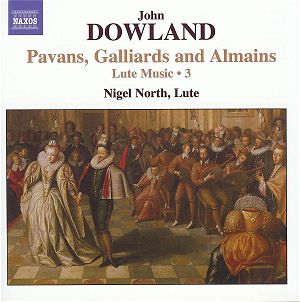
revisions. The artwork is, as usual with Naxos, tasteful, though
the cover painting of a court ball with music provided by a lute
consort is not quite appropriate for a solo lute recital.
Brian Wilson