Editorial Board
MusicWeb International
Founding Editor Rob Barnett Editor in Chief
John Quinn Contributing Editor Ralph Moore Webmaster
David Barker Postmaster
Jonathan Woolf MusicWeb Founder Len Mullenger
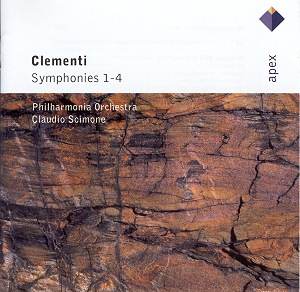
Muzio CLEMENTI (1752-1832)
Symphony No. 1 in C major [25:27]
Symphony No. 2 in D major [24:00]
Symphony No. 3 in G major (Grand National Symphony) [26:57]
Symphony No. 4 in D major [28:24] Philharmonia Orchestra/Claudio
Scimone
rec. Henry Wood Hall, London, January 1978 WARNER APEX
2564 627622 [49:27 + 55:21]
I'd guess that most listeners know Clementi,
if at all, as the composer of the sonatinas that have been the
bane of generations of second-year piano students. Who'd have
thought that this same composer would, in the symphonic arena,
have been a full-fledged innovator?
The
autograph scores and orchestral parts for these symphonies were
discarded or otherwise variously went missing over the years,
explaining their prolonged obscurity; the present editions are
reconstructions by the musicologist Pietro Spada. Granted, without
knowing the full extent of his reworkings and other contributions,
it's hard to divine just how much of what we're hearing is original
Clementi. Still, in whatever form, these scores, composed by Clementi
in middle-age - when he had come under the personal and professional
influence of Beethoven - are complex and forward-looking in a
way that those ricky-ticky sonatinas could never have suggested.
Thus,
the introduction to the C major symphony, with its steady tread
and organlike wind writing, sounds suitably formal yet somehow "advanced," and
it's not immediately clear why. The difference lies in the composer's
use of the winds. In much Classical writing, the winds undertake
melodic duties strictly as soloists; as a group, they're relegated
to supporting the dominant string body. Clementi's novel stroke
is to give the winds parity as a group with the strings,
folding the contrasting timbral blocks in and around each other
in the texture as contrapuntal units. Even the trumpets occasionally
cut loose from the batteria to participate in this kind
of linear deployment. This technique yields an unusually rich
sonic tapestry - it's not too much to hear it as foreshadowing
Bruckner - which gives the music its distinctive sound.
The
inner movements, too, have their quirks. The theme of the Andante
con moto is simple enough, but unfolds in off-kilter three-bar
phrases before sidling into the standard four-bar units. In the Menuetto,
Clementi speckles the light, crisp horn-and-woodwind theme with
little double graces and breaks up the standard one-in-a-bar pattern
with hemiolas, for a bumptious effect. A quicksilver Finale returns
in tutti to the weightier feel of the first movement. The
results are altogether refreshing, yet Classical form and technique
remain inviolate.
The
Fourth Symphony, too, looks forward in its details. Following
a searching, mysterious introduction, the first movement's long-spanning
principal theme anticipates Schubert's extended theme-groups,
seasoned by "answering" phrases in contrasting timbres
and registers and abrupt, Beethovenesque changes of mood. An airborne,
lyrical 'cello melody affords some breathing space, after which
the development wanders through a wide range of key centers with
a cheerful, even boisterous energy. In the Andante cantabile,
Clementi again splits segments of the theme among different timbral
blends; the sound and scale are "big" for a Classical
slow movement. The third movement is marked Menuetto, but
suggests Beethoven's one-in-a-bar scherzi in its minor-key
agitation and brisk scansion; soft tympani strokes add an earthy
touch to the gentler Trio. The Finale's bouncy opening
theme is jaunty and lyrical all at once, marked by dotted rhythms
which also invade the smoother contrasting subject.
The
other two symphonies, less overtly "different," can
still take the listener by surprise. The G major gets its nickname
from the injections of God Save the King into the slow
movement - a big-boned, majestic structure with a strong brass
presence - and the sprightly, elegant finale. The first movement's
main theme is segmented in a way that throws the stresses onto
different parts of the bar, and the exposition (not the
development!) rather thoroughly explores fringe harmonies. The
score is a synthesis of Haydn's rugged vigor and Mozart's more
yielding expression, looking ahead to Schubert in the Minuetto's
easygoing Trio.
The
Second Symphony strikes a nice balance between busy "horizontal" activity
and strong, "vertical" weight, recalling Haydn in the
bustling energy of the outer movements. Note the way that, in
the Minuetto's recap, Clementi gradually fills out the
light, soloistic textures. In the finale's coda, the prominent
horn entry and syncopated fugato are nice surprises.
The
Philharmonia sounds good, though a bit muzzy and diffuse, and
not just because of the recorded ambience - there's a hint of
looseness in attacks and releases. This was one of Claudio Scimone's
first excursions into the "big" repertoire, and I suspect
that his baton signals, adequate for leading his Solisti Veneti
chamber orchestra, may not have been sufficiently clear to elicit
really precise playing from a large ensemble. Sonics are acceptable,
though you might find a volume boost in order.
Stephen Francis Vasta
Please support our advertisers below by clicking on the logos for further information.

























 Philharmonia Orchestra/Claudio
Scimone
Philharmonia Orchestra/Claudio
Scimone