Editorial Board
MusicWeb International
Founding Editor Rob Barnett Editor in Chief
John Quinn Contributing Editor Ralph Moore Webmaster
David Barker Postmaster
Jonathan Woolf MusicWeb Founder Len Mullenger
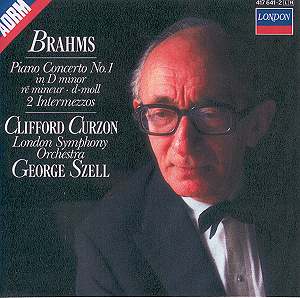
Johannes BRAHMS (1833-1897)
Piano Concerto No.1 in D Minor, Op.15 (1854-1858) [50:13]
Intermezzo in E flat major, Op.117 No.1 (1892) [4:51]
Intermezzo in C major, Op. 119 No.3 (1893) [1:42] Clifford Curzon
(piano)
London Symphony Orchestra/George Szell
rec. 1962, 1963. ADD LONDON 4176412 [56:57]
This recording of
Brahms' first piano concerto is rightly acclaimed as a classic. Soloist,
conductor and orchestra are united in their interpretative view
of the score, but they are not of one mind. This is as fierce
and combative a reading as you will hear.
Clifford Curzon is
in imperious form in this, his third and final commercial recording
of the D minor concerto. His reading of the first and last movements
is full of fire. He punches out his trills in the first movement
with more vehemence than anyone else on record, but in the midst
of the sand storm he finds oases of wistfulness. There is exquisite
poetry too in the slow movement and in the cadenza of the finale. There
is some untidiness in the more exposed passages in the first and
last movements as Curzon cascades through fistfuls of notes, but
this matters little – his performance has sweep and ardor enough
to banish complaints.
In George Szell he
has a perfect sparring partner, whose fat-free conception of Brahms'
score is very much in keeping with his own. Szell and his Clevelanders
recorded this concerto with both Fleisher and Serkin,
and his approach to the score is consistent in this reading. His
tempi are swift and he demands and gets razor sharp articulation.
The big difference
here is the sound of the orchestra. In the early to mid 1960s,
the London Symphony Orchestra was still in the process of wresting
the mantle of London's best band from the Philharmonia. It was
not the polished ensemble that it is today. It did, however,
have a distinctive sound. The ranks bristled with fantastic wind
and brass principals in particular – from Gervase de Peyer on
clarinet to Denis Wick on trombone to Barry Tuckwell on French
horn – and as a whole it had the air of the cocky up-and-coming
ensemble. Listen to any of their recordings from this period
and you will hear what I mean: their recordings of the first two
Mahler symphonies with Solti, for example, or their Walton
1 or Shostakovich
5 with André Previn. Even when there are rough edges in these
performances, their excitement and engagement with the music want
for nothing. So it proves here. The terrific thwack of the timpani
and the ferocious bite of the violins engage you instantly in
the drama of this score. The barking of the horns is a call to
battle rather than the hunt.
The overall timing
of this performance may seem to indicate that tempi are middle
of the road, but this is not the case. The stormy first movement
takes 22:14 – on the quick side of the average but full of marked
tempo fluctuations – and the finale flies by at 12:03. It is
in the slow movement that Curzon and Szell really relax their
tempo, taking 16:03 where another great poet of the keyboard,
Radu Lupu, takes only 13 minutes.
The first of the two
intermezzi that follow are played with understated and poetic
beauty, and the second is blithe and nicely pointed.
The recorded sound
is beginning to show its age, being a little shrill above the
stave and a touch dry in the concerto, and veiled in the couplings. There
is also more performance noise than one might expect in the first
and last movements of the concerto. The concerto is certainly
due a careful remastering and reissue on Decca's Originals imprint*. Arkiv
have done music-lovers a service by keeping this classic recording
available at least until then.
Tim Perry * I note that this performance was cleaned up
for reissue in Decca's now defunct Legends series, where it was
generously coupled with Franck's Variations symphoniques and
the famous scherzo from Litolff's Concerto symphonique No.4.
Please support our advertisers below by clicking on the logos for further information.

























 Clifford Curzon
(piano)
Clifford Curzon
(piano)  4176412 [56:57]