Although many British
composers active during the first half
of the 20th century composed
a lot of piano music, piano sonatas
were not particularly plentiful. I can
think of Benjamin Dale’s large-scale
Piano Sonata in D minor Op.1,
Alan Bush’s Piano Sonata in
B minor Op.2 (1921) and
of York Bowen who wrote several, although
I have yet to hear them. There are no
piano sonatas by RVW, Holst or Moeran.
In such a context, the six piano sonatas
recorded here likely represent the most
substantial output in the genre composed
during the period 1900-1950. All of
them are large-scale, substantial works
that were important milestones in their
respective composer’s achievement, even
if Bax may be best-remembered for his
symphonies and orchestral works.
Bax’s Piano Sonata
No.1 in F sharp minor was first
performed by Myra Hess as Romantic
Tone Poem who played it later in
1919 as Symphonic Phantasy. These
early alternative titles clearly point
to the symphonic character of this substantial
work laid-out in one vast single movement
as was its successor, and also to the
rhapsodic nature of the music that alternates
many moods expressed in an often warmly
romantic manner looking back to past
models.
Bax composed his Piano
Sonata No.2 in G in 1919 and
revised it one year later. As already
mentioned, it, too, is in one large-scale
single movement. The music, however,
displays considerable stylistic progress.
I wonder if I am the only to hear some
faint echoes of Stravinsky [at about
8:00 – track 2] as well as of John Ireland
in some passages of this imposing work.
The work ends with a lengthy epilogue
as do the symphonies. It seems clear
that by the time he composed the Second
Piano Sonata Bax had found his true
and highly personal musical voice. In
spite of the work’s large-scale structure,
the musical ideas are handled in a much
tighter manner than in the somewhat
rambling First Sonata. Malcolm Binns,
who recorded the Second Piano Sonata
many years ago, consulted a number of
textual sources including the manuscript
held in the British Library. This sheds
light on Bax’s compositional process
in that it contains two fairly important
passages that were later replaced in
the revised version. These passages
are included here as Appendix 1 and
Appendix 2 and will certainly prove
very informative and illuminating for
any Bax specialist, probably less so
for the average music lover (I am one
of these). Their inclusion in this comprehensive
release is most welcome.
Before completing his
Piano Sonata No.3 in G sharp minor
(1926), Bax wrote yet another sonata
that eventually became his First Symphony.
Unlike its predecessors, it is cast
in three movements much along the same
lines as the symphonies; by that time,
he had completed his first two symphonies.
The weighty opening movement is followed
by a quite beautiful Lento moderato
opening in a dream-like atmosphere and
building-up to a powerful climax before
reverting to the opening mood. The third
movement concludes the Third Piano Sonata
in an assertive way. By the way, the
insert notes label the third movement
as Lento moderato, which I suppose
is wrong.
"The piano sonatas
by Bax are all demonstrably examples
of his romantic and highly subjective
musical style. However, by the time
he came to write the Fourth Piano Sonata
... he had moved on somewhat to a less
subjective and textually more simplified
style" (Lewis Foreman). For once,
it is both shorter than any of its predecessors
and on a less epic scale than any of
them. "The slow movement seems
to be a paraphrase on an Irish folk
tune Has sorrow thy young
days shaded, according to Tilly
Fleischmann" (Lewis Foreman). On
the whole the Piano Sonata No.4
in G is somewhat lighter in
mood and the music often displays a
rather unusual linear clarity that one
would not have readily associated with
Bax. By comparison to its predecessors,
the Fourth Piano Sonata may be less
compelling and absorbing, but is still
quite enjoyable, the slow movement being
particularly attractive.
Now, I must confess
– much to my shame – that I had never
heard any of Bax’s piano sonatas before,
so that listening to these recordings
was quite a discovery and an important
musical experience for me. My comments
have been made, as if hearing new pieces,
and – as usual – from the listener’s
standpoint.
John Ireland often
complained that he was not taken seriously
as a composer because he did not compose
any symphony or large orchestral works.
His Piano Concerto and
These Things Shall Be
are probably his largest orchestral
pieces. His impressive Piano Sonata
(1918/20) more than compensates for
the absence of a symphony in Ireland’s
list of works. I had not heard it for
many years and I had completely forgotten
what a beautiful work it is, full of
typical Ireland fingerprints: melodic,
harmonic and rhythmic. It is in three
movement of which the central Non
troppo lento is the emotional core,
a beautifully moving elegy. It seems
that Ireland made some revisions in
1930 and 1951. The 1951 published revised
version is played here, probably for
the first time ever. John Talbot discusses
this edition in the 2007 edition of
the British Music Society’s journal
British Music.
Frank Bridge’s imposing
Piano Sonata composed
between 1921 and 1924 and inscribed
to the memory of Ernest Farrar, a most
distinguished composer killed in action
in 1918 shortly before the Armistice,
is his only large-scale work for piano
and one of his mature masterworks. By
the time he had completed it, Bridge
had begun exploring new musical horizons
and estranging himself both from audience
and critics for whom his new, more radical
music-making proved too difficult. Fortunately,
times have changed, and Bridge is now
generally regarded as a great composer.
The Piano Sonata is an often grim, sombre
work full of rugged but powerful lyricism,
that would soon become the mark of Bridge’s
mature works such as the cello concerto
Oration, the Second Piano
Trio and the last two string quartets
- the unquestionable peaks of his output.
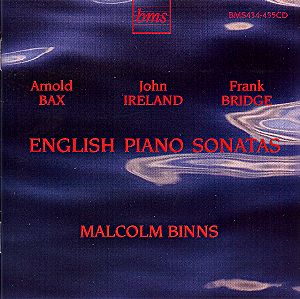
This important and
generous compilation was released to
mark the fiftieth anniversary year of
Malcolm Binns’ London debut recital
at the Wigmore Hall in 1958; but it
is – first and foremost – a magnificent
collection of impressive and substantial
British piano sonatas written during
the first half of the 20th
century. These works are still too-little
known although things are now changing
in terms of commercial recordings. They
definitely represent their respective
composers at their best. It is good
to have these important works in one
set, especially in fine performances
such as these. The recorded sound is
nicely natural throughout. The lavish
insert notes include an illuminating
interview of Malcolm Binns by Lewis
Foreman and definitely make this generous
release indispensable to anyone interested
in British piano music.
Hubert Culot
see also review
by Colin
Scott Sutherland
























 for details
