The ever-growing ranks
of lovers of English chamber music will be in their element here.
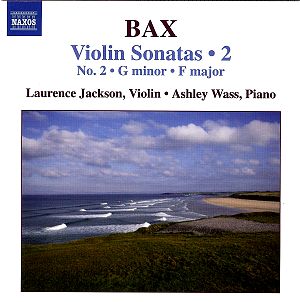
Released as part of the company’s 20th Century British Music series
this second volume of Bax’s works for violin and piano is once
again performed by violinist Laurence Jackson, and pianist Ashley
Wass. I recently reviewed the winning first volume containing
the first and third sonata on 8.557540 – a joy to hear.
This was a double
review combined with a disc of Bax’s works for viola and piano
on Naxos
8.557784.
The
present disc opens with Bax’s Violin Sonata No.2 from 1915
a score contemporaneous with the orchestration of the Nympholept
and preceding The Garden of Fand. It seems that Bax withheld
the sonata for a few years before giving it considerable revision
in 1920. After which it was premiered by the violinist Bessie
Rawlins with Bax at the Wigmore Hall, London. The Sonata
is cast in four distinct movements that are played continuously.
This is probably Bax’s finest chamber score and although I attend
numerous chamber recitals I have yet to see it programmed.
The
movement is marked Slow and gloomy. Contrasting moods define
this splendid movement and one notices the stamping piano part.
At times I was reminded of the opening Modéré from Ravel’s
Violin Sonata; a score composed over a decade later.
There seems to be little emphasis on Slow and gloomy here.
One minute Bax is communicating confidence, warmth and comfort,
the next a switch to darkness and unease. The second movement
bears the evocative title of The Grey Dancer in the Twilight.
Bax described it as a, “dance of death”. For me the profusely
optimistic and buoyant opening half of the movement has the feel
of Gallic cafés. One notices the Dies Iræ motif but it
does not predominate. From around 3:18
the mood shifts to one of aquatic mystery with a touch of apprehension.
Initially
the third movement, marked Very broad and concentrated,
evokes summer pastoral vistas with an episode of angst and tension
between 2:15-2:57.
Bax creates a fatiguing atmosphere radiant with nostalgic yearning
for the happy carefree days of youth. Self-assured, forthright,
often angry and brutal the final movement, marked Allegro feroce
makes a welcome appearance after what has gone before. One notes
the return of a passage of a watery quality from 1:44. Around 5:31 there is a distinct second half to the movement containing
music of a rather ambiguous character. Here one cannot easily
decide if the temperament is relaxing or if there is an underlying
tension. In the Coda the score fades away placidly into
the distance.
The
Ballad for Violin and Piano was composed in 1916, the same
year as his orchestral tone poem The Garden of Fand. The
unsettling events of the Easter uprising of armed nationalists
in Ireland may have been a major influence for the powerful single
movement score. Dedicated to violinist Winifred Small it seems
that that the Ballad was consigned to the drawer for in
excess of a decade until Bax undertook revision in 1929. The Ballad
could easily represent a squall at sea contrasted with the butterfly-like
delicacy of a summer cornfield.
From
1915 the Legend for Violin and Piano is a substantial single
movement work. This dark and unsettling score may well reflect
Bax’s abhorrence at the mounting carnage of the Great War. Violinist
Winifred Small and pianist Harriet Cohen performed the score in
1916 at the Aeolian Hall, London. The rocking
introduction to the Legend serves as a harbinger of the
unhurried and mournful disposition that permeates the music.
The
Sonata in G minor composed in 1901 is from Bax’s early
days as a student at the Royal Academy of Music. Designed as a
single movement marked Allegro appassionato Bax dedicated
the score to his then violinist girlfriend Gladys Lees, a fellow
Academy student. Providing a fascinating insight into Bax’s fledgling
composing activities the score has a dance-like opening that soon
transforms into a concentrated movement of knotty tension.
The
final work on the disc, the two movement Sonata in F major
from 1928, is sometimes referred to as the fourth violin sonata.
The sonata is more widely known in Bax’s 1930 reworking as a Nonet
for flute, clarinet, oboe, harp, two violins, viola, cello
and double-bass. Bax seems to have consigned the F major score
to the drawer. Consequently it was not performed until 1983 for
the centenary celebrations of Bax’s birth. The generally agreeable
nature of the first movement Molto moderato predominates,
however, one senses that sinister undercurrents are never far
away. The temperament of the high-spirited Allegro gives
way to a calmer and reflective section at 2:41-4:55.
From point 5:47
the music takes on a slower, more disconcerting quality that peaceful
fades away.
There
is competition in the catalogues for the Bax violin sonatas, although,
I have not heard the alternative recordings. Perhaps the best
known are the accounts from violinist Erich Gruenberg and pianist
John McCabe who recorded the Violin Sonatas No. 1 &
2 on Chandos 8845. The violinist Robert Gibbs and pianist
Mary Mei-Loc Wu have recorded the Violin Sonatas No. 2-4
on ASV CD DCA1098. They have also
recorded the Violin Sonata No. 1 and the one movement Violin
Sonata in G minor on ASV
CD DCA1127. In addition violinist Tasmin Little and pianist
Martin Roscoe have made a recording of the Violin Sonata No.
2 for the label Global
Music Network GMNC 0113 (c/w Elgar Violin Sonata).
Not to mention the Concert
Artist disc of No. 1 (ed.).
Throughout this Naxos disc the impressive Jackson-Wass duo let
the music speak for itself with assured and perceptive playing
of string and key. Their tone is refined and tuning faultless.
For
Naxos
the team of Walton and Thomason provide defect-free production.
In addition the essay from Lewis Foreman is of a standard that
all authors should aspire to in what is a most attractive release.
Bax’s reputation can only gain enhancement from this superbly
performed and recorded second volume of violin sonatas from Naxos.
Michael Cookson
see also Review
by Ian Lace
























 Laurence Jackson (violin)