Another cherished misconception
bites the dust: hitherto I had thought of Peter Philips only
as a composer of music for the Roman Catholic liturgy, chiefly
found in the two collections of
Cantiones sacræ; now
I recall that he was also an important composer of instrumental
music worthy to be compared with Dowland or his fellow exile
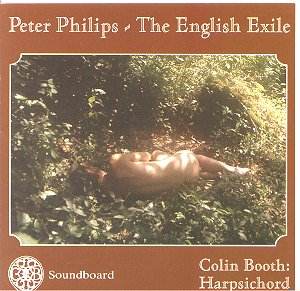
(eventually) John Bull. The present collection of about
two thirds of the Philips works contained in the Fitzwilliam
Virginal Book contains music which Colin Booth describes
in the booklet as ‘most beautiful and immediately attractive.’ I
concur; everything here is well worth hearing in these performances.
This recording has already
been reviewed on Musicweb, as long ago as 2000, by Rob Barnett,
the classical editor – see
review. It’s
come my way now as a result of my receiving another of Colin
Booth’s recordings (
Restoration: Treasures of the English
Baroque, with Jette Rosendal, CDK1002 – see
review)
and my expressing an interest in some of his earlier ventures. RB
admitted that he wasn’t an expert on Elizabethan music – though
he’s probably forgotten more about 20
th-century
English composers than I ever knew and I’ve found his advice
concerning the likes of Bax invaluable. I can, perhaps,
claim a little more expertise in this area on the slim basis
of a London University MA in Renaissance Studies; I certainly
endorse Rob’s opinion that this recital is definitely worth
exploring.
Though he taught the virginals
in Antwerp from about 1590 onwards, his keyboard style remained
English; as the
Oxford Companion to Music neatly puts
it, ‘Philips was an Englishman in his keyboard music, but
a continental in his vocal works’. Whereas we frequently
suspect that terms such as ‘dolorous’ were used for effect
in the late 16
th and early 17
th century,
as in Downland’s regular puns on his own name (
semper
Downland, semper dolens – Dowland is always dolorous),
Philips appears to have had good cause to write in a melancholy
vein: not only did he live all but the first 20 years of
his life in exile, he was briefly imprisoned in The Hague
on suspicion of plotting against Queen Elizabeth.
Booth’s dates, which I
have mainly followed above, ascribe the
Pavana doloroso (track1 – the
titles in the Fitzwilliam book appear to demonstrate a typical
English insouciance about the gender of foreign nouns and
adjectives) to that experience of 1593 and it is probable
that the
Galliarda dolorosa also dates from that period. Whether
or not we are entitled to assume that the experience makes
the music more ‘genuine’, these are certainly impressive
pieces and they make an excellent opening to the programme.
This is not the only recording
exclusively devoted to Philips’ keyboard music, and individual
items are available elsewhere. There is a 2-CD complete
set on Dabringhaus und Grimm (Siegbert Rampe, MDG341 1257-2
and MDG341 1435-2) where the performances are divided among
harpsichord, clavichord and organ. A CD of the keyboard
music of Byrd on the Alpha label, entitled
Pescodd Time,
includes Philips’
Pavana Dolorosa and
Galliarda
Dolorosa (Alpha 016); you may initially think Bertrand
Cuiller’s rather livelier tempi for these two pieces more
exciting, until you remember that their titles indicate the
opposite of lively.
On another Alpha recording
entitled
Bara Faustus’ Dreame: Mr Francis Tregian his
choice, (Alpha 063) Les Witches perform the same two
pieces, dashing them off even more rapidly. Neither of these
Alpha recordings seems to me to capture the essential dolorousness
of the music – it seems entirely lacking from Les Witches’ performance
of the
Galliarda Dolorosa and almost as completely
lacking from Cuiller’s account of the same work, though his
middle way with the
Pavana Dolorosa strikes me as
a useful middle way, where Colin Booth is perhaps a little
too close to the lugubrious.
Surprisingly, Elizabeth
Farr’s Naxos recital devoted entirely to Philips’ keyboard
works (8.557864, recorded in 2003) does not contain these
two best-known pieces. (Is a second volume planned?) She
does, however, include a number of other items on the Soundboard
recording, including the
Pavana of 1580.
If we are correct in accepting
the ascription of that
Pavana (track 3) as Philips’ first,
composed in 1580 before he went into exile, it might have
been more logical for both collections to have begun with
it; though it is less striking than the two works of 1593,
it is still a cut above the ordinary. I haven’t been able
to hear the whole of Farr’s performance of that piece, only
the opening section, but her approach is very similar to
that of Booth and their timings are almost identical (Soundboard
3:41, Naxos 3:27).
The same is true of the
Pavana and
Galliarda
Pagget. My colleague Paul Shoemaker liked Farr’s Naxos
recording enough to convince me that those opening snippets
which I have been able to hear are representative of her
performances overall – see
review. Glyn
Pursglove was, if anything, even more enthusiastic – see
review.
The inevitable question ‘what
if?’ must be asked – suppose Philips’ talent had been recognised
in England at an earlier date and his recusancy tolerated
as that of Tallis and Byrd was, would his keyboard style
have developed as it did? The
Fantasia of 1582 (tr.14)
suggests that it was already developing in a very promising
manner just before or just after he embarked on his journey
of exile. Here Farr is slightly slower than Booth, emphasising
the dreamlike nature of the work where he concentrates on
its virtuosity – the title may imply either and both approaches
seem valid, bearing in mind that I’ve been able to hear only
part of Farr’s interpretation. I believe that Booth was
right to end his recital with this display of keyboard virtuosity.
Elizabeth Farr performs
the music on an interesting instrument, built in Rome in
1658 and restored by Keith Hill. Colin Booth plays an even
more interesting instrument – one which he made himself in
hia ‘day job’ as maker of keyboard instruments. The instrument,
illustrated in the booklet, is a copy of an Italian original,
tuned to a=392, well below ‘normal’ ‘baroque’ pitch, and
meantone-tuned. All of this works very well for me, though
I have to admit that I am totally devoid of the sense of
absolute pitch which I have always envied in my violinist
and cellist friends. If your idea of a harpsichord is of
a clangorous instrument, think again; this certainly isn’t.
With very good recording
and a most informative booklet, professionally produced – no
sense of cottage-industry here – this recording may be recommended
with confidence. We no longer award stars, but, if we did,
I’d stretch RB’s original four stars to ****(*).
The recording can be obtained
direct from Soundboard Records and
Colin Booth can be contacted by
email.
Brian Wilson
see also review by Rob Barnett
























 Colin Booth
(harpsichord)
Colin Booth
(harpsichord) 
