Keiser was a pupil
at the Thomasschule in Leipzig for seven
years before moving on to musical appointments
in Brunswick and Hamburg. He was a prolific
opera and oratorio composer. Long tenure
in Hamburg saw visits from Handel, collaboration
with Telemann, and a steady stream of
religious and secular compositions.
His Dialogues von
der Geburt Chrsti dates from 1707.
This is a work of great piety. It’s
also a work of considerable concision
and essentially homophonic. Yet within
that structure Keiser writes with considerable
flexibility, not least for the accompanying
instrumental forces which are constantly
varied, and consistently imaginative
in their deployment. The immediacy and
excitement – the sense of anticipation
reflected in music and text – starts
early with an opening chorus of arresting
strength. Keiser’s schema is precise
but also charming in places. The undulating
line of the bass aria Heller Glanz
von’s Vaters Licht is both witty
in itself but also reflects the shining
light that penetrates the text’s ‘grey
of eternity’. One might also have suggested
that Keiser was an adept writer for
the stage for the sense of compressed
tension he brings to the Terzetto Es
klopft noch unsre volle Brust [track
13] where the halting unease in the
musical line reflects precisely the
beating anxious hearts the text evokes.
Elsewhere there are consoling arias
and choruses – an especially fine quasi-lullaby
in O Jesu parvule – and as ever
with the composer, those constantly
shifting accompanying instrumental colours,
always deployed with intelligence and
an ear for colour. It’s a practical,
uplifting work set on a small scale
and very well sung and played by the
solo voices, instrumentalists and choral
forces of Rastatter Hofkapelle.
The coupling is Graupner’s
Magnificat in C written fifteen years
later. It’s a spirited and vivacious
little work lasting around fourteen
minutes. As with Keiser Graupner was
also a Saxon and also attended the Thomasschule
– and followed the drift to Hamburg
as well, where he worked as a harpsichord
player. In 1709 he became vice-Kapellmeister
in Darmstadt and after promotion remained
there until he died in 1760. He churned
out a prodigious number of sacred cantatas
– 1,400 is the figure Christine Blanken
mentions in her booklet notes. It’s
assumed that the Magnificat was composed
as an application for the position of
Thomaskantor back in Leipzig, since
Magnificat settings were not customary
at the time in Darmstadt. In any event
his employer vetoed the application.
The Christmas spirit
is strongly audible in this spirited,
trumpet-proud setting. The oboe writing
is eloquent and whilst his instrumental
writing in this work is generally less
intricate than Keiser’s in his Dialogues
it’s no less practical and effective.
The choruses are dynamic and melodies
broadly triadic. Once again the performances
evoke the sense of time and place with
great effectiveness and the recording,
though unusually in my Carus experience
taped in the SWR Studio Baden-Baden
and not in a church or cathedral, is
equally effective and not too cold.
Full texts are provided
with translations into English (Keiser)
and from the Latin into German, English
and French (Graupner). A splendid festive
offering from Carus – albeit short value
at forty five minutes.
Jonathan Woolf
























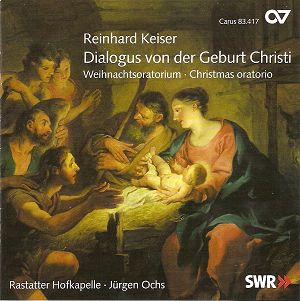

 Rastatter Hofkapelle/Jürgen Ochs
