Elgar's Dream of Gerontius, completed in 1900 for
the Birmingham Festival, is one of the cornerstones of the choral
repertoire. As such there are many recordings available, including
an earlier one from the Hallé conducted by Sir John Barbirolli
in 1964; so this new disc is up against some formidable competition.
The oratorio uses a poem written by Cardinal Newman
in 1865 and is in two parts. Part 1 deals with the death of Gerontius,
and Part 2 with the journey the soul takes after death. In style,
it is 'through composed': there are no set 'numbers' as in, say
a Handel oratorio. Somewhat Wagnerian in style, Elgar also uses
a series of leitmotifs to unify it musically. It is scored for
a large orchestra (including organ), three soloists, a full mixed
choir, and a semi-chorus. In this recording the semi-chorus is
taken by the Hallé Youth Choir, a choice which yields interesting
results.
The work opens with an orchestral prelude which
uses some of the important themes signifying moods or feelings
which will be heard again later. Elder follows the tempo markings
and dynamics scrupulously. It is interesting to compare this with
the recordings by Barbirolli in 1964, Boult in 1974, and Colin
Davis in 2005 - this last recorded live in the LSO Live series.
Barbirolli allows the woodwind, particularly the cor anglais,
to dominate giving a distinctive almost keening quality. Elder
and Boult favour a more integrated, balanced sound. At the climactic
march theme Boult plays as marked Molto Largamente, in a stately,
broad tempo. Elder, Barbirolli and Davis maintain a quicker pace
and so lose out a little in the grandeur of the theme. In the
sections alluding to prayer all play with the utmost subtlety
and delicacy.
This Prelude leads into a long monologue for Gerontius.
A most difficult part to sing as the performer must be able to
change moods quickly; sing in a declamatory fashion one moment
and then softly and delicately the next. Indeed, some of the words
are in parentheses which signify interruptions to his main train
of thought. Paul Groves, a relative newcomer to this role, sings
with all the necessary feeling for the words and follows Elgar's
dynamic markings sensitively. He carefully dovetails his lines
with those of the choir for the semi-chorus "Kyrie"
so the choir is almost an extension of the soloist; and similarly
at the choir entry "Be merciful".
The "Sanctus fortis" is delivered with
an heroic ring to the voice which is pared down for the reprise
at figure 53 marked piangendo - literally crying or weeping. There
are many examples of this type of 'word-painting' in this performance
which stands it apart from others available.
Part 2 presents us with Gerontius's soul being
transported to be judged. This now requires the singer to display
a refinement which one gets from a lieder singer. Paul Groves
manages this with great aplomb. Listen to his first entry "I
went to sleep" ; and in the duet with Alice Coote's angel
where the voices intertwine beautifully. The only criticism is
in the final "Take me away" where he does not quite
have the sound of pain and anguish that say, Richard Lewis for
Barbirolli has. Lewis obviously brings years of experience singing
this role to the fore. I will say that Colin Davis's recording
is severely compromised by the unsteady singing and variable pitching
of David Rendall. Nicolai Gedda, on the other hand, for Boult
gives a satisfactory performance in very good, idiomatic English.
I was looking forward to hearing Bryn Terfel singing
the part of The Priest. Brass chords introduce the solo "Proficiscere,
anima Christiana", and this is the first real disappointment
on the disc. I find the tone is raw and unsteady in the opening
phrases. Walter Legge, the famous record producer, noted that
the first solo lies happily for a high baritone and the solo in
Part 2 for a lower basso cantante - he would cast two singers
for this. Once past the opening phrases Terfel seems to settle
down into a more comfortable sound and, as with the tenor, observes
the dynamic markings. He delivers a fine performance as one would
expect from an artist of this calibre. It is interesting to compare
the opening of this section with Boult's bass Robert Lloyd, and
Colin Davis's Alistair Miles; both Verdian basses who deliver
the opening with a steadier, more majestic sound. The Angel of
the Agony in Part 2 suits Terfel better and he gives a forthright
account skilfully preparing the way for Gerontius to appear before
his judge.
Alice Coote as The Angel only appears in the second
part. She follows a distinguished line of singers in this role:
Janet Baker (Barbirolli), Helen Watts (Boult), Yvonne Minton (Britten),
and even some surprises including Anne Sophie von Otter (Colin
Davis). She is fully inside the role and gives us a distinguished
rendition. Listen to the repeated Alleluias, each with its own
inflection. The passage beginning "A presage falls upon thee"
is given with warmth and intensity very much in the Janet Baker
mould. The final farewell has a heartfelt intensity as the soul
is sent on its way. This singer can proudly stand with the greatest
exponents of this role. Janet Baker is a well known quantity in
this and, I believe, has yet to be surpassed. Helen Watts, is
an interesting performer as she is more of a contralto than a
mezzo-soprano giving an unexpected gravitas to some of the music.
However she is tested by some of the high-lying lines.
The contribution of the choirs is important in
any performance of Gerontius and the present line-up certainly
brings its rewards. The use of a youth choir for the semi-chorus
parts brings an interesting contrast of timbre to the main adult
choir. The transitions from one to the other are managed seamlessly.
The only other recording with a young choir for the semi-chorus
is Benjamin Britten's where he uses the Choir of King's College.
There are many places where this contrast produces a magical effect.
In Part 1, the chanting "Noe from the waters in a saving
home" contrasted against the "Amen" from the full
choir is a magical moment and an inspired piece of writing. Similarly
affecting, toward the end of Part 1, is the passage where the
sopranos and altos sing in octaves to the words "The holy
mount of Zion" - perfectly balanced and in tune. I could
go on.
The main Hallé Choir's contribution is nothing
short of magnificent. The way this group project the text and
have mastered the varying styles required to be angels one moment
then demons the next, is thrilling. They can produce the most
exquisite pianissimos and earth-shattering fortissimos in equal
measure and even a real crescendo at the end of the "Praise
to the holiest" section, raising the roof of the Bridgewater
Hall. The soft singing is a delight which does not lose focus,
always a danger for a big choir.
What of Mark Elder's interpretation? Well, he is
carefully observant of all the markings in the score. The dynamics
are scrupulously observed, as are all the small changes in tempo.
As an example listen to the opening of Part 2 . In 26 bars of
music before the entry of the tenor there are 8 tempo changes
and about a dozen dynamic marks or changes. All of them are observed
which gives this passage a luminous quality entirely apt for the
soul's onward journey and the description in Cardinal Newman's
poem. There are numerous examples of the care and attention to
detail taken by the conductor, particularly in the quiet passages.
However, this is not done to the detriment of the overall architecture
of the piece. Elder's vision is achieved by setting these details
into the overall plan, so that like a cathedral, this huge edifice
is hung with a multitude of details which creates a satisfying
whole.
The recording is well captured and a myriad details
have been caught by the engineers. The Bridgewater Hall acoustic
gives the sound a natural bloom and the various elements, orchestra,
soloists, and choirs have been well balanced.
The booklet has an informative essay from Michael
Kennedy, information about the performers, and full text.
Does this performance live up to the Elgar tradition
in Manchester? The answer is a emphatically Yes. The baton has
been passed to a new generation of performers who are doing Elgar
proud. This is a fine achievement from all concerned. In spite
of my reservations about Bryn Terfel this performance would be
an asset to any record collection.
Arther Smith
see also review
by John Quinn
























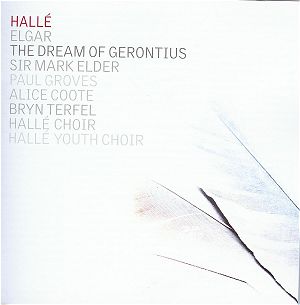
 Alice Coote
(mezzo) - The Angel; Paul Groves (tenor) – Gerontius; Bryn Terfel
(bass-baritone) - The Priest and The Angel of The Agony
Alice Coote
(mezzo) - The Angel; Paul Groves (tenor) – Gerontius; Bryn Terfel
(bass-baritone) - The Priest and The Angel of The Agony 
