|
Making
a Donation to MusicWeb
About MWI
Site
Map
More
Reviews
How to find a review
Book
Reviews
Film
Music Reviews
Nostalgia
Comment
Arthur Butterworth Writes
Phil
Scowcroft's Garlands
Classical
blogs
Reviewers
Logs
Announcements
Don't
Go Here!
Community
Bulletin Board
Web
Ring
Reviewers
Helpers
invited!
Resources
How
Did I Miss That?
British
Composers
British
Light Music Composers
Other
composers
Indexes
Label
Masterwork
Discographies
Composer
National
Themed
Review pages
Complete Books
Programme
Notes
External sites
British Music Society
The BBC Proms
Performers
Orchestra Sites
Recording Companies & Retailers
Online Music
Agents & Marketing
Publishers
Other links
Newsgroups
Web News sites etc
Editorial
Board
Classical Editor
Rob Barnett
Seen & Heard
Editor and Webmaster
Bill Kenny
MusicWeb Webmaster
Len Mullenger
Assistant Webmaster
David Barker
PotPourri
A
pot-pourri of articles
MW
Listening Room
MW
Office
Helping
MusicWeb
Advice
to Windows Vista users
Questionnaire
Site
History
What
they say about us
What
we say about us!
Where
to get help on the Internet
CD
orders By Special Request
Graphics
archive
Currency
Converter
Dictionary
Magazines
Newsfeed
Web Ring
Translation Service
Rules
for potential reviewers :-)
Do
Not Go Here!
April Fools
|

 |
 |
|
alternatively
CD: AmazonUK
AmazonUS
Download:
Classicsonline
|
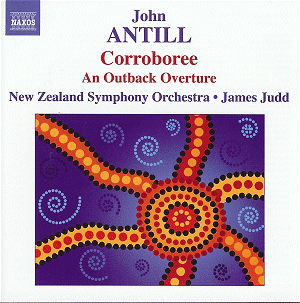
John ANTILL (1904–1986)
An Outback Overture (1954) [7:57]
Corroboree (1946) [41:09]
New Zealand
Symphony Orchestra/James Judd
rec. Michael Fowler Centre, Wellington, New Zealand, 8-10
June 2006
NAXOS
8.570241 [49:06]
|
|
|
John
Antill might well be one of these composers known for one
single work although in Antill’s case that work was generally
more widely discussed than actually heard. His ballet Corroboree -
the suite drawn from it - was once fairly well known thanks
to Sir Eugene Goossens’ recording. Many went as far as
proclaiming it the first truly Australian music and a landmark
in Australia’s musical history. All this may have more
than a grain of truth since Corroboree might well
have been the very first Australian work based on Aboriginal
music written down by the composer-to-be in 1913. It also
folds in a generous harvest from many musical trends of
his time. Stravinsky’s Rite of Spring often lurks
around the corner as well as jazz, which sometimes makes
for a rather curious mixture.
The opening section Welcome
Ceremony certainly brings Stravinsky’s ballet to mind
but is also redolent of the music of Revueltas (his formidable Sensemaya).
The whole suggests a sort of raw primitivism perfectly
attuned to its subject. This fairly long, percussion-led
and often ostinato-based section, may be one of the most
successful ones of the entire work. It is followed by five
considerably shorter episodes before the large-scale finale: Procession
of the Totems and Closing Ceremony. The first of the
aforementioned shorter pieces, Dance to the Evening
Star with prominent oboe and celesta parts (a shade
of Holst’s Venus here) is quite delicately scored. A
Rain Dance reverts to the primitive mood of the opening
section. It opens with an impatient gesture underpinned
by percussion. Brass add weight to the textures while the
dance proper unfolds alternating leisurely and more dynamic
episodes. The effect is spiced by the flute’s high-lying
screeches, the whole sustained by heavy ostinatos. The
ensuing Spirit of the Wind is – appropriately enough – a
fleeting scherzo again punctuated by brass and percussion.
The music swirls away into thin air. In Rising Sun,
the writing is once again strongly energetic and in complete
contrast with the next section The Morning Star which
is characterised by subtle percussion, harp, celesta and
woodwind. As already mentioned, the final section is by
far the longest of the whole work, but not necessarily
the most convincing. Procession of the Totems, that
might have usefully recalled the opening section, is at
times a bit too long. This long movement restates and reworks
material from the preceding sections. At first it builds
up to some big cathartic climaxes achieved by accumulation
rather than development of earlier motifs. In fact there
is more: after a loud tam-tam crash, the music starts all
over again with much brass and percussion, the latter being
at times left on its own in cadenza-like episodes. The
music apparently comes to a standstill over rattling percussion
which launches the final dance of the Closing Ceremony.
This ends in complete frenzy punctuated by the terrible
other-worldly sound of the bull-roarer. Terrific!
I
may at first have sounded a bit lukewarm; but, all in all,
Antill’s Corroboree is a fine score. It includes
some impressive scoring although it would be idle and – more
importantly – meaningless to compare it either to Stravinsky’s
innovative and ground-breaking Rite of Spring or
to Prokofiev’s decibel-loaded Scythian Suite. It
nevertheless deserves to be heard complete, especially
when played with as much commitment and obvious relish
as it is here. The New Zealanders do the Aussie proud.
There
is no reason to complain about their involvement in their
performance of Antill’s somewhat later An Outback Overture.
It is a rather run-of-the-mill concoction that does not
add much to the composer’s reputation. Pleasant enough
for the occasional hearing it lacks genial tunes of the
sort that make light overtures successful. Some have done
that much better.
Anyway,
the complete Corroboree is the work that makes this
none too generous disc worth acquiring both for those new
to the piece and for those who cherished their long-deleted
LP recording by Goossens. I had never heard either the
complete work or the suite so I was delighted to have such
a nice opportunity to do so. I wonder what are Antill’s other works
like? Well worth more than the occasional hearing.
Hubert
Culot
|
|
Advertising
Rates
Visitor
stats
MusicWeb
International
has over 25,000 Classical CD reviews on offer
Gerard
Hoffnung Concerts &
The
Bricklayer Story

New
Releases

New
Releases


MusicWeb
sells the Polish
catalogue CDAccord
£10.50 post free W-W

MusicWeb sells the
Arcodiva catalogue
£12.00 post free W-W

£11.50
post-free world-wide
Try
it and see - Sale or Return
MusicWeb
can now offer you discs from the following catalogues:
Prices include postage
MusicWeb
Recommended Recordings
DISCS OF THE YEAR 2008
Google Ads - for information about privacy matters, click here.
|