Editorial Board
MusicWeb International
Founding Editor Rob Barnett Editor in Chief
John Quinn Contributing Editor Ralph Moore Webmaster
David Barker Postmaster
Jonathan Woolf MusicWeb Founder Len Mullenger
Sir
Arthur SULLIVAN (1842–1900) and Sir
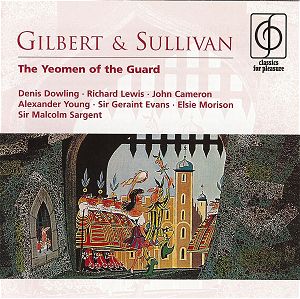
William S. GILBERT (1836–1911) The Yeomen of the Guard (1888) [93.28] Sir
Richard Cholmondeley – Denis Dowling (baritone)
Colonel Fairfax – Richard Lewis (tenor)
Sergeant Merryll – John Cameron (baritone)
Leonard Merryll – Alexander Young (tenor)
Jack Point – Sir Geraint Evans (baritone)
Wilfred Shadbolt – Owen Brannigan (bass)
First Yeoman – Alexander Young (tenor)
Second Yeoman – John Carol Case (baritone)
Elsie Maynard – Elsie Morison (soprano)
Phoebe Meryll – Marjorie Thomas (contralto)
Dame Carruthers – Monica Sinclair (contralto)
Kate – Doreen Hume (soprano)
Glyndebourne Festival Chorus
Pro Arte Orchestra/Sir Malcolm Sargent
rec. No. 1 Studio, Abbey Road, London, 10-14 December
1957 CLASSICS
FOR PLEASURE 2134652 [55.49 + 37.39]
It
was from this recording that I learned The Yeomen
of the Guardin the 1970s. Then I enjoyed
its strong musical values and distinguished cast and
all the roles were sung by fine operatic voices. Returning
to it after a considerable gap I am still impressed with
the credentials of the cast. From Richard Lewis as Colonel
Fairfax down to Alexander Young as Leonard Merryll and
the First Yeoman it is indeed a mouth-watering cast.
The
conductor, Malcolm Sargent, had a distinguished history
as a conductor of Gilbert and Sullivan, having worked
with the D’Oyly Carte Opera in the 1920s. He also recorded
some of the operas with them at this time. He returned
to the Savoy Operas in the 1950s when he recorded nine
of them for EMI, all with singers from opera and oratorio
rather than the D’Oyly Carte. Sargent also recorded Yeomen
of the Guard and Princess Ida in the 1960s
again with D’Oyly Carte for Decca, with Elizabeth Harwood
in the soprano parts.
Yeomen
of the Guard was the most
serious of the librettos which Gilbert produced for
Sullivan; not that the operetta is really serious.
However it lacks most of the topsy-turvy elements that
crop up in the other operettas. Some familiar aspects
are present: what with mistaken-identity, falsifying
a death and the usual elderly contralto desperate to
marry. That said, Gilbert embeds them in a more earnest
world; even his jester is a sad clown and the whole
piece has a less farcical feel.
Colonel
Fairfax is an almost entirely serious character so he
makes a good foil for Richard Lewis who plays him completely
straight and embeds Fairfax’s upright character in his
mellifluous tones. Lewis also demonstrates the advantage
of having a cast of this vintage; he, like all the cast,
sing with superb diction.
Jack
Point is a role which I always associated with Derek
Hammond Stroud, who had the most wonderful ability to
be sad and funny at the same time. He brought out the
innate pathos of the character. Sir Geraint Evans does
not quite do that but he is pretty impressive and charming.
He and Elsie Morrison as Elsie Maynard make their opening
number, I have a song to sing, profoundly moving.
Neither
Lewis nor Evans, however, sound as if they are really
in a dramatic production of the operetta. This is the
set’s biggest drawback: the individual numbers, lovely
as they are, do not always add up to a complete dramatic
performance. Much of this surely can be laid at Sargent’s
door, which is surprising given his history with Gilbert
and Sullivan. Evans, though, makes neat work of the
patter numbers which are allocated to Point.
Elsie
Morrison has an attractive, soubrettish voice with a
noticeable vibrato. She sings neatly enough and with
a degree of personality but you feel that ultimately
she lacks the element of steel which is required of a
G&S heroine. Elsie Maynard is more than a shrinking
violet, she has backbone, but Elsie Morrison does not
completely bring this off. Also, I felt at times that
she struggled a bit to make herself heard, which on the
face of it would seem unlikely given Sullivan’s careful
orchestration and could perhaps be attributable to the
recording.
Marjorie
Thomas as the second female lead, Phoebe, has an attractive
soft-grained contralto voice which contrasts suitably
with the strong contralto of Monica Sinclair in the role
of Dame Carruthers. Unfortunately Thomas seems to be
content to coast along, singing nicely but not doing
much else. Perhaps the lack of dialogue hampered her
but her Phoebe seems to entirely miss the sharp, minx-ish
element which is so essential to the character. It is
this quality which provides strong contrast with her
putative fiancé Wilfred Shadbolt.
Shadbolt
is played by Owen Brannigan and he proves immensely effective
at making each little vocal gesture tell. Maybe on the
stage Brannigan’s Shadbolt would seem a trifle over-done,
but here in a performance struggling to create drama,
Brannigan’s characterful performance stands out.
Monica
Sinclair provides a strongly musical Dame Carruthers.
She gets two striking numbers to sing but generally the
character is under-written, so Sinclair compensates with
her familiar distinctive contralto voice. John Cameron
makes a strong Sergeant Merryll who gets his moment in
the spotlight with his grumpy duet with Sinclair’s Dame
Carruthers.
At
times the Glyndebourne Festival Chorus sound untidy.
Their performance is adequate and sometimes creditable
but you can find better choral performances on other
discs. The Pro Arte Orchestra, under Sargent’s direction,
accompany neatly and crisply.
Undoubtedly
this performance has been overtaken by other recordings.
Sargent’s 1964 recording with the D’Oyly Carte - with
Elizabeth Harwood as Elsie - is notable for its sense
of drama and pacing, though Charles Mackerras’s account
with WNO is notable and provides a recording with modern
sound. For those wanting dialogue, it is worth hunting
out the Academy of St. Martin in the Fields account.
But
this is a disc that I would still want on my shelves,
even though it has drawbacks. Its charm is its strongly
operatic cast who provide superb diction, high musical
values and a wonderful opportunity to hear some fine
English singers letting their hair down a little.
Robert Hugill
Please support our advertisers below by clicking on the logos for further information.

























 Sir
Richard Cholmondeley – Denis Dowling (baritone)
Sir
Richard Cholmondeley – Denis Dowling (baritone) 
