The Spanish pianist Miguel Baselga - actually born in Luxembourg,
though his family is Aragonese - has rightly attracted a good
deal of praise for his recordings of de Falla (see review)
and Albeniz (see sample review).
Here he turns his attention to a well chosen and well organised
sequence of piano waltzes though not all of them started out as
works for the piano. He plays with the same vigour and delicacy
that he brought to his recordings of those two Spanish masters.
Liadov’s familiar
Snuffbox glints and tinkles with attractive freshness,
the score’s instruction that it be played ‘automaticamente’
not precluding some rhythmic subtleties from Baselga. For all
that, a sense of dazzling artifice is created, which serves
as a kind of point of reference for everything that follows.
The Concert Arabesque on Themes from ‘On the Beautiful Blue
Danube’ introduces Strausses into the proceedings – at least
Johan Strauss as richly encased in elaborate figurations – more
like a Fabergé egg than a snuffbox – by Andrei Schultz-Evler.
I remember Jonathan Woolf, in the course of discussing
the famous recordings by Joseph Lhevinne, describing this Concert
Arabesque as “ridiculous but intoxicating”. Precisely! And
Baselga does something like full justice to both those elements.
After such absurdly
jewelled encrustations, there is a delightful naturalness in
both the music and the performance of Brahms’ Op. 39 No.15 waltz,
utterly inviting, played with a very even touch and elegant
legato at its close. The pendulum swings back towards the gilding
of lilies with Friedman’s charming - and yet more than slightly
irritating! - version of Frühlingsstimmen. For all the
unforced panache with which it is played there is - to borrow
the CD’s café metaphor - so much cream in the cake that it is
hard to eat it all at one sitting! Liszt’s pastiches of two
of Schubert’s waltzes are rather easier to digest – and constitute
much healthier musical food. Baselga’s playing here has a real
elegance and technical ease which are a joy to hear, the rhythms
irresistibly dancing. In Debussy’s La plus que lente the
shifts of tone and colour are exquisite, Baselga’s playing eloquently
bringing out the ‘distancing’ of Debussy’s treatment of the
waltz, written at a point of removal, both geographically and
historically, from this quintessentially Viennese form. Debussy’s
parody tiptoes the boundary lines between affection and mockery,
sentiment and sentimentality, a balancing act well articulated
by Baselga. In La Valse - played here in Baselga’s own
arrangement - Ravel uses the dance form as means to social comment
and personal reaction to the first World War and its destruction
of old familiarities. The crowded ballroom evoked at the beginning
of the piece, full of social artifice, is finally propelled
to quasi-apocalyptic destruction. Good as Baselga’s work is
here, it has to be admitted that La Valse makes yet more
impact in its original orchestral form. Still, what might have
been a mere anthology is far more, as Baselga’s programme begins
with a music box and ends - at least metaphorically - in explosions.
The waltz as symbol of social attitudes and assumptions is at
least as important here as the waltz understood purely as a
musical form. Baselga’s programme planning is as intelligent
as his work at the keyboard.
The CD’s title alludes
to café life, and Richard Llorca in the booklet notes suggests
that “Miguel Baselga transports us to [a] world so typical of
the nineteenth century … of the waltzes; of the cafés and of those
long afternoons sitting at a marble table listening to piano music;
or while having an informal gathering and savouring an endless
cup of coffee or a cup of orujo (liquor distilled from grape refuse)”.
Maybe - I can’t speak for the pleasures, or otherwise, of orujo
- but I suspect that few, if any, cafés ever boasted a pianist
as subtle and accomplished as Miguel Baselga. His reading of this
music, his ability to give meaning even to the pieces which are
really rather slight - but not to claim excessive meaning for
them - is compelling. It is certainly best appreciated without
the distraction of rattling coffee (or orujo) cups or the buzz
of conversation. It deserves no less than one’s full attention
– and rewards it amply.
Glyn Pursglove
























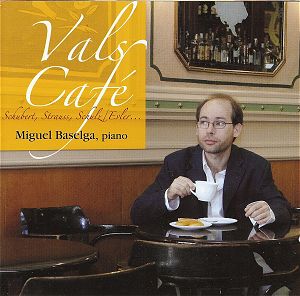

 Miguel Baselga
(piano)
Miguel Baselga
(piano) 
