Following their
disc of Symphonies 2 and 4, Dausgaard
and the Swedish Chamber Orchestra
now offer Schumann’s First
Symphony with four of his rather
less familiar works. The growing
number of chamber orchestra recordings
of Schumann’s orchestral works represents
a laudable trend. The heavy, monumental
manner of performing Schumann, now
regarded as old-fashioned, often
amounts to a disservice to this
composer and especially to his much-discussed
orchestration. Certainly a very
welcome transparency is more likely
to be achieved with a smaller string
group. Harnoncourt (COE, Teldec),
has affectionately brought out the
warm, lyrical qualities of this
music within a lighter orchestral
texture.
Dausgaard has an
excellent chamber orchestra at his
disposal, allowing him more easily
to achieve transparency, yet his
general approach could not be described
as intimate. On the contrary, the
Spring Symphony here receives
a virile performance of strong,
fiery accents and considerable weight.
Indeed, I find a little too much
aggression and sometimes over-emphasis,
for example in the opening movement.
Suggestions of this tendency are
found at certain points in the introduction,
as the horns and timpani are allowed
undue prominence – without any essential
musical reason. Admittedly, Schumann
quite often marks sforzando
here, but Dausgaard interprets these
rather fiercely and heavy-handedly.
Here and throughout the symphony
the horns and brass err on the Wagnerian
side, so that we sadly lose sight
of the early-Romantic spirit.
On the subject
of string sound, I feel that judicious,
rather than unvarying, use of vibrato
is very desirable, but here it is
altogether too sparing – sometimes
perversely banished at moments which
cry out for expressive warmth. Bare
string sound does not lie comfortably
with Schumann’s ardently expressive
music. Again, at the Allegro
molto vivace - surely the molto
applies to the vivace, not
the allegro? - this performance
feels rather driven. Forcefulness
and bluster are substituted for
warmth. The effect is exhilarating
in its own way, but nevertheless
I feel it projects too much machismo.
Essentially this music is, I would
suggest, friendly and genial. Those
who disagree, feeling a highly strung
impulse behind this music, may find
Dausgaard more to their taste. However,
even these listeners may find undesirable
the squeeze-box effect where Schumann
marks forte-pianos and expressive
accents in the coda.
In the slow movement
the forte-piano markings
in the first few bars surely need
to be tenderly expressive, whereas
Dausgaard treats them quite heavily
– almost disruptively. Some listeners
will perhaps feel this as Dausgaard’s
response to a perceived element
of pain in this lyrical outpouring.
A quick comparison with Harnoncourt
reveals more obvious affection -
expressive emphasis rather than
bumps.
Dausgaard’s scherzo
is incisive and robust, not in the
least sluggish, but the principal
theme would have benefited from
more feeling of tension then release.
More problematic is the second trio,
strangely lumbering and unconvincing.
Significantly,
Schumann includes the word grazioso
in the finale’s tempo indication,
and this is surely a vital quality
– at least in the violin melody
following the initial flourish.
Dausgaard is reasonably successful
here. One of the most original passages
in any of Schumann’s symphonies
is the cadenza for horns and flute,
precursor of so much nature-music
in Mahler and others. Here Dausgaard
is a little under-characterised
and unimaginative. Overall, Dausgaard
fails to compete with Sawallisch,
Harnoncourt, Bernstein and other
great Schumann interpreters.
The Overture,
Scherzo and Finale is a work
of tremendous buoyancy and charm,
but again Dausgaard’s tendency to
overdo accents robs the music of
some of its natural character. However,
his tempo for the central movement
– which may initially seem slow
- works rather well. It would work
even better were it not for a certain
stiffness of manner. In Genoveva
there is the same tendency to treat
expressive emphasis or nuance a
little too ruggedly.
It is good to have
the late, rarely played overture
based on Schiller’s tragedy
The Bride of Messina, a work
of character and atmosphere but
rather unmemorable material. Even
more of a collector’s piece, and
of little more than curiosity value,
is the youthful Zwickau symphonic
movement.
In general I am
unconvinced that Dausgaard is a
natural Schumann conductor, but
many eminent conductors have found
this composer’s blend of qualities
elusive. Hans Gál, in his
BBC Music Guide to Schumann’s
Symphonies, finds the style "not
easy to describe", but nevertheless
puts his finger on some important
points – "exuberance is certainly
a most essential component …"
- "his soul is in every expressive
phrase he shapes, and the instrument
has to sing it in order to do it
justice" - "sophisticated
rhythmical and harmonic structure
… demands a subtlety of shading".
The recording quality
of this generously filled disc is
as fine as one would expect from
BIS.
Philip Borg-Wheeler
























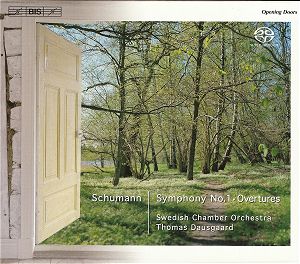

 Swedish Chamber Orchestra/Thomas Dausgaard
 BIS-SACD-1569
[77:36]
BIS-SACD-1569
[77:36] 
