Editorial Board
MusicWeb International
Founding Editor Rob Barnett Editor in Chief
John Quinn Contributing Editor Ralph Moore Webmaster
David Barker Postmaster
Jonathan Woolf MusicWeb Founder Len Mullenger
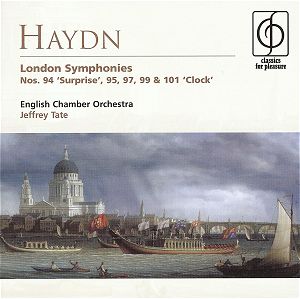
Joseph HAYDN (1732-1809) CD 1
Symphony No. 94 in G, “Surprise” (1791) [24:04]
Symphony No. 95 in C minor (1791) [20:46]
Symphony No. 97 in C (1792) [25:15] CD 2
Symphony No. 99 in E flat (1794) [26:57]
Symphony No. 101 in D, “Clock” (1794) [29:38] English Chamber Orchestra/Jeffrey
Tate
rec. Abbey Road Studio No. 1, London, England, February 1991 (CD1); May 1988
(CD2). DDD. CLASSICS
FOR PLEASURE 5218552 [70:54 + 57:02]
During the time
when the historically-informed period instrument scholars
and performers were revolutionizing the modern performing
practices of baroque and classical music, one conductor made
a name for himself. He did this without ever completely abandoning
a more old-fashioned style. That conductor was Jeffrey Tate,
and his work remains compelling because the passage of years
proves that Tate’s style wasn’t merely a reactionary retreat
from the coming wave. It was nothing more and nothing less
than the personal vision of a musician who aimed to combine
courtly elegance with a thoughtful understanding of where
the music is going. As such, this Classics For Pleasure reissue
of five of Haydn’s London Symphonies is very much
of a piece with Tate’s other recordings: Conservative, but
lucidly alert.
Tate’s unhurried
but never stolid or stiff way through the Surprise Symphony is
uncommonly elegant. Compared to Georg Szell, Tate is more
flexible, more smiling. Compared to Sir Colin Davis, Tate
is lighter, more gleaming. Whereas Szell or Adam Fischer
punch the surprise to a greater extreme in the slow movement,
Tate makes his impact more fastidiously, making sure that
the orchestra plays together, something not always heard
on this famous chord: listen to the otherwise fine Antal
Dorati recording to hear the bassoon beat everyone else to
the chord by a fraction of a second. The “Menuetto” of the Surprise
Symphony is revealing of Tate’s way. Dorati roughs it
up a little to emphasize its peasant, ländler-like qualities.
Davis fusses over its phrasing, and Szell plays it fast and
clipped, like a Beethovenian scherzo. Tate is dapper as ever.
He concentrates on the flow of the musical logic more naturally
integrating the staccato upbeat notes that stick out in the
Davis recording because of the somewhat heavy-handed tempo.
For overall elegance,
I found myself digging all the way back to the 1929 recording
Jascha Horenstein made of the work with the Berlin Philharmonic.
But Tate trumps that version, too, thanks to a greater certainty
on how to pace the slow sections. Horenstein, perhaps under
the influence of Furtwängler in those days, paces the “Andante” more
like an “Adagio”. Elsewhere, Horenstein’s natural classicism
and clarity makes his rendition hold its age well in every
way except recorded sound, which cannot, of course, compare
to Tate’s modern digital sound. For a compromise between
Szell’s thrust and Tate’s joyfulness, I would recommend the
live Marlboro Festival recording from the early 1970s led
by Pablo Casals except that its original coupling was a punchy
and overwrought Symphony No. 95. It’s hard to find,
anyway.
In Symphony
No. 95, Szell makes more of the way the work foreshadows
Beethoven. One hardly misses that element in Tate’s performance,
except possibly in the “Menuetto,” where Szell’s spicy
handling of the folk-music element gives the mischievous
dance an almost Hungarian dash. Tate’s elegance is similar
to the gleaming clarity of the RCA recording Fritz Reiner
made with a studio orchestra in the early 1960s, though
Tate has a touch more sparkle. Dorati is at his least persuasive
in this symphony and doesn’t enter into competition.
Likewise, in Symphony
No. 97, Szell leans toward grandeur in the first three
movements, only letting an operatic sense of humor and
adventure come into the “Finale.” Tate is more equable
throughout, finding more bustling good nature in the first
movement, and finding much more grace in the slow movement.
Tate’s “Menuetto” is lighter on its feet, and his finale
is witty, if not as boisterous as Szell’s. Incidentally,
aside from the familiar late-1960s Szell recording available
on Sony’s Essential Classics, the label’s wonderful but
egregiously short-lived Masterworks Heritage series gave
the first CD release to a feistier 1957 stereo recording
by Szell and the Clevelanders. The sound is a little close-up,
but the performance was not matched in the later remake.
The first movement is more focused, and the middle movements
flow better than in the later recording, while the finale
is even faster, with devilish high spirits. Either way,
Tate’s recording is a distinct alternative.
Tate and Szell
interestingly diverge in unexpected ways in Symphony No.
99. Here, Tate is more operatic and mischievous in the
first movement, but then unexpectedly broad and serious in
the “Adagio,” which Szell flows through. Tate is lighter
in the third movement, but similarly precise in the tricky “Finale.” Possibly
the finest of Dorati’s recordings of later symphonies is
his Symphony No. 99, as it combines more vigor than
either Szell or Tate. But for the “ultimate” first movement
of this work, make sure to investigate the blazing mono recording
Hermann Scherchen made with the Vienna State Opera Orchestra
for Westminster in the mid-1950s. Beecham is dapper in this
work, but Tate matches much of the old master’s flair, while
giving us a considerably more limber flexibility.
My favorite modern-instruments
version of the Clock Symphony is Leonard Bernstein’s
recording with the New York Philharmonic, a high-spirited
affair which balances personality with an elegance not always
associated with that conductor. Tate isn’t far off in his
sparkling version, and both are considerably ahead of the
sluggish Dorati and the ponderous Beecham.
Despite a first
impression of excessive politeness in these recordings, repeated
listening has revealed the subtle delights of Tate’s renditions.
Direct comparisons with admired masters such as Szell, Beecham,
Davis and Dorati reveals Tate showing them up more often
than one might suspect. Indeed, one could say that Tate took
those conductors’ traditional approach but lightened and
clarified it. In the end, I can’t describe these recordings
as anything less than first-class, and one hopes EMI will
bring out the rest of Tate’s London Symphonies in
this super-bargain series, because anyone who loves Haydn
will want these charming, masterful renditions.
Mark Sebastian Jordan
Please support our advertisers below by clicking on the logos for further information.

























 English Chamber Orchestra/Jeffrey
Tate
English Chamber Orchestra/Jeffrey
Tate 
