|
Making
a Donation to MusicWeb
About MWI
Site
Map
More
Reviews
How to find a review
Books
Film
Music
Nostalgia
Records Of The Year
Recommendations
Comment
Arthur Butterworth Writes
Phil
Scowcroft's Garlands
Classical
blogs
Reviewers
Logs
Announcements
Don't
Go Here!
Community
Bulletin Board
Web
Ring
Reviewers
Helpers
invited!
Resources
How
Did I Miss That?
British
Composers
British
Light Music Composers
Other
composers
Indexes
Label
Masterwork
Discographies
Composer
National
Themed
Review pages
Complete Books
Programme
Notes
External sites
British Music Society
The BBC Proms
Performers
Orchestra Sites
Recording Companies & Retailers
Online Music
Agents & Marketing
Publishers
Other links
Newsgroups
Web News sites etc
Editorial
Board
Classical Editor
Rob Barnett
Seen & Heard
Editor and Webmaster
Bill Kenny
MusicWeb Webmaster
Len Mullenger
Assistant Webmaster
David Barker
PotPourri
A
pot-pourri of articles
MW
Listening Room
MW
Office
Helping
MusicWeb
Advice
to Windows Vista users
Questionnaire
Site
History
What
they say about us
What
we say about us!
Where
to get help on the Internet
CD
orders By Special Request
Graphics
archive
Currency
Converter
Dictionary
Magazines
Newsfeed
Web Ring
Translation Service
Rules
for potential reviewers :-)
Do
Not Go Here!
April Fools
|

 |
 |
|
alternatively
CD:
AmazonUK
AmazonUS
Download: Classicsonline
|
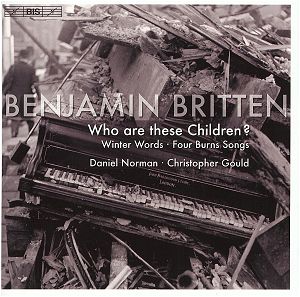
Benjamin
BRITTEN (1913-1976)
Winter Words Op.52 (1953) [22:39]
Four Burns Songs (1975) [8:32]
Who are these Children? Op.84 (1969) [22:44]
If it’s ever Spring Again (1953) [2:40]
Dawtie’s Devotion (1969) [1:17]
The Gully (1969) [0:53]
The Children and Sir Nameless (1953) [2:42]
Tradition (1969) [0:53]
Ca’ the Yowes (from Folk Song Arrangements, Vol.5)
[4:08]
Daniel
Norman (tenor)
Christopher Gould (piano)
rec. August 2005. Potton Hall, Suffolk, England
BIS
BIS-CD-1510 [68:11]  |
|
|
I
was first introduced to Benjamin Britten’s Winter
Words by way of an old Decca Eclipse recording with
Peter Pears and the composer. This has become my touchstone
for any subsequent recording or performance. The work
was written for Pears in 1953 and the vocal line tends
to reflect that singer’s unique style. Perhaps Pears’ interpretation
would be regarded as an anachronism nowadays – certainly
his voice can sometimes sound contrived and perhaps even
a little strained. However, he was instrumental in performing
many of Britten’s finest works; he defined a large number
of operatic roles and also interpreted a wide variety
of English songs. Of his recordings Schubert’s Winterreise is
masterly. And, for the record, I listened again to Pears
singing Winter Words and Who are these Children? as
part of my preparation for writing this review.
So
Pears defined Winter Words. Other singers, including
Ian Partridge and Anthony Rolfe Johnson have made these
songs their own. Surprisingly, there have been comparatively
few recordings of what is probably one of the masterworks
of vocal music written in the twentieth century.
And
now we come to Daniel Norman. I am baffled. I am not
convinced by his interpretation of this work. Another
reviewer has noted that “I have never before heard a
tenor who could offer such a rich palette of colours,
and who also has the ability to employ them with such
alacrity.” And I guess it is this ‘rich palette’ which
I feel he overdoes – not only in Winter Words
but in most of the rest of the repertoire on this disc.
The only comparison I can think of is that of over-registering
a piece of organ music - constantly changing the stop
simply because there are so many of them. Some of Norman’s
interpretations I really do warm to – for example the The
Little Old Table and even the Wagtail and Baby.
However I feel that the most important song in this cycle
and perhaps one of the greatest songs ever composed is
less successful. It just seems to lack the depth that
Hardy’s text demands. Before and After Life does
not move me as Pears’s version does.
The Four
Burns Songs derive from A Birthday Hansel which
was composed specifically to celebrate Queen Elizabeth,
the Queen’s Mother’s 75th birthday. This work was scored
for voice and harp. It contained some seven - not six
as the programme notes indicate - songs. At the composer’s
request Colin Matthews made an arrangement for tenor
and piano of the four songs presented here. They are
truly lovely pieces and at least the tenor does not
overdo the effects for effect’s sake. Nor does he
feel a need to introduce a faux-Scots accent. These
are my favourite performances on this CD.
I
do not like Who are these Children? I understand
that they are written from a socialist and a pacifist
standpoint and that hardly represents my political take
on life. However, I have long admired the writing of
William Soutar and like most listeners I can shrive my
conscience of preconceptions so as to be able to listen
to a musical work of art. Soutar served in the Royal
Navy during the Great War so he has personal experience
of much that he condemns in his writings. But no matter
how hard I try, I cannot get my head round this work.
Perhaps it is the fact that the cycle has some thirteen
songs or bits of song? Maybe it appears a bit disjointed?
Or could it be that the Scottish accent grates on me
- I am a Scot. I do not know. Taken individually I appreciate
the poems - even those that are explicitly violent.
To
be fair to Britten, he has made a wise choice of texts.
Only four of them are truly morbid in their ‘ever so
true’ analysis of man’s inhumanity to man. The other
poems are ‘lyrics, rhymes and riddles’ that explore a
number of issues and evoke a variety of moods. Somehow
I find this song-cycle hard work to listen to. Daniel
Norman’s singing does not make it any easier for me – especially
his Scots accent. I must confess that I do not know how
this cycle can be performed convincingly by any singer:
the depth of the poems demands more than a contrived
Harry Lauder patois.
This
CD is interesting in one key respect. The additional
numbers which form appendices to Winter Words and Who
are These Children? are included. The songs were
published in the latest scores of these cycles with the
strict instruction that they are not to be given as an
integral part of the work. This admonition is held to
by Norman and Gould: the songs are presented after the
three main works. In fact they are even mixed up!
It
is the first time that I have heard these works and my
first reaction is to be quite glad that they are not
included in the ‘official’ batting order of the song-cycles.
This is especially so with ‘If it’s ever spring again’ and The
Children and Sir Nameless. I truly believe that they
would upset the balance of the work. Yet this not to
deny their importance. Both songs are settings of ‘typical’ Thomas
Hardy texts. Both are fine songs in their own right and
well deserve their place in the canon of English song.
The
Soutar additional poems could well have been incorporated
into the song-cycle –except for the fact that it would
have made it over-long and complex.
I
worry a little about the balance of this CD. When the
music is relatively quiet the piano sometimes seems almost
to drown out the soloist. Yet in the louder passages
I found myself having to turn down the volume.
All
in all this is a ‘mixed’ CD. It will never become my
preferred choice for Winter Words – that will
remain Peter Pears with all his faults! I guess that
it is Pears’ ‘intimacy’ that wins out in the end. However,
the Burns Songs are masterly and the additional
songs are welcome ‘for the record.’
And
finally, I do wonder why BIS chose to record Ca’ the
Yowes. This arrangement was made in 1951 and was
published as part of ‘Folk Song Arrangements Volume 5
British Isles’ in 1961. Perhaps they felt it was a nice
way to round off a disc of music which had a large Scottish
element. Whatever the reason it is a lovely way to conclude
this CD – and as an encore it would bring the house down
(and ne’er a dry e’en) in any recital given by Messrs
Norman and Gould!
John France
|
|
Advertising
Rates
Visitor
stats
MusicWeb
International
has over 25,000 Classical CD reviews on offer
Gerard
Hoffnung Concerts &
The
Bricklayer Story

New
Releases

New
Releases


MusicWeb
sells the Polish
catalogue CDAccord
£10.50 post free W-W

MusicWeb sells the
Arcodiva catalogue
£12.00 post free W-W

£11.50
post-free world-wide
Try
it and see - Sale or Return
MusicWeb
can now offer you discs from the following catalogues:
Prices include postage
Musicweb
Special
Offers
Google Ads - for information about privacy matters, click here.
|