Editorial Board
MusicWeb International
Founding Editor Rob Barnett Editor in Chief
John Quinn Contributing Editor Ralph Moore Webmaster
David Barker Postmaster
Jonathan Woolf MusicWeb Founder Len Mullenger
Charles
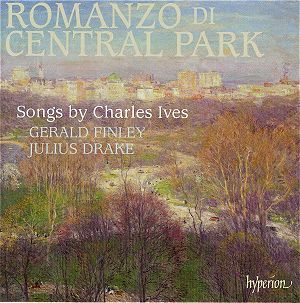
IVES (1874-1954) Romanzo di Central Park On the Counter (1920) [1:28] The Circus Band (1894) [2:13] Two Little Flowers (and dedicated to them) (1921)
[1:21] Ilmenau (1901/2) [2:12] A Night Song (1895) [1:19] Down East (1919) [3:07] Premonitions (1921) [1:50] The See’r (1920) [1:01] Songs my mother taught me (1895) [2:25] In the Alley (1896) [1:58] Mists (1910) [1:38] They are There! (1917, rev. 1942)* [2:53] In Flanders Fields (1917, rev. 1919) [2:58] The South Wind (1899, rev. 1908) [2:41] My Native Land (1895) [1:41] Watchman! (1913) [1:43] The Children’s Hour (1901) [2:28] Evidence (c1898, rev. 1910) [1:19] The World’s Wanderers (1895) [1:43] Slow March (1887/8) [1:50] Omens and Oracles (c1900) [2:52] Those Evening Bells (1903, rev. 1907) [1:53] Allegro (1900) [1:20] Evening (1921) [1:59] The Last Reader (1921) [1:39] To Edith (1919) [1:27] At the River (1916) [2:29] A Christmas Carol (1894) [2:07] The Light that is Felt (1904) [2:11] Romanzo (di Central Park) (1900)* [2:58] Gerald Finley
(baritone), Julius Drake (piano)
*Magnus Johnston (violin)
rec. 16-20 February 2007, venue not given. Song texts provided HYPERION CDA67644 [62:28]
Charles
Edward Ives was something of a musical magpie, bringing back
to his nest scraps of hymn tunes, patriotic songs, sentimental
ballads and parade marches. The result is usually startling
but always fascinating, not least in his symphonies. The Fourth in
particular is a ‘true original’, a polyrhythmic riot of colliding
tunes and influences. Of course this Puckish streak, tempered
with a degree of seriousness, is present in the songs as
well. Some are deceptively simple, almost fragments, others
more ambitious in their structure and wide-ranging in their
sources. All display that unique cast of mind we call Ivesian.
The
Canadian baritone Gerald Finley’s first disc of Ives songs
(Hyperion CDA67516) has been very well received and with
the able and sympathetic support of accompanist Julius Drake
his two collections are bound to become benchmarks in this
repertoire. As for the recording – on this disc at least – the
music has a natural bloom and glow that brings out both the
felicities of Ives’s writing and the many subtleties of Finley’s
many-hued voice.
Of the early songs The Circus Band
is Ives at his catchy, quick-stepping
best, Finley alive to its mood of
boyhood excitement. Already Ives is
being more daring in his harmonies
and stretching the singer’s expressive
range – at times it almost becomes
a shout. By contrast A Night Song,
one of Ives’s ‘sentimental ballads’,
finds the composer in mellifluous
Schubertian mode, Finley sounding
wonderfully rich and velvety in the
quiet lower passages.
In
the Alley is a charming ‘street song’, the instrumental prelude capturing the
slight clanginess of a much-used parlour piano. Finley’s
diction and phrasing are a joy to hear, his changes of
mood finely calibrated without ever seeming calculated.
As if that weren’t enough he is able to sing with aching
inwardness in The South Wind, originally a Heine
setting reset to words by Ives’s soon-to-be wife, Harmony
Twichell. This collection has several of her settings which,
as poetry, aren’t particularly distinguished. That said,
it’s the composer’s musical response that brings these
texts to life.
Ives
the compulsive eclectic didn’t turn his back on Heine, setting
a translation of his poem My Native Land. Despite
its title it’s not so much a patriotic song as a dreamy reflection
of nature as a comfort and refuge. Here Heine’s European
landscape is suffused with a completely different light,
the piano part a perfect synthesis of simplicity and sentiment.
Ditto in Evidence, which although dated 1910 was originally
an 1898 setting of a poem by Klaus Groth; Ives simply substituted
his own text, a hymn to his native landscape.
Speaking
of hymns, The Christmas Carol has the simple devotional
style that permeates so many of his works. But there is a
subversive clash at 1:36, quite at odds with this gentle
lullaby. The same goes for his setting of Shelley’s The
World’s Wanderers; herethe outwardly simple piano
writing hints at more unconventional harmonies, with a recurring
dissonance.
Thus
far Ives’s piano writing isn’t mould-breaking but change
is in the air. What doesn’t change is the composer’s remarkable
economy of style, no melody wasted, no harmonies outstaying
their welcome. Julius Drake’s playing is similarly concentrated,
ranging from quiet reflection and nostalgia to the more febrile
outbursts of Omens and Oracles. There Ives makes extra
demands on the singer as well, but Finley has the vocal dexterity
to match. Whether inward or ardent, his range and consistency
of tone are just inspirational. Full marks to the Hyperion
team for capturing it all so faithfully.
Of
course nostalgia is an integral part of Ives’s musical persona,
as we hear in On the Counter. Set to his own text
this song speaks of ’The same old chords, the same old time,
the same old sentimental sound’. There is a similar rosy
glow to Songs My Mother Taught Me, which Finley infuses
with just the right amount of feeling. As always he judges
the mood of these songs very well; in fact, I can’t think
of one item on this disc where he puts a foot wrong
Drake
is also a model of intelligence and sensitivity throughout,
producing some of the most beguiling piano sounds I’ve heard
in ages. In pieces such as Those Evening Bells, To Edith, At
the River, Mists and The Light that is Felt the
piano parts may be pared down, yet they remain highly evocative.
It really is a case of less is more, with the pianist alive
to every nuance of this music. Vocally these five songs call
for more sustained, quiet singing, which Finley carries off
with his usual aplomb. The close of Mists is particularly
magical, fading to silence.
They
are There! dates from 1917
and also exists in a version for orchestra and chorus;
the latter is a real blockbuster, full of fire and unbridled
energy. Drake and Finley capture much of that here, with
Magnus Johnston adding extra colour on the violin. That
final wisp of violin melody sounds remarkably like an echo
or distant bugle, a lovely touch. This is Ives in marching
band mode, and his wartime pieces call on this part of
his musical heritage. The restless, edgy prelude to In
Flanders Fields and the repeated, more extreme dissonances
show Ives in a much more experimental mode. Indeed, the
song’s communicative strength is so clearly derived from
its darker, more uncompromising harmonies.
Watchman!,
Down East, Premonitions and Evening – the
latter a setting of Milton, no less– all have that
trademark harmonic ambiguity. Although less brooding and
intense than InFlanders Fields, the music
acts as a perfect foil to the more conventionally lyrical
and sustained vocal line. Harmonically, Premonitions is
the most complex of this group, with powerful dissonances
and more angular vocals. And what of the strange swoops
and moans of ‘The old man with a straw in his mouth’ in The
See’r? This affectionate thumbnail of small-town quirkiness
ends as abruptly as it began.
The best is left until last, the delectable
Romanzo (di Central Park).
Set to A Love Song by Leigh
Hunt – a series of quatrains, each
line just one word long – it encapsulates
everything that is so admirable about
this disc. Musically and vocally it
belongs to the world of Ives’s early
songs, and with Johnston’s silvery
violin adding to the accompaniment
it burns with a steady, warming light..
All
credit to Hyperion for producing such a glorious disc. It
would be hard to imagine a more sympathetic pairing in this
repertoire than Finley and Drake; such commitment and unfailing
musicality are rare indeed. No surprise, then, that this
is a disc to treasure.
Dan
Morgan
Please support our advertisers below by clicking on the logos for further information.

























 Gerald Finley
(baritone), Julius Drake (piano)
Gerald Finley
(baritone), Julius Drake (piano) 
