MusicWeb is not a subscription site and it is these advertisers that pay for it. Please visit their sites regularly to see if anything might interest you. Purchasing from them keeps MusicWeb free.

Classical Editor: Rob Barnett                               Founder Len Mullenger


CD REVIEW

Site Map

More Reviews

How to find a review

Classical CD Review Archive

Book Reviews

Film Music Reviews

Jazz CD Reviews

Nostalgia

Comment

Norman Lebrecht Weekly

Arthur Butterworth Writes

Phil Scowcroft's Garlands

Classical blogs

Reviewers Logs

Announcements

Don't Go Here!

Community

Bulletin Board

Web Ring

Reviewers

Helpers invited!

Resources

Quiz

British Composers

British Light Music Composers

Other composers

Indexes
   Label
   Masterwork

Discographies

On-line Music
[Download sites]

Themed Review pages

Our Classic Classics

Online books
MWI Classical
     Encyclopaedia

Gilder Dictionary of
     Composers

MWI Pop
     Encyclopedia

Other Complete Books

Programme Notes


British Music Society
Performers
The BBC Proms
Musical WWW pages
Classical Music Online

Recording Companies and Retailers
Agents and Marketing
Publishers
Non-Classical Web pages
Orchestra Web Sites
Newsgroups
Web News sites etc


Editorial Board
Classical Editor
   
Rob Barnett
Seen & Heard
Editor and Webmaster
   Bill Kenny
MusicWeb Webmaster
   Len Mullenger
Assistant Webmasters
   Patrick Waller
   David Barker

PotPourri
A pot-pourri of articles

MW Listening Room
MW Office
Helping MusicWeb
Advice to Windows Vista users  
Questionnaire    
Site History  
What they say about us
What we say about us!
Where to get help on the Internet
CD orders By Special Request
Graphics archive
Currency Converter
Dictionary
Magazines
Newsfeed  
Web Ring
Translation Service

Rules for potential reviewers :-)
Do Not Go Here!
April Fools

Would you like a hyperlinked weekly summary of the CDs we have reviewed?
Click for further details

Sample: See what you will get

Not available in the USA

Classicsonline Crotchet


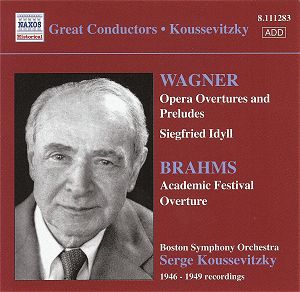
Richard WAGNER (1813-1883)
Der Fliegende Holländer (1843) - Overture [10:17]
Lohengrin (1850) - Prelude to Act I [9:09]
Parsifal (1882) – Prelude to Act I [14:58]
Parsifal (1882) – Good Friday Spell [11:46]
Siegfried Idyll (1870) [18:01]
Johannes BRAHMS (1833-1897)
Academic Festival Overture, op.80 (1880) [9:58]
Boston Symphony Orchestra/Serge Koussevitzky
rec. Symphony Hall, Boston, 4 April 1947 (Der Fliegende Holländer and Parsifal Act I prelude); Symphony Hall, Boston, 27 April 1949 (Lohengrin and Siegfried Idyll); Symphony Hall, Boston, 19 April 1946 (Parsifal Good Friday Spell); Symphony Hall, Boston, 2 April 1947 (Academic Festival Overture)
NAXOS HISTORICAL 8.111283
[74:09]


Experience Classicsonline


Serge Koussevitzky was a victim of his dates. Born in 1874, he retired in 1949 after 25 years at the helm of the Boston Symphony Orchestra and died only two years later.
 

As such, he just missed out on the huge technological advances, including the widespread adoption of stereo recording and of the LP format, that would transform the recording industry in the 1950s.  Thus the bulk of his recorded legacy fell, for many years, into something like oblivion as – to consider only his American peers - Ormandy, Szell, Bernstein and others began re-recording the core repertoire in high fidelity sound.

To be sure, Koussevitzky’s memory lived vividly on among those who had been present at his concerts, but that dwindling band was not enough to keep his name in the public eye for long. 

Now, though, the fashion for disinterring and remastering old recordings is uncovering some long-neglected treasures (plus, as should only have been expected, a great deal of mundane material) and thereby giving a wider audience the opportunity to reappraise some of the frequently far larger than life characters who ruled the world’s orchestras in the first half of the twentieth century. 

So what does this Naxos Historical release, excellently remastered by Mark Obert-Thorn, tell us about Serge Koussevitzky? 

Let us first of all be clear what it does not tell us.  There is no indication here of the reason why Koussevitzky deserves to be remembered even if he had made no recordings at all: the commissioning and performing of a very wide range of new music.  As Colin Anderson’s useful booklet notes remind us, many of the most important composers working at the time – including Hindemith, Prokofiev, Stravinsky, Bartók, Britten, Barber, Copland, Harris, Piston and Schuman – were among the recipients of the Koussevitzky regime’s largesse. 

This new release focuses instead on more conventional offerings that would, in the increasingly conservative late 1940s, have probably pleased most of the Symphony Hall audience rather more. 

The bulk of what we have here is music by Wagner and I was particularly eager to listen to the disc after reading John L. Holmes’s assessment (Conductors: A record collector’s guide [Victor Gollancz, 1988]) that “Koussevitzky was less certain with Wagner, and recorded very little of the composer…”. 

On the basis of these tracks it is difficult to see what Holmes’s throwaway aside is getting at. These are appealing, confident and highly musical accounts.  As required, they are full of life and energy (the terrific opening of the overture to The Flying Dutchman will knock you out of your seat), majesty and spirituality (the Lohengrin and Parsifal extracts), lyricism (the Siegfried Idyll) and, when appropriate, touches of emphatic theatricality (let’s not forget that we have here extracts from three works written to be performed on an operatic stage). 

The performances are also quite distinctive: the typical Koussevitzky sound is not aiming for homogeneity, let alone “beauty” for its own sake (although many passages are actually very beautiful indeed).  On the contrary, here is a conductor positively revelling in opportunities for tonal contrast and for highlighting the individual strengths – and, inadvertently, some of the weaknesses - of the various sections of his orchestra. 

The Brahms overture is a vigorous and thrusting account.  Koussevitzky must have had a lot of spare time at the Moscow conservatory – he is said to have completed the five years course for double bass players in just five months! – and it sounds, from this account, that he certainly enjoyed student life himself.

If he had lived and worked for just a few more years (as, after all, Toscanini did) Koussevitzky might well enjoy an entirely different reputation today.  As it is, this disc – once one comes to terms with the distinctly subfusc sound – is of immense interest in highlighting his distinctive characteristics as a musician and an under-appreciated conductor.

Rob Maynard



Advertising Rates
Visitor stats
MusicWeb International
has over 21,000 Classical CD reviews on offer


Gerard Hoffnung Concerts &
The Bricklayer Story

Naxos Classical 

Australian Eloquence CDs on Buywell.com


New Releases

Hyperion
New Releases


Guild Music


23rd-27th May


MusicWeb sells the Polish
catalogue CDAccord
£10.50 post free W-W


MusicWeb sells the
Arcodiva catalogue
£12.00 post free W-W


Price Reduction: £11.75
post-free


Bull Horn
Price comparison Website


MusicWeb can now offer you discs from the following catalogues:
Prices include postage

[Acte Préalable £13.50]
[Arcodiva £12.00]
[Ashgate Music Books]
[Avie from £6.25]
[British Music Society £13.49]
[CDACCORD from £10.50 ]
[Hortus £14.99 ]
[Lyrita ONLY £11.75 ]
[Onyx £12.00
]
[REDCLIFFE £11 ]
[Tactus £11.50 ]
[Talent from £12.00 ]
[Toccata Classics £12.50 ]

MusicWeb Recommended Recordings 2007

DISCS OF THE YEAR 2007


Return to Review Index


Reviews from previous months
Join the mailing list and receive a hyperlinked weekly update on the discs reviewed. details
We welcome feedback on our reviews. Please use the Bulletin Board.  Please paste in the first line of your comments the URL of the review to which you refer..


You can purchase CDs and Save around 22% with these retailers: