Editorial Board
MusicWeb International
Founding Editor Rob Barnett Editor in Chief
John Quinn Contributing Editor Ralph Moore Webmaster
David Barker Postmaster
Jonathan Woolf MusicWeb Founder Len Mullenger
Igor
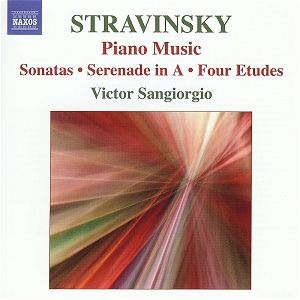
STRAVINSKY (1882-1971) Piano Music
See end of review for track listing Victor Sangiorgio
(piano)
rec. 9-10 December 1991, St John’s Church, Loughton, Essex,
UK NAXOS 8.570377 [71:20]
Stravinsky
didn’t write a great deal of piano music but he stayed faithful
to the instrument, from the Tarantella of 1898 through
to the Two Sketches for a Sonata (1967). This Naxos
collection spans roughly four decades and gives the listener
some idea of Stravinsky’s evolving musical character. The
early works are heavily influenced by the likes of Tchaikovsky
and Rimsky-Korsakov, the neo-classical ones by his interest
in 18th-century forms. And then there are the
pieces from the last 30 years of his life, which are not
represented here.
This
recording originally appeared on the now defunct Collins
label and Naxos must be commended for returning it to the
catalogue. The Italian-born pianist Victor Sangiorgio, who
grew up in Perth, Western Australia, is a commanding performer.
Despite his rather grim demeanour – the booklet photograph
is very unflattering – he seems keenly attuned to the many
moods of this music, from the frothy little Scherzo of
1902 to the more technically demanding Serenade and Piano
Sonata Stravinsky wrote for himself in the 1920s.
The
forceful opening of the F sharp minor Sonata of 1903-04
sounds remarkably like Tchaikovsky and Rachmaninov at their
most imperious. That said there is a startling clarity to
the writing, which Sangiorgio captures very well indeed.
He is helped in no small measure by the lucid recording,
which brings out inner detail and articulation without ever
sounding harsh or brittle.
The
Scherzo benefits enormously from this acoustic, the cascading
figures so deftly – yet charmingly – rendered. The more elegiac
Andante finds Stravinsky in uncharacteristically reflective
mood, Sangiorgio’s playing suitably expansive, even rhapsodic,
at times. Surely this movement is the most Beethovenian in
structure and weight, even though the thematic material is
somewhat overworked. No matter, this is a substantial, varied
and vigorous piece that only loses its way in the overextended
Allegro – Andante.
The
Op. 7 Etudes of 1908 hark back to their 19th-century
predecessors but they are distinguished by an economy of
style, especially in the second Etude. There is a
restless energy in the first and fourth Etudes, Sangiorgio
bringing out the rhythms with considerable flair. And although
there’s a Bachian flavour to the florid second and fourth
studies they have just enough character and verve to avoid
becoming tedious.
No
time for tedium in the bare-boned little Piano-Rag-Music (1919).
This is concentrated Stravinsky, the ‘ragged time’ element
distilled down to its very essence, the tune glimpsed beneath
broken chords and meandering melodies. The irregular rhythms
may hint at Le Sacre but the music’s underlying jauntiness
is artfully maintained throughout.
The
neo-classical formality of the Piano Sonata (1924)
is unmistakable, veering more towards the baroque in the
filigreed writing of the second movement and the Bachian
two-part invention of the third. How like a harpsichord Sangiorgio
makes the Adagietto sound, delicate yet crisply projected
and tastefully proportioned. This is no mere pastiche, but
a highly-skilled and individual homage to an earlier musical
era.
Next
to the Sonata the Serenade seems a little more
relaxed. The opening of ‘Hymn’ evokes the peal of bells and
although the rest of the movement has a baroque cast it’s
all filtered through the prism of Stravinsky’s own imagination.
Ditto the Romanza, which is outwardly calm and unruffled
yet rhythmically unsettled. Once again Sangiorgio’s playing
is a model of precision and proportion, especially in the
highly-ornamented Rondoletto and the free-flowing Cadenza.
A lesser piece than the sonata, perhaps, but eminently satisfying
nonetheless.
Dance
was an essential part of Stravinsky’s musical make-up and
some of the latert piano pieces – Tango (1940) and
the Circus Polka (1941-42) – confirm that. Tango most
resembles Piano-Rag-Music in its pared-downed structure,
yet this and the polka are cleverly sustained by their distinctive
dance rhythms. The latter, originally an orchestral piece
written for Barnum & Bailey, even has a modicum of humour
in its awkward, tramping gait. Sangiorgio plays this a little
faster than usual but it’s a showpiece in its own quirky
way.
This
collection is a near duplication of Peter Hill’s earlier
survey (Naxos 8.553871), criticised in some quarters for
being much too dry. Arguably Sangiorgio goes to the other
extreme, offering a blend of warmth and clarity. This won’t
suit all tastes, but when essayed with such intelligence
and style it seems churlish to complain.
Dan
Morgan
Track listing Piano-Rag-Music (1919) [3:12]
Circus Polka (1941-42)
[3:32]
Piano Sonata (1924)
[10:29]
I. Crotchet = 112 [2:50]
II. Adagietto [5:20]
III. Crotchet = 112 [2:19]
Serenade in A major (1925) [11:52]
I. Hymn [3:32]
II. Romanza [3:40]
III. Rondoletto [2:25]
IV. Cadenza [2:14]
Tango (1940)
[4:04]
Four Etudes, Op. 7 (1908) [8:01]
I. Etude No. 1 in C minor
[1:33]
II. Etude No. 2 in D major
[2:41]
III. Etude No. 3 in E minor
[1:54]
IV. Etude No. 4 in F sharp
major [1:53]
Scherzo (1902)
[2:14]
Piano Sonata in F sharp
minor (1903-04) [27:57]
I. Allegro [10:53]
II. Scherzo [4:52]
III. Andante [5:43]
IV. Allegro – Andante [6:29]
Please support our advertisers below by clicking on the logos for further information.

























 Victor Sangiorgio
(piano)
Victor Sangiorgio
(piano) 
