Editorial Board
MusicWeb International
Founding Editor Rob Barnett Editor in Chief
John Quinn Contributing Editor Ralph Moore Webmaster
David Barker Postmaster
Jonathan Woolf MusicWeb Founder Len Mullenger
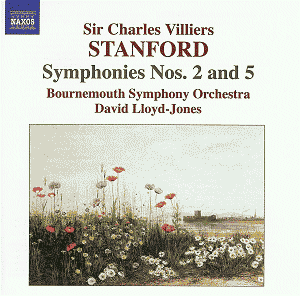
Charles Villiers STANFORD (1852-1924)
Symphony No. 2 in D minor, “Elegiac” (1880) [34:46]
Symphony No. 5 in D major, “L’Allegro ed il Penseroso” Op.
56. (1894) [39:47] Bournemouth
Symphony Orchestra/David Lloyd-Jones
rec. The Concert Hall, Lighthouse, Poole, Dorset, UK, 29-30
June, 25-26 July 2006. NAXOS 8.570289 [74:33]
Sir Charles Villiers
Stanford was born to a family of Dublin lawyers in 1852. He,
along with Hubert Parry, was one of the two most significant
British composers prior to Elgar and he did much to advance
the cause of British music. Having secured a degree from Queen’s
College, Cambridge, he was appointed organist at Trinity College.
After study in Germany, he returned to Cambridge where he instigated
many reforms in the musical establishment. He would later be
appointed to the newly-formed Royal College of Music, where
he would teach such luminaries as Bridge, Butterworth, Moeran
and Vaughan Williams. He is often credited with beginning the
revival of British composition that would produce great composers
from the above-mentioned all the way to Sir Peter Maxwell Davies.
His seven symphonies
are the cornerstone of his output. Carefully crafted and vigorous
in nature, they never really wander outside of the model set
forth by Mendelssohn, Brahms and Schumann. Although the second
symphony is titled “Elegiac” there is nothing particularly
mournful about it. The symphony begins with an energetic and
tuneful opening movement, followed by a warm and perhaps somewhat
melancholy slow movement, a brisk minor key scherzo and a structured
and climactic finale.
David Lloyd-Jones
leads his Bournemouth charges in a taut, well-paced performance.
The romantic nature of the music is taken seriously, yet Lloyd-Jones
never indulges in overt sentimentality, always keeping up a
steady, even, forward line. The orchestra sounds warm and rich,
particularly in movements two and four, and there is some superior
playing from the orchestra’s winds. Of particular merit is
the second movement lento, in which Lloyd-Jones sets a most
lovely tone, bathing us in sound akin to the perfect swim;
in waters that are the ideal temperature. There is plenty of
energy in the resounding last movement, all delivered with
the appropriate English restraint.
The Symphony No.
5 is a horse of a different color. Based on two contrasting
poems of John Milton, Stanford is far more explicitly dramatic
in this score, going so far as to quote rather lengthy sections
of the poetry in the score. Reflective of the text, which describes
horrors, shrieks and other such nastiness, the symphony opens
with raucous brass and timpani followed by busy strings and
woodwinds. It never loses its energy from start to finish.
The second movement is a remarkable contrast to the first.
Tuneful and jolly, this is gracious and endearing music.
The cream here
is the stunningly beautiful third movement based on verses
from Il Penseroso. This is perhaps what Elgar should
sound like: nostalgic, sweeping melodies, warm brass-laden
orchestration yet never bottom-heavy. The Bournemouth pull
this music out of their instruments at the perfect degree of
tension, sending the listener up one mountain summit after
another, wrapped in an exquisitely woven blanket of sound.
The work ends with a confident final movement marked by an
underpinning of pulsating string figures capped by soaring
and sanguine melodies.
For those of you
who enjoy the work of the German romantics, you will probably
find this music most enjoyable. While it is quite a bit less
ponderous than its German cousins, it still contains enough
gravitas to satisfy the musical soul-searcher, yet veers often
enough into a light-hearted realm that seekers of beautiful
melodies will leave just as happy.

























 Bournemouth
Symphony Orchestra/David Lloyd-Jones
Bournemouth
Symphony Orchestra/David Lloyd-Jones 
