Editorial Board
MusicWeb International
Founding Editor Rob Barnett Editor in Chief
John Quinn Contributing Editor Ralph Moore Webmaster
David Barker Postmaster
Jonathan Woolf MusicWeb Founder Len Mullenger
Constantin
Silvestri
Edward
ELGAR (1857-1934)
1. Cockaigne overture (In London Town), op.40 [15.27]
2. Symphony No.1 in A flat major, op.55 [54.53] Malcolm ARNOLD (1921-2006)
3. Beckus The Dandipratt – comedy overture, op.5 [7.51] Peter Ilyich TCHAIKOVSKY (1840-1893)
4. Symphony No.2 in C minor, op.17 [32.40] Claude DEBUSSY (1862-1918) 5. Jeux – Poème Dansé [17.11] Benjamin BRITTEN (1913-1976) 6. Four Sea Interludes from Peter Grimes,
op.33a [17.13] George ENESCU (1881-1955)
7. Romanian Rhapsody in A major, Op.11, No.1 [11.15] Bournemouth Symphony Orchestra/Constantin
Silvestri
rec. live, Winter Gardens, Bournemouth, 6 December 1966(1) / 25 July 1968 (2)
/ 23 February 1963 (3)/ 12 November 1966 (4)/ 10 November 1965 (5)/ 26 November
1966 (6)/ Royal Festival Hall, London, 22 November 1966 (7). ADD.
All recordings except the Arnold overture are in mono sound. BBC LEGENDS BBCL41822 [78.36
+ 78.59]
To
give a different perspective from Evan Dickerson’s reviewI’m
concentrating on Silvestri in comparison with other recordings.
First up is the most leisurely account I’ve heard of Cockaigne.
The 1962 Philharmonia Orchestra/John Barbirolli recording
(EMI 5628862) takes 14:35, Silvestri 15:27. Not that this
is disadvantageous. In the very opening phrase Silvestri
points up the appoggiaturas with more humour than Barbirolli.
The theme representing the Londoner (tr. 1 1:09) has breadth
though it doesn’t stand quite as proud as Barbirolli’s.
Silvestri’s lovers in Regent’s Park (2:07) seem more starry-eyed
in their greater warmth and relaxation. Silvestri finds
a compelling rawness in the excitement of anticipation
of the military band’s arrival, a gentle solemnity to the
lovers in church (9:00) and a comically lumbering quality
to the amateur band (11:12) where Barbirolli has more of
a Falstaffian swagger. Overall Barbirolli has more adroit
finesse but Silvestri draws attention to more vibrant detail.
For
Elgar’s first symphony I compared the Hallé Orchestra/John
Barbirolli 1970 concert performance (BBC Legends BBCL 4106-2).
Here are the timings. I have excluded the applause time
in the Barbirolli to make the comparison exact:
Timings
I
II
III
IV
Total
Silvestri
22:04
8:12
11:33
13:04
54:53
Barbirolli
20:44
7:02
12:16
12:02
52:04
Barbirolli’s
first movement prelude has more inwardness and stateliness.
Silvestri brings more sense of progression to the theme
and more direct vigour. Barbirolli’s second theme has more
winsome fragility yet Silvestri’s (tr. 2 4:46) has a lissom
sunnier quality. Barbirolli’s return of the prelude theme
on the horns is mournful where Silvestri (7:40) is warmer.
Barbirolli’s climaxes are starker where Silvestri’s shows
their architecture in a more deliberate manner. Barbirolli’s
final return of the opening theme is more delicately infused
but Silvestri’s is flowing and serene. Barbirolli brings
a magical calm to the coda. Silvestri emphasises its mystery,
his concentration evident and the outcome eloquent.
Barbirolli’s
scherzo is more impetuous and fiery. Silvestri’s second
theme march (tr. 2 0:36) is rugged and robust where Barbirolli’s
is grim and garish. Even Barbirolli’s trio is evanescent
in its idyllic nature, swept forward by the overall precipitation.
Silvestri’s trio (1:57) has a noticeably different atmosphere,
basking idyllically. Barbirolli’s slow movement is warm
and smooth yet assured, both rich and restrained with greater
relaxation later yet sustained serenity. Silvestri works
more intently at expression and dynamics, seamlessly and
wholeheartedly projecting and savouring a passionate joy,
even more sustained from the third theme (tr. 4 8:00).
Barbirolli’s
finale has a mysterious and ominous introduction where
Silvestri’s directness is cosier, with less atmosphere.
Barbirolli’s Allegro is more impulsive, his second
theme of a more heroic character than Silvestri’s more
objective observation (tr. 5 3:29). Barbirolli’s third
theme march has a compelling nervous energy where Silvestri
is in comparison (4:22) more square. To the transformation
of this theme into a noble cantabile melody (7:04)
Silvestri brings a gently glowing serenity where Barbirolli
is smoother and more silky. Silvestri’s sonorous return
of the opening movement prelude theme doesn’t realize quite
Barbirolli’s grandeur.
In
Malcolm Arnold’s Beckus the Dandipratt (tr. 6) that
particular urchin announces his presence to the world on
braying cornet. In Silvestri’s hands it’s a graphic, raw,
raucous assault, all quick-fire orchestral effects and
contrasts vividly conveyed with total relish. Arnold’s
1955 recording with the Royal Philharmonic (EMI 3 82146
2) is a little faster at 7:23 against Silvestri’s 7:51,
Beckus cuts a more dashing, less raunchy figure and Arnold’s
relaxed moments have a more poetic lightness, but the mono
sound is less immediate and has less body than Silvestri’s
stereo.
CD2
begins with Tchaikovsky’s Symphony 2. I compared the 1979 ‘studio’ recording
by the Berlin Philharmonic Orchestra/Herbert von Karajan
(Deutsche Grammophon 459 518-2). Here are the comparative
timings:
Timings
I
II
III
IV
Total
Silvestri
10:46
7:11
3:48
(4:43)
11:00
32:40
(33:35)
Karajan
11:08
8:06
5:46
10:17
35:17
The
opening horn solo under Karajan is more poetic and poised
but this artistry takes away its folksy quality to which
Silvestri brings more natural flow. And more mounting excitement
to the build ups, rigour to the Allegro rather than
Karajan’s crispness, a second theme (tr. 1 3:46) of more
ardour and seriousness than Karajan’s.
The
slow movement march is somewhat dour at first but perks
up with contrasted scoring. Silvestri finds a gently sighing
quality for the second theme (tr. 2 1:04). To the folksong
centre (2:05) he brings a freer flowing grace with a natural
feel about it. Karajan’s march is more suave, his second
theme more whimsical, the folksong quite serious. Silvestri’s
greater flow gives more of a sense of purpose and freshness
overall. The athletic momentum Silvestri finds in the scherzo
gives it a virile vigour while the observation of dynamic
contrasts allows it to be waspish and feathery by turns.
Silvestri doesn’t make the second section repeat. The timing
in brackets above makes an exact comparison with Karajan
who does. The trio is neat and bright. Karajan shows more
stylish shading but less verve.
In
the finale Silvestri’s ubiquitous momentum pictures an
eager procession surging forward. The second theme (tr.
4 3:11) begins more dreamily yet also of a free, open air
character so that as it becomes more assertive it influences
the opening theme to be lighter, less formal. Karajan offers
a virtuoso display of high powered climaxes and balletic
deftness, a graceful second theme merging with the rest
more conventionally.
Bernard
Haitink’s 1979 ‘studio’ recording of Jeux with the
Concertgebouw Orchestra (Philips 438 742-2) presents the
variegation of Debussy’s orchestration with a beguilingly
seamless assurance. Silvestri, more animated with a total
timing of 17:11 in comparison with Haitink’s 18:46, is
more volatile and dramatic. Quicksilver details emerge
from the kaleidoscope, like the throbbing excitement of
the first violins’ brief theme (tr. 5 2:19). And there’s
more haunting material like the wonderful, fragile poise
to the first violins’ ‘sweet and sad’ phrase (9:17). Less
unified than Haitink’s, Silvestri’s is a graphic account
easy to get involved with.
Silvestri’s ‘Dawn’, the
first of Britten’s Four sea interludes from Peter Grimes,
is fresh and keen. I compared the 1974 ‘studio’ recording
by the London Symphony Orchestra/Andre Previn (EMI 5 62615
2). Here are the comparative timings:
Timings
Dawn
Sunday M
Moonlight
Storm
Total
Silvestri
3:36
4:17
4:35
4:30
16:58
Previn
3:44
3:48
4:23
4:29
16:24
Previn’s
slightly slower ‘Dawn’ is an artistic musical portrait,
a refined, almost abstract distillation of landscape, seascape
and varying natural forces. Silvestri has a more poetic
and dramatic feel for the melodic lines as an experience.
This difference in approach applies throughout. Silvestri’s
slower ‘Sunday Morning’ is a hive of exuberant activity
in the midst of which Ellen’s theme in violas and cellos
(tr. 7 0:52) is a resolute thanksgiving. Previn’s activity
is spikier, Ellen’s theme dreamier and more isolated. In ‘Moonlight’ Silvestri’s
sea drags drowsily but there’s a richness of density too
where Previn finds beauty in stillness. Silvestri’s ‘Storm’ begins
more grittily than Previn’s and has more elemental wildness.
In the second contrasting section (tr. 9 2:27) Silvestri
achieves Previn’s quality of distance and also a serenity
of suspended time of sudden peace and stillness before
the final screaming onslaught.
From
the opening playful clarinet Enescu’s first Romanian
rhapsody (tr. 10) gets a rivetingly folksy performance.
The 1996 BBC Philharmonic/Gennady Rozhdetvensky ‘studio’ recording
(Chandos CHAN 9633), taking 12:57 against Silvestri’s 11:15,
is a more refined affair, with more languorous opening
and grand brass at the close, but Silvestri gets a more
authentic feel of weight and character, violins now skittering,
now sunnily taking their ease. The dance begun by flutes
at 5:28 grows ever more frisky, the trumpets’ blare which
follows more festive and from 6:53 it’s almost impossible
not to tap your feet. A fitting close to a set of distinctive
performances with a real sense of spontaneity presented
in serviceable recordings.
























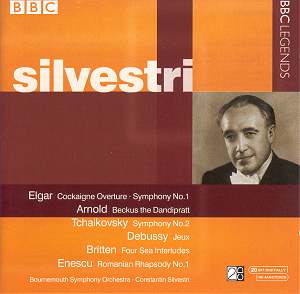

 Bournemouth Symphony Orchestra/Constantin
Silvestri
Bournemouth Symphony Orchestra/Constantin
Silvestri 
