It’s hard to believe
that Peter Sculthorpe will be 80 years
old in 2009, with well over 50 years
of composition behind him. His works
range over all the musical forms –
Concerto, Orchestral music (the four
Sun Music works being, perhaps,
the best known of these), song, piano
pieces, opera and, his major achievement,
sixteen string quartets (so
far). Much of his output has been
recorded, and next year I am sure
we can expect more, but now a young
company has inaugurated its catalogue
with a very special tribute, and one
which no-one (perhaps not even the
composer himself) could have expected,
even as an early birthday tribute.
The founder of the
company, Fremantle Vynile, studied
with Sculthorpe and knew that he kept
some "special" pieces in
his bottom drawer. The composer has
often said that over the years he
had written "portraits"
to commemorate friends, places and
events from his life, but only for
his own pleasure and not for public
consumption. We must, therefore, be
grateful to Vynile for persuading
Sculthorpe to open that drawer for
us and allow us to hear a mere handful
of these pieces in newly prepared
editions. Indeed, so interested was
Sculthorpe in the project that he
took time off from the composition
of his latest (16th)
Quartet to make these new arrangements.
So here we have a
set of 12 pieces that follow one after
the other. What they are all about
is important so I’ll take a quick
look at each piece.
Walking Upsidedown
(1939) is one of Sculthorpe’s earliest
existing works. At school one day
his teacher told the class that people
in the northern hemisphere always
joked that Australians walked upside
down because they were on the other
side of the world and this made the
young, fledgling, composer write a
piece which, half way through, turns
upside down, the bass becoming the
treble and vice versa.
Susan’s Hair
refers to a neighbour in the 1960s
who had long hair to her waist, then
one day she had it all cut off and
wore it to her shoulders thereafter.
The music starts in a languid mood
then speeds up as the scissors start
their relentless chopping, the music
ending with a downward rush as the
cut hair falls to the floor and a
short lament regrets the cutting.
Bouncer is
about just that, a bouncer at a local
nightclub Sculthorpe frequented just
after his return to Australia from
studies in England. The bouncer was
desperate to be an actor but, as is
the case, had little talent for it
hence the subtitle of the piece. "A
lovely man," says Sculthorpe,
"but dear, oh dear!"
Two crickets-based
pieces follow. Sculthorpe has always
been a cricket nut and composition
takes a back seat whenever Australia
is playing international matches,
in fact there was some confusion over
the completion of one of his more
recent works when Australia lost the
Text series in England and the Sculthorpe
household was almost in mourning for
several days.
Erin’s bro, Conor,
reflects on an Irish brother and sister
who lived at the corner of the street
in which Sculthorpe lived whilst studying
with Wellesz in Oxford. Conor was,
like Sculthorpe, a cricket nut and
the two spent many hours studying
Wisdon and attending cricket matches.
This piece, somewhat cleverly, mixes
English and Australian rules. The
music is based on 8 beat phrases (8
balls in an Australia over) and 6
beat phrases (6 balls in an English
over), the two phrases follow one
after the other until 97 beats have
been played and the music falls down
(97 being a feared number in Australian
cricket as it is three short of a
century), then the music starts again
until 111 beats have passed and once
again the music breaks down (111 being
the English cricketers equivalent
of the Australian 97) This process
is repeated several times until finally
someone hits a six and the ball (or
beats) soar away into the sky.
The second piece
derives from the BBC Radio Test Match
commentary and is the only time Sculthorpe
has used a pre-recorded CD in his
music. At the Oval Test in 1991, Ian
Botham fell on his wicket and was
judged to be out. Quite right and
proper. Unfortunately the BBC commentator
made a slight slip of the tongue and
hilarity ensued. Commentator Jonathan
Agnew said: "He lost his balance
and the tragic thing about it (is)
he knew exactly what was going to
happen. He tried to step over the
stumps and just flipped a bail with
his right leg…He just didn’t quite
get his leg over…" and, starting
with Brian Johnston, the whole team
spend the next 42 seconds in glorious
merriment. Totally schoolboy, of course,
but a sheer joy. What Sculthorpe neglects
to tell us is that in that innings
England was all out for 419. The music
consists of a series of climbing movements
which collapse until off come the
bails and the commentary takes over.
For sheer joyousness you cannot beat
this track.
Sculthorpe’s dedication
to the great game cannot be over-stressed.
One of his prized possessions is a
near complete collection of Wisdon
(one of the finest in private hands
in Australasia), many signed by the
players whose achievements on the
field are recalled within its yellow
covers.
On a rather sad note,
Sculthorpe told me that just as the
disk was going to the manufacturers
he heard of the death of Conor in
an air crash (his body was never discovered)
and as Sculthorpe has memorialized
people in some of his most serious
works (Irkanda IV (1961) –
his first masterpiece and the first
true masterpiece of contemporary Australian
music - was written in memory of his
father) he has started work on a new
String Quartet to commemorate
his friend. Sculthorpe says that this
new quartet will be a 20 minute threnody
based on Irish reels and jigs and
he refers to it as his begob and begorrrrah
quartet.
Pas de fumer
is a lament for the time Sculthorpe
stopped smoking. A difficult listen
for anyone who has undergone the same
fate. Harold was a Bishop who
spent all his free time working with
the homeless and who befriended a
carpenter and gave him work. After
the carpenter had built a loo for
a small church on the outskirts of
Sydney, he started rehabilitating
himself thanks to Harold.
Paul who robbed
his son is a portrait of a neighbour
who turned out not to be the hard
headed businessman everyone thought
him to be but a petty thief.
This Door is Alarmed,
This Window is Petrified came
about after Sculthorpe saw a sign
on a door at the ABC Studios in Sydney
saying that the door was alarmed and
Sculthorpe naturally took the thought
to the next stage. A piece of chattering
nonsense from the ensemble here. The
final piece, Vroom, Vroom (1 to
5: The MG scherzo) celebrates
Sculthorpe’s love of the motor car,
especially the MG, of which he has
owned several. It’s a headlong dash
down country lanes, main roads, motorways,
meetings to get to, rehearsals to
attend, premieres to be in attendance.
A screech of tyres brings the toccata
to an abrupt halt as he is stopped
by the police for speeding.
A fascinating look
into a side of Peter Sculthorpe which
is totally unknown to his many fans
worldwide. This is Peter Sculthorpe
the larrikin!
To fill up the disk
Sculthorpe realized that he had never
given William Barton a piece which
was entirely his. The composer has
reworked many of his pieces, especially
the Quartets, to include a
part for didjeridu, specifically for
Barton, but he’s never written a piece
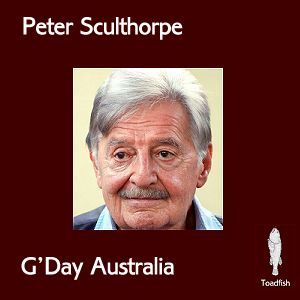
expressly for Barton until now. G’Day
Australia is Sculthorpe’s response
to this omission in his catalogue.
As he writes in his witty and informative
note in the booklet, "it’s one
thing to write a Concerto for an instrument
which can play great tunes (whether
the performer can play the instrument
or not) but it’s quite another to
write a large scale work for a solo
instrument which can’t even play tunes!"
Sculthorpe gets round this problem
admirably by basing the music on certain
events in the life of Ned Kelly, the
(in)famous bushranger. This is another
homage to William Barton who is a
keen student of the exploits and life
of this iconic figure in Australian
history. The first movement is rhythmic
and depicts the wide open spaces of
the outback. No Dreamtime here, just
a hard life with no respite. The slow
movement is a nocturne, a reverie
of stars and clouds before the last
movement, Showdown, bursts out and
depicts Kelly’s final confrontation
with the Victoria police force on
28 June 1880 when Kelly was shot between
six and twenty eight times (reports
vary) in his legs, before being captured,
tried and finally hanged on 11 November
of that year. The work ends with a
lament for the man and the people
involved with him, gang members and
civilians alike, who died as a result
of his actions.
It’s a serious end
to a most enjoyable disk, but at the
same time it’s an uplifting work which
compliments the frivolity of the rest
of the programme. It’s the biggest
work here and all the pieces are of
various durations, some of which are
longer than others.
All the works receive
excellent performances by the Toowoomba
chamber players, an ensemble of one
each of woodwind and brass, string
quartet, bass, keyboards and percussion,
to which Sculthorpe has added his
beloved didjeridu. Special praise
must go to the young pianist Ramsay
Street, who, quite rightly, gets special
billing on the disk, for his contribution
cannot be ignored. The fistfuls of
notes he has to essay is positively
breathtaking. This is Street’s first
recording – he won the first Alice
Springs All-Comers Piano Fest two
years ago and a well deserved win
it was too. The disk was recorded
in the Verbrugghen Hall of the Sydney
Conservatorium of Music and the beautiful
rich sound of the hall is in full
evidence in the recording.
In the midst of all
this light heartedness, we must not
forget Sculthorpe’s standing as an
Australian Treasure (succeeding one
of his greatest heroes, the cricketer
Don Bradman), an honour bestowed on
the most important people in their
field by the National Trust of Australia.
At the ceremony where he was inducted
during his speech the presenter of
the award told the audience that Sculthorpe
was a National Treasure for his orchestral
works and especially for his string
quartets (which numbered 15 at the
time), saying that he knew that not
just the Australian public but music
lovers the world over could rest assured
that this Australian had, "…reached
the very top of the tree in string
combinations". The audience roared
its appreciation.
Sculthorpe has told
me that this disk will not be released,
more likely, he says, "it will
escape into the world on an unsuspecting
public at the beginning of April".
And you are welcome to enjoy it as
it deserves.
Bob Briggs

























 Ramsay Street (piano)
