In 1987, when I interviewed to become a composition student at
the Royal Conservatoire in The Hague, my principal interrogator
and critic was Brian Ferneyhough. He seemed determined to discover
the complicated philosophy behind my selection of tones or notes.
I didn’t really care that much, seeking enrolment to be taught
by Louis Andriessen in any case. In the end I admit to becoming
somewhat impatient: “if I want middle C it’s there for me on the
piano – boing! – no need for long rumination or soul-searching
…” Some months later when term started, Mr. Ferneyhough had departed
somewhat abruptly for America, and been replaced by Frederic Rzewski:
this to the horror of all the pale and intellectual students who
had come for Brian, some of whom soon drifted away quietly not
long after. I on the other hand was delighted by the dryly laconic
and saturnine figure of Frederic. He arrived about two hours late
on the first day, and I shall never forget his story about the
adventures which resulted from getting on what he thought was
the early train from Liège, and then finding his carriage being
shunted into a siding in some obscure part of the station. He
would often play bits of new pieces in the group lessons: he was
working on North American Ballads at the time, and for
those of us who were happy to see him he was a great friend who
at that time was content to join us for drinks and talk about
cigars and life in general as well as music. He once remarked
to me, “that’s a nice shirt …”, “thanks” I replied. The conversation
moved on a little, and then he suddenly turned on me: “You know
what, you’re not a sport.” “Erm, I’m sorry, what do you
mean …?” “I said; you’re not a sport. I said the same thing
once to Arne Nordheim (I think it was, but it may not have been
Arne Nordheim – my apologies if the memory proves incorrect) about
one of his ties, and you know what Arne did? He immediately took
off the tie and handed it to me, saying: ‘if you like it, you
must have it …’” Rzewski had a knack of pointing out and exposing
defects in your character you never even knew you had, but suddenly
taking off my shirt in a crowded bar and giving it to someone
will, alas, remain nothing more than the provenance of Freudian
analyses where I’m concerned.
The
People United Will Never Be Defeated!
is a seminal piano work of the 20th
century. The piece is a 36-bar theme,
36 variations in which the material
of the theme more often than not dictates
the fabric of the music, an optional
improvisation, and a return of the final
theme. The theme is by a Chilean composer
called Sergio Ortega, and the song from
which it comes became a symbol of defiance
against dictatorship throughout the
world. Not necessarily immediately obvious
on a first hearing, there is a great
deal of structural logic to the work,
which consists of six sets of six variations,
the final variation of each set being
itself in six parts, and a summation
of the material in its group of pieces.
Commissioned by Ursula Oppens, it is
her recording on the Vanguard Classics
label against which I will be comparing
this new release played by Ralph van
Raat. As well as the original performance
and this new one, there is also a recording
made by Marc-Andre Hamelin on Hyperion
CDA67077 in 1998. The variations are
paired with the Winnsboro Cotton Mill
Blues (as on the Naxos disc) and also
'Down by the Riverside'
The admirable qualities of Oppens’ 1978 recording are transparency,
subtlety of touch, and just the correct amount of urgency and
forward momentum to carry us through 50 minutes of often complex
and ‘difficult’ piano music. If you can find a copy, it is still
a vitally vibrant and ‘classic’ performance. Ralph van Raat’s
version comes in at over 12 minutes longer than Oppens’, but
hers doesn’t have any improvisational section – an idea which
either appeared later, or was a device which emerged from Rzewski’s
own performances. Either way, Raat gives no impression of sluggishness.
The Naxos recording does have a plusher piano sound and an altogether
rounder sonic profile, which gives the music a gentler feel
in general. The contrasts seem less extreme, but I have the
impression that this is partly an effect of the recording rather
than the playing. Raat is dramatic, expressive, nimble, elegiac
and virtuosic, and he has a fine feel for the variations with
any kind of jazz idiom, but for some reason I get less of a
sense of the all-important theme recurring in the music. It
is there, no doubt, but Oppens brings it out at every available
opportunity, where Raat seems more keen to bring out the contrasts
in pianistic style with each variation. Both pianists worked
with the composer when preparing these recordings, so here the
honours are even. This is a very fine performance, and worth
every penny of its diminutive asking price. The sonic effects
of the lid banging are spectacular, and Raat’s improvisation
towards the end is a fascinating mixture of effects and bravura
creativity. I don’t, however, actually prefer it to the ‘original’,
which wins, by a margin, on musical faith to the spirit of the
origins of the music, rather than to Raat’s greater emphasis
on pianism. It may also be that Rzewski’s views on the music
have changed in the last 30 years, in which case I bow to the
work’s right to its own evolutionary process.
I do have one very big beef with Naxos on this release. With
the Vanguard Classics CD, each variation is given its own access
track number. On Naxos the whole piece is on track one, which
means students, reviewers and casual listeners are all out of
luck after about 5 minutes, as no-one knows where on earth we
are in the piece: the complete list of variations with expression
and tempo markings become pointless – unless you already know
the work intimately of course. This is, agreed, the equivalent
of the situation in a concert performance, but the whole idea
of CDs was to remove this kind of vague wandering through the
dark mysteries of vinyl grooves and analogue tapes, where finding
a particular point in a piece could be the equivalent of trying
to find a certain star in the night sky with a powerful telescope
on which the sighting lens has been lost. This is an unforgivable
lack in the production which I hope might be filled in any re-release,
though I don’t hold out too many hopes.
Winnsboro Cotton Mill Blues is the kind of militant minimalism which has its musical counterpart
in works like Alexander Mosolov’s ‘Iron Foundry’. The piano
is turned into a huge machine, conjuring the never-ending cycle
of the works, while the workers sang the tune which also appears
in the work. I only have a recording of Rzewski himself playing
the third of the North American Ballads from which the
Blues is number 4, but I am sure the punishingly dramatic
impact Raat creates with this monumental piece is that which
the composer sought when writing it.
This is another excellent
Naxos release, and should be snapped up by anyone with even the
mildest interest in 20th century piano music, or just
piano music in general. The People United … can rightly
be seen as one of the greatest set of variations since Bach penned
his ‘Goldbergs’ or Beethoven his ‘Diabellis’, and there is really
nothing which should hold you back from exploring what is after
all a relatively accessible and direct statement on a subject
which concerns us as much today as if did when Pinochet was suppressing
his opponents all those years ago.
Dominy Clements
























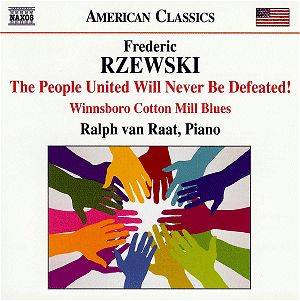

 Ralph van Raat (piano)
