Editorial Board
MusicWeb International
Founding Editor Rob Barnett Editor in Chief
John Quinn Contributing Editor Ralph Moore Webmaster
David Barker Postmaster
Jonathan Woolf MusicWeb Founder Len Mullenger
Gustav
MAHLER (1860-1911)
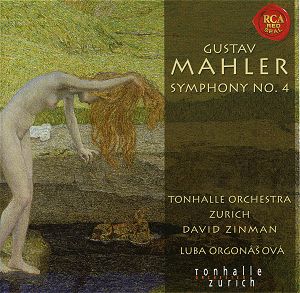
Symphony No. 4 in G major(1900) Luba Orgonášová (soprano)
Tonhalle Orchestra Zurich/David Zinman
rec. 13-15 November 2006, Tonhalle, Zurich RCA-BMG
88697 168522 [57:21]
ArkivMusic
list around 100 Mahler Fourths on their website, so
what makes this new one stand out from the rest? For a start
it's the latest instalment in David Zinman's Tonhalle cycle,
which has already yielded one of the most rewarding 'Resurrections'
in recent memory (see review).
Not only that, he has produced a thoughtful First, complete
with discarded 'Blumine' movement. And although his Third was
marginally less convincing than either (see review)
this crisp, invigorating Fourth marks a welcome return
to form.
Mahler's Fourth has
a distinguished history on record, and with it comes a wide
variety of performance styles. Listeners who prefer a relaxed,
genial approach to this, the last of Mahler's 'Wunderhorn'
symphonies, will be spoilt for choice; of course those who
relish a real challenge can always try Roger Norrington's
controversial reading on Hänssler 093164, more of which later.
Zinman's
Mahler Fourth offers a happy medium without also being
an unsatisfactory compromise. From the outset it's clear
this is not one of those well-upholstered performances. Make
no mistake, though, there is still plenty of charm and 'lift'
here, but none of the cloying sentimentality the score so
often attracts.
Philip
Barford describes this symphony as 'a masterpiece of delicate
counterpoint, Mozartian lucidity and sensuous beauty' (Philip
Barford: Mahler Symphonies and Songs. BBC Music Guides,
London, 1970) and it's a mark of Zinman's achievement that
he captures all these qualities. The Zurich band play with
complete conviction, phrasing and pointing with precision
and feeling, especially at the start of the first movement.
The flutes and sleigh bells and the dipping melody that follows
have rarely sounded as transparent as they do here.
Clearly
Zinman's Mahler owes much to historically informed performance
practice (HIP) but what is so refreshing is that he wipes
away the accumulated grime from these vast canvases without
damaging the delicate pigments underneath. Norrington is
inclined to be much more cavalier, swabbing away most of
the detail as well.
Death
really does lead the music of the second movement.
This spooky Ländler – Mahler’s very own danse macabre – has
just the right amount of inflection; the solo violinist’s
playing ‘wie eine Fiedel’ is superbly realised too. The Sony-BMG
engineers deserve praise for capturing all the spatial information
that gives this recording its depth and breadth. Even the
tiniest instrumental details are rendered with great clarity
and naturalness; indeed, this must be one of the most tactile,
'hear through' performances of this symphony on disc.
Of
course this work is not just about detail – although
there is plenty of it – it's also about overall structure.
Zinman has a solid grasp of Mahler's musical architecture.
He paces the Ländler very convincingly, so when the
music broadens at 6:26 it sounds entirely spontaneous. All
too often this strange movement comes across as a series
of discrete phrases wrapped in parentheses but Zinman manages
to achieve a remarkable sense of organic growth and musical
unity here.
Thus
far Zinman’s performance is wonderfully buoyant, aerated
even. Of course his sympathetic response to Mahler's delicate
scoring counts for much, which is more than one can say for
Norrington, who barely gives the notes time to breathe before
pressing on regardless. The music’s topography is lost in
the process, its hills and valleys hammered flat. It’s all
so relentless and it sells Mahler short at every turn.
By
contrast Zinman delves into the score in a way that is altogether
more illuminating. In particular the Adagio has the usual ‘sensuous
beauty’, the usual ebb and flow, but there is a surprising
undertow as well. Seldom have the climaxes sounded so spectral,
sending a real shiver up the spine. And surely there is more
than a hint of the valedictory Ninth in those disembodied
figures? Zinman crowns this movement with a peroration that
yawns like an abyss, pounding timps and cymbals adding to
the thrilling effect.
After
the beautifully etched close to the Adagio comes the child-heaven
finale. As in so many of Mahler's final movements this is
make or break time. Great sopranos past and present have
tackled this faux-naif style of singing with mixed
results. Ever the iconoclast Leonard Bernstein even opted
for a boy soloist in his DG account, which really doesn’t
work at all.
Zinman’s
choice of soloist – the Bratislava-born soprano Luba Orgonášová – is interesting,
and it’s one that will probably divide critics the most.
The singer is set further back than usual, which makes for
a much more integrated sound picture; thankfully audibility
and diction aren’t sacrificed in the process. If there are
any caveats it’s that Orgonášova’s voice is more soft-grained than we are used to and it’s a touch too
mature to suggest childlike innocence. In spite of these
minor reservations she makes a fairly convincing job of it.
An acquired taste, certainly, but very much in keeping with
Zinman’s fresh approach to this loveliest of scores.
This
wondrous new Fourth – and for once the superlative
is warranted, for it is a performance full of wonder – confirms
Zinman as a Mahlerian of real stature. Thereadingmay
not displace the likes of Mengelberg, Szell, Klemperer et
al but it does deserve a place alongside them. As for
recent rivals this simply knocks Norrington into a cocked
hat.
The
Sony-BMG disc sounds splendid in both its CD and SACD incarnations,
with the higher-resolution format offering an extra degree
of transparency and detail. Some listeners may find the sound
a trifle lightweight, a criticism levelled at earlier discs
in the cycle, but what we are hearing is the music relieved
of all its excess baggage.
So,
another fine instalment in what is surely the most significant – and
satisfying – Mahler cycle in progress. Roll on the Fifth!
Dan
Morgan
Please support our advertisers below by clicking on the logos for further information.

























 Luba Orgonášová (soprano)
  [57:21]
