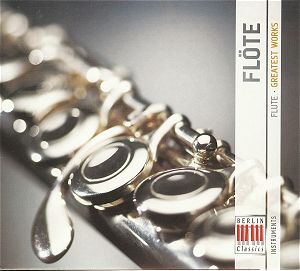
This two-disc set is a compilation of some of the most important
works in the flute’s repertoire. Ranging from concertos to solo
pieces, with composers from Vivaldi to Ibert, it offers a good
overview of the instrument’s capabilities. The set is well presented,
although there is no information given in the sleeve-notes about
any of the performers or the instruments they play. These range
from baroque flute to modern flute, and possibly recorder, in
the case of the Vivaldi concerto.
This performance of Vivaldi’s Concerto is certainly
tempestuous, with an array of orchestral colour. The solo
line is well handled, and does not indulge. The fast semi-quaver
passages are sometimes rushed, particularly in the last movement.
The dynamic range of the soloist is less than that provided
by the accompaniment, perhaps due to the use of period instruments.
Frederick the Great’s Concerto No. 4 is
one of a number of works composed by the King of Prussia.
He studied the flute and composition with Quantz and his court
became an important cultural centre. His flute concertos are
charming works, full of poise and dignity. The performance
here is not the best I’ve heard - listen to Jost Nickel’s
recording, among others - but it is nevertheless convincing.
The baroque flute lacks the strength of tone of the modern
instrument, particularly in the low register, and there is
a marked difference in volume between the solo line and the
orchestra. The slow movement is expressively played, and there
is an impressive and well-written cadenza. The final movement
is played with considerable charm and some lovely additional
ornamentation.
The orchestral playing in this recording of Mozart’s
G major concerto has a sprightly feel, with much clarity and
energy. The flute sound is a little muffled, but well phrased
and musically expressive. There are numerous recordings of
this work available - my favourite is William Bennett’s -
and although this is a good performance, there is little to
distinguish it from any of the others. The first movement
cadenza is long and meandering and did not hold my interest.
There is too much vibrato in the slow movement for my taste,
which I found difficult to ignore. However, Johannes Walter
has a good sense of line. The Rondo is altogether better;
the energy of the work carries the movement along. The orchestral
playing is excellent and highly enjoyable, and Walter phrases
well.
The opening of Bach’s Suite in B minor is
dramatically played, with exaggerated rhythms and a strong
orchestral sound, coloured by the solo flute. Although I am
used to hearing double-dotted rhythms and a slightly faster
tempo, this was nevertheless completely convincing as an alternative
interpretation. The fugue is controlled and full of energy.
The rest of the suite is well performed, with strength from
the accompanying orchestra where required. There is also some
wonderfully delicate playing at times. The famous Badinerie
at the end of the suite is joyful and spirited, with the players
resisting the temptation to hurry.
Bach’s Sonata in E major begins the second
CD and it is performed by Eckhart Haupt with continuo accompaniment.
The playing is light and deliberately phrased. Haupt plays
with a smooth tone which is a delight to listen to. The fast
movements are played with sensitivity and excellent control,
while the slow movements are expressive and elegant.
Quantz’s Concerto in G follows, with its
bright and brisk first movement. The playing is accurate and
contained, and captures the essence of the work well. The
slow movement is expressively played, with some lovely ornamentation
added to the solo line. The vibrato is once again a little
distracting, but much less so than previously. The orchestral
accompaniment is generally well played, and there are some
lovely continuo moments in the slow movement. The finale opens
with renewed vigour, and is full of character throughout,
despite a slight tendency to rush.
Following Mozart’s Andante in C - a piece
I have never particularly enjoyed but is heard here in a reasonable
version, despite the aforementioned vibrato - the mood changes
completely as we are taken to twentieth century France and
Poulenc’s famous Sonata. Although technically controlled,
the overall sound is a little muffled; I suspect this is something
to do with the production techniques rather than the playing.
The first movement has charm; the second is a little pedestrian
in places for my liking, but the finale had the required fireworks
and was an enjoyable and dramatic performance.
The recording of Syrinx here has added reverb,
which is quite a change from the rest of the disc. I would
describe this as a ‘traditional’ rendition, with many rhythmic
departures from Debussy’s score. There is a point in the score
where he asks for rubato; it is my opinion that by including
this indication, he suggests the rest of the piece should
be played without it. That said, this is an expressive performance
which captures the atmosphere of the work.
The opening of the Ibert concerto came as something
of a shock after the tranquillity of Syrinx. This is
a wonderful work, full of life, virtuoso display and wonderful
harmonic shifts. The first movement is played with character,
but there are some balance issues; the brass section seems
extremely loud in the few moments in which they play, compared
to the strings. There is also a slightly overpowering clarinet
solo which drowns out the solo flute. The articulation of
the solo flute lacks clarity, and the whole movement feels
a little like a battle of supremacy between the flute and
the accompaniment. The second movement is generally better,
although I would still have liked more of the flute in the
balance. The movement as a whole has a sense of calm serenity,
allowing Ibert’s wonderful harmonies to take center-stage.
The third movement is rhythmically strong, fiery and spectacular,
with a wonderful improvisatory interlude, which is capably
performed and flowing. The flute playing is reasonable, but
does not live up to the standards we have become accustomed
to, thanks to superior artists such as Sharon Bezaly, Emmanuel
Pahud and William Bennett. I have Susan Milan’s recording
of this work and it is in an altogether different league from
this.
To sum up, this set of discs provides an interesting
introduction to the flute’s repertoire. The orchestral playing
is generally good - at times better than that of the solo instrument
- expressive and well-controlled in its accompanying role. Production
standards are average. For me, however, the biggest disappointment
was the flute playing. There are some good performances here,
but I was dismayed to find that the player I liked least was playing
on most of the pieces. I doubt this is a CD I’ll listen to much;
there are some much better quality flute players who have recorded
this kind of repertoire, and I would rather seek out other versions.
Carla Rees