Editorial Board
MusicWeb International
Founding Editor Rob Barnett Editor in Chief
John Quinn Contributing Editor Ralph Moore Webmaster
David Barker Postmaster
Jonathan Woolf MusicWeb Founder Len Mullenger
John
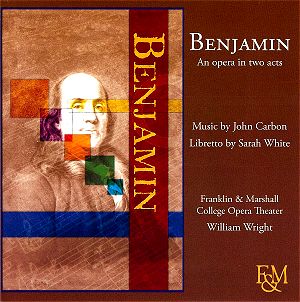
CARBON (b.1951) Benjamin: An Opera in Two Acts (1987)
Libretto by Sarah White Benjamin
Baritone - Stephen Kalm (baritone)
Deborah Franklin - Valerie Bernhardt (mezzo)
Benjamin Younger - Kristen Forrest Leich (mezzo)
Temperance – Colleen Yorlets (soprano)
Resolution – Gregory Johnson (tenor)
Silence – Ashley Konig (alto)
Order – Michael B. Popovsky (baritone)
Chastity – Dana Tambellini (soprano)
First Messenger – Jami Ross (baritone)
Second Messenger – Austin D. Williams (tenor)
Madame Brillon - Lorraine Ernest (soprano)
Maître de Musique – Bruce Gustafson (harpsichord)
Franklin and Marshall College Opera Theatre/William Wright
rec. live, Roschel Performing Arts Centre, Franklin and Marshall
College, Lancaster, Pennsylvania, 19-21 January 2006. ZIMBEL
RECORDS ZR114 [65:47 + 66:58]
John Carbon has been on the faculty of Franklin and Marshall
College since 1984 and three years after joining he collaborated
with librettist and poet Sarah White (b.1936) on this opera.
Carbon’s music has been recorded by MMC and he’s joined with
musicians such as Richard Stolzman and Marin Alsop, both
of whom have recorded pieces by him. He seems to favour historical
figures for his stage work; he’s working on an opera about
Houdini and his connection with Conan Doyle.
Houdini shares one thing in common with Benjamin Franklin,
the subject of the opera under review - most people think
they were American and they weren’t. Houdini was a Hungarian
Jew and Franklin was an English Colonist. Franklin may have
been a diplomat and scientist (and briefly an American) but
he wasn’t an escapologist - except perhaps linguistically
and in matters of the heart. This chamber opera charts his
life from a prologue in about 1715 to scenes in Philadelphia
in about 1730 and 1740, an Atlantic sea crossing in 1757
and then, in Act II scenes in London and Philadelphia, and
Paris followed by a final sea crossing and death in 1790.
The opera has some conceits starting with a Prologue with
the child Benjamin (called Benjamin Child) playing with musical
glasses as the real chorus warms up. Benjamin himself – called
Benjamin Baritone – makes his child self climb into a steamer
trunk and closes the lid. The conceit of the trunk recurs.
This almost metaphysical, play-within-a-play framing device
adds a jolt of anti-realism to the proceedings from the outset
and keeps the idea of narrative consistency at arm’s length.
Carbon uses a form of baroque based recitative tinged with
spiced harmonies to propel his narrative. There are strong
elements of musical theatre at work and whilst there’s no
clear lineage Stravinsky must have been an influence on Carbon
in a general sense, as well as perhaps de Falla and in the
lyrical moments maybe a Ned Rorem sensibility. These are
very general pointers, in no way to be taken as directly
applicable, but they do show the kind of enjoyably middle-of-the–road
position Carbon adopts.
The neo-classical writing for winds does add a certain tart
tint to the ensemble, whereas the writing for strings is
often lyric. The chorus can sometimes sound close to the
conventional contemporary-classical muse; the chorus that
ends Act One Scene One – Greetings Deborah – sounds
dangerously close to Ruttersville. But there are fine little coup
de théâtre – the Lightning Scene must look good with
an electrocuted turkey held aloft; is this a rebuke to Wagner’s
swan? And when Franklin’s modernity is invoked the accompaniment
shifts from harpsichord to Copland-tinged piano, maybe the
better to suggest the modernity of Franklin’s mind and inventions.
The pace slackens when Franklin travels for the last twenty
years of his life; the Second Act loses the concentration,
anticipation and the focus that’s generated in the First.
But there are still things to enjoy; the French dialogue
and flirtations in Paris, the spooky glass harmonica music,
the in-joke about Franklin College - which gets an appreciative
in-house laugh from the audience. We hear Madrigals, folk
tunes (Sur le pont d’Avignon), some enjoyable arias
and the death of Franklin in which the twin Franklins, Baritone
and young self, reach a sense of reconciliation.
In this chamber opera Carbon has fashioned elements and devices
contemporary with Franklin – operatic recitative, folk song,
madrigal, coloratura. Through stage and narrative devices
he and Sarah White have tried to suggest Franklin’s multiplicities,
his divided and undivided selves, the accommodations he made,
the wife he perforce neglected through travels and diplomatic
work, the scientific and musical advances he made.
A full English libretto is included and the sound is perfectly
serviceable – indeed more than that. It’s a very likeable
work, and without seeing it one has to imagine the choreography,
the comic and other interludes, and the general impression
that it would make on stage. The singing roster is quite
big though and scenes such as the appearance of the Allegorical
figures could perhaps be trimmed. Let’s hope this disc inspires
chamber companies and allied singers – some of the singing
roles are demanding – to give Carbon and White’s opera further
showings.
Jonathan Woolf
Please support our advertisers below by clicking on the logos for further information.

























 Benjamin
Baritone - Stephen Kalm (baritone)
Benjamin
Baritone - Stephen Kalm (baritone) 
