Editorial Board
MusicWeb International
Founding Editor Rob Barnett Editor in Chief
John Quinn Contributing Editor Ralph Moore Webmaster
David Barker Postmaster
Jonathan Woolf MusicWeb Founder Len Mullenger
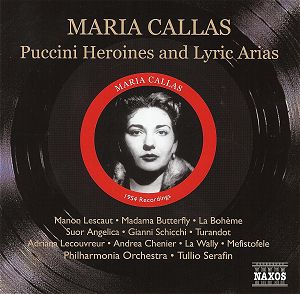
Maria Callas: Puccini Heroines & Lyric Arias Giacomo PUCCINI (1858–1924) In quelle trine morbide (Manon Lescaut) Sola, perduta, abbandonata (Manon Lescaut) Un bel di vedremo (Madama Butterfly) Tu piccolo iddio (Madama Butterfly) Si, mi chiamano Mimi (La Boheme) Donde lieta usci (La Boheme) Signore Ascolta (Turandot) In questa reggia (Turandot) Tu, che di gel sei cinta (Turandot) Francesco CILEA (1866-1950)
Io son l’umile ancella (Adriana Lecouvreur) Poveri fiori (Adriana Lecouvreur) Umberto GIORDANO (1867-1948)
La mamma morta (Andrea Chenier) Alfredo CATALANI (1854-1893)
Ebben? Ne andro lontana (La Wally) Arrigo BOITO (1842-1918)
L’altra notte (Mefistofele) Maria Callas (soprano)
Philharmonia Orchestra/Tullio Serafin
rec. 15–21 September 1954, Watford Town Hall. ADD NAXOS 8.111275 [69.13]
The
arias on this disc all come from Callas’s 1954 recording
sessions for Walter Legge. The sessions were held at Watford
Town Hall with the Philharmonia conducted by Serafin, rather
than an opera house orchestra. The selection of arias is
slightly curious as Callas includes excerpts from Manon
Lescaut, La Boheme, Madama Butterfly and Turandot which
she would go on to record complete for Legge; whereas the
album includes no arias from Tosca which she had just
recorded.
This
means that the Puccini selection does rather concentrate
on roles which Callas either never sang on stage or which
are not particularly associated with her. Innocence and girlish
charm are not Callas strong points so the processing of naïve
16 year olds must have caused her some pause for consideration.
But Callas was a singing actress, so In quelle trini morbidi from Manon
Lescaut succeeds in conveying a certain innocence and
purity, even if Callas is not girlish, and she matures wonderfully
in the second excerpt from the opera.
Un
bel di vedremo from Madam Butterfly is equally winning, if a bit generalised,
but you can almost hear her taking care. The tone is perfectly
controlled and each phrase is beautifully shaped. She makes
heroic efforts to rein in her rather uncontrollable wobble.
The result is lovely but you can hear the art that has
gone into the performance. Other singers, whose fach this
more naturally is, can do the aria in a far more naturalistic
manner. But Callas is always worth listening to, and she
can surprise you with a small phrase. In Tu piccolo
iddio she lets go a little more and we hear the passionate,
intense, unbridled Callas that we know.
Similarly
in the two arias from La Boheme we are conscious of
the care which goes into them, but there are lovely moments. Senza
Mamma from Suor Angelica is sung in a somewhat
freer manner; perhaps she felt less constrained by comparisons
with other performers. Serafin takes O mio babbino caro at
a remarkably steady tempo but Callas shows no sign of trouble.
In fact in this aria she also displays strong control, though
her performance is rather lacking in humour.
Whilst
Liu’s two arias from Turandot are not perfect and
Turandot’s In questa reggia is commanding but not
icy enough, Callas differentiates between the two characters
in a way that is an object lesson for other recitalists.
So
far, I have used the word ‘control’ quite a bit in describing
Callas’s performance. But it must be admitted that she is
only capable of a certain type of control. She is a singing
actress par excellence and her voice is capable of
achieving every expressive device expected of it, except
for the wobble. This has caused some comment in this recital
ever since the discs were first issued.
Puccini’s
heroines require Callas to sing out with full voice in her
upper register which inevitably leads to a strong vibrato
(wobble). The ending of In questa reggia is a case
in point ... and the effect was repeated when she recorded
the whole opera. In quieter moments she controls it, but
in the throes of passion, inevitably the voice gives way.
This is nothing new, the Callas wobble is something that
I realised I would have to live with if I wanted to listen
to her recordings.
But,
rather oddly, Naxos’s liner notes - written by Michael Scott,
author of Maria Meneghini Callas - make a great deal
of her vocal problems; so much so that one starts to wonder
why anyone should listen to the arias at all. It is true
that Caballé’s Liu and Nilsson’s Turandot both surpass Callas.
But Callas brings to everything her familiar intelligence
and vocal expressiveness, so if you can get beyond the wobble
then there are many lovely things to be heard here.
The
Puccini items are accompanied by a selection of arias which
formed the lyric section of her “Coloratura and Lyric Arias” recital,
Naxos having already issued the coloratura items.
In
the two items from Adriana Lecouvreur Callas displays
a beautiful sense of line and, frankly, I find these performances
lovely; but then again, Adriana has always been a role to
flatter sopranos. In La mamma morta from Andrea
Chenier she is nearly equally controlled, but more passionate.
The
performance of the famous aria from La Wally is perhaps
notable for the amount of control that Callas is able to
bring to it, reining in the wobble; making it remarkable
for technical rather than musical issues.
Finally,
in the aria from Mefistofele she brings all her skill
in earlier 19th century Italian opera to bear
on Boito’s elaborate music. The result shows what she can
really do on a good day.
This
is by no means a perfect recital. It does not play to Callas’s
strengths but she is never less than interesting. Given the
rather downbeat liner-notes and description on the outside
of the jewel case, I am puzzled about the market Naxos intend
for this reissue. Many Callas fans will already have the
arias. That said, Mark Obert-Thorn’s remastering is admirable
and well worth the minimal investment required for the disc.
Those who are not convinced Callas lovers will surely be
put off by the comment that the selection is ‘not without
blemishes’.
Don’t
be put off. If you can get beyond the blemishes - notably
the infamous wobble - then there is much else in here as
well.
Robert Hugill
Please support our advertisers below by clicking on the logos for further information.
























 Maria Callas (soprano)
