Anton Bruckner:
Symphony No. 9 in D minor WAB 109
The unfinished Finale
© Aart van der
Wal, February 2006
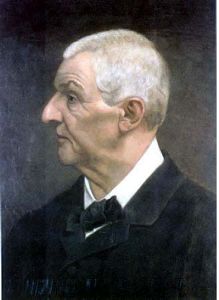 Anton
Bruckner, ca 1896 (oil painting by
Franz Antoine, Anton Bruckner Institute
Linz)
Anton
Bruckner, ca 1896 (oil painting by
Franz Antoine, Anton Bruckner Institute
Linz)
“See, I have already
dedicated symphonies to two majesties,
to poor King Ludwig and to our illustrious
Emperor, as the highest earthly majesty
I recognise, and now I dedicate my
last work to the Majesty of all Majesties,
to the dear Lord, and hope that He
will grant me sufficient time to complete
it and mercifully accept my gift.
I therefore intend to introduce the
Allelujah (probably wanted to say
Te Deum) of the second movement
again in the Finale with all power,
in order that the symphony end with
a song of praise to the dear Lord.”
[1]
These were Bruckner’s
words to his physician Richard Heller,
as they simply and convincingly efface
the strongly rooted tradition of performing
the Ninth as an all-inclusive three-movement
body that should finally end with
those very last murmuring and utterly
moving bars for horns and strings
in the Adagio, the movement that so
clearly marks the ‘Farewell to
life’, its motto appearing for
the first time in bar 29.
Apart from the manuscript
of the Finale that Bruckner left to
posterity, his words to Heller also
reveal that the Ninth was in no way
intended and conceived solely from
the perspective of a musical concept.
On the contrary, Bruckner’s unsurpassed
semantics were religiously driven,
and he commissioned his last work
at the very peak of his creative powers
to der liebe Gott. He must
have known it, as he shaped the symbolism
in his ultimate artistic gestures.
God is everywhere in
the Ninth, its ample indications demonstrating
Bruckner’s devotion to and his
recognition of God’s majesty,
in glorious moments of retrospection
and farewell, adoration and ecstasy,
humbleness and absolution, but also
the Last Ordeal, Dies Irae,
and the reality of the progressing
shadows of death, the course of life
coming to its closing chapter.
There can be no question
that Bruckner’s last Adagio contains
the autobiographical elements anchored
in his strong religious belief, and
therefore his reliance on God’s
mercy in the presence of death, a
clear and outspoken artistic statement
embedded in the complexities of ambiguous
harmonic progressions, strong and
radically symphonic, not just sanctuary
by fits and starts. The great chorale
in tubas and horns bears Bruckner’s
own description: ‘Farewell to
life’, and in this elusive hemisphere,
without a completed Finale at hand,
it is not hard to understand why the
long performance tradition confined
Bruckner’s opus ultimum
to the first three movements, with
the Adagio as the conclusive confirmation
that ‘all has been said’.
Do we really need Bruckner’s
own words to Heller to feel
and to comprehend what the composer
wanted to express in his last symphony?
Not at all. We notice instantly that
this work delivers the gigantic forward
thrust with its tremendous semantic
expansion of transcendental proportions,
that the message reaches out to metaphysical
borders, and that we do not need extensive
program notes and exhaustive analysis
to feel it all. This is the kind of
music that has the spiritual resources
really to uplift us, as in all great
music from a great mind, be it, as
in the case of the Ninth, in the familiar
three-movement version, or –
as it is now gradually recognised
– as a full four movements symphony,
as it should be.
First performance
Bruckner died in Vienna
on 11 October 1896. It was Ferdinand
Löwe, one of Bruckner’s
admirers and pupils, who conducted
the first performance of the three
movements at a concert of the Vienna
Concert Society (now the Vienna Symphony
Orchestra), on 11 February 1903. The
performance in the Musikvereinssaal
was no less than a triumph for Bruckner
and Löwe, but it was seriously
flawed by the many changes Löwe
had made in the original score. His
obvious reasoning was the success
he wanted to achieve with this first
performance, and in this sense the
performance was almost pre- programmed,
with Löwe less interested in
Bruckner’s originality and more
in ‘marketing’ the symphony.
By polishing and softening the edgy
instrumentation and by remodelling
the bold progression of harmonics
in the score he thought he could increase
the chances to glorify, and the history
books would mention it. Löwe
succeeded, although at the expense
of the purity of Bruckner’s heritage.
However, we should
not forget that Bruckner’s music
had no fundamental part in Vienna’s
musical scene, with the mainstream
of musicians and the public being
indifferent or even hostile to the
composer’s creative output. Prominent
critics like Eduard Hanslick had their
share in the long and ongoing battle,
taking each and every effort to condemn
and to marginalise the modest composer,
driving him to breakdowns and stimulating
this poor man without adequate self-assertion
to revise his works. Under these circumstances
it was no less than the act of a hero
to take the Ninth to the concert hall
and to lead the musician through the
hardship of long rehearsals to get
the best out of them. This was certainly
one of Löwe’s great achievements,
and despite our criticism we should
be grateful for his advocacy of Bruckner’s
music, stubbornly knocking and heading
against a strongly biased environment.
Löwe’s concert
ended with the Te Deum, which
was performed after the interval as
a solitary work. In the program booklet,
Löwe underlined that The Te
Deum would be played in the right
place and order, in accordance with
Bruckner’s wish. [2] He did neither
mention the changes he had made in
the first three movements nor did
he show any substantial interest in
what Bruckner had left of the Finale.
Many reviews of this
performance – and the interval
must have played a part in this –
did not mention that the choral work
was set in C major, instead of in
D major, the tonal scheme that should
have concluded the D minor symphony
in all its splendour. Bruckner, although
one of the great advocates of formal
tonality schemes, had indeed suggested
that the Te Deum would qualify to
serve as the final movement for the
symphony, failing a better solution.
His decision got some support from
Max Kalbeck, one of the leading Viennese
critics, who persisted that after
the closing bars of the Adagio in
E major, the following C major did
not sound better or worse compared
to the usual D minor, and that there
was no reason whatsoever to confine
to the formal tonal scheme, with ample
spiritual and esthetical arguments
to left abandoning tonal unity (of
the classical scheme) in this particular
case. This was written clearly against
the intentions of Löwe and Hirschfeld,
who both suggested the symphony should
better be performed without the Te
Deum at all, and that Löwe
followed Bruckner’s own suggestion
only with 'piety for the master's
decision'.
Hence the discussion
focused on the idea that Bruckner’s
illness and death deprived him of
the opportunity to finish the work,
that the Adagio was Bruckner’s
real farewell to the world, the heartfelt
conclusion of his work on earth, and
at the same time the quite moving
announcement of the transition from
suffering to transfiguration. Just
from this perspective the soft drum
roll that starts the quirky Finale
is hopelessly out of tune... The myth
was created hundred years ago and
is still alive today, heartily joined
by most great Bruckner conductors
and their compliant audiences.
In that long history
of performing the Ninth, the three-movement
version is always predominant. Löwe’s
voice still sounds: although the symphony
remained unfinished, it does not need
to be finished. Or: the three movements
say all that needs to be said, period.
The myth is a very long preserved
one, even after Alfred Orel had published
a flow of so far unknown manuscript
papers in his rather chaotic edition
prepared for the Bruckner Kritische
Gesamtausgabe.
Alfred Orel
Already in 1921 the
musicologist Alfred Orel had published
a review in the Viennese leading music
magazine Der Merker on the sketch
material of the Ninth: Skizzen
zum vierten Satz von Bruckners Neunter
Symphonie.
In 1929 the Kritische
Bruckner-Gesamtausgabe (Complete
Critical Bruckner Edition) was launched
and in 1934 Alfred Orel presented
both the original score of the first
three movements of the Ninth, together
with a study score containing drafts
and sketches of all four movements
(Entwürfe und Skizzen).
Orel did not present a correct picture
of the Finale manuscripts as already
available at that time (Nowak made
instant corrections by hand on his
copy after its publication). The score
was to appear in 1932 already, but
the publisher, Filser, collapsed.
This turned out to be a good thing
for Orel: the first proofs for his
edition contained almost no music
for the Finale at all, but then in
1931 Franz Schalk died, and Orel got
access to the Finale manuscripts through
Schalk’s widow. That he would
have to prepare the Finale material
in such a short time may explain some
of his shortcomings.
A substantial number
of sketch pages did not appear because
Orel had no access or did not find
them worthwhile, but it was at least
the first attempt to present the Finale
to scholars, performers and the public.
Although a study score covering the
first three movements and The Deum
had already been published by Universal
Edition in 1911, it did not carry
much significance, as it was solely
based on Löwe’s edition
for the first performance of the work
in 1903 (The Te Deum remained
untouched in the first print).
The premiere of the
original three-movement version took
place on 2 April 1932 in Munich, conducted
by Siegmund von Hausegger. He conducted
two consecutive renditions of the
Ninth. In the first he used the only
existing printed edition with its
typical almost creamy Wagnerian 'soundscape',
which was far from Bruckner’s
own manuscript. The second performance
was based on pre-copies of the new
edition prepared for the Kritische
Gesamtausgabe. Hans Weisbach conducted
the premiere of the Finale’s
exposition based on an edition arranged
and edited by Fritz Oeser on 12 October
1940 in Leipzig, at the beginning
of the concert, just before the first
movement took off.
Through the years Orel’s
1934 edition stimulated a mainstream
of workshops, piano transcriptions,
orchestral schemes or attempts to
complete the Finale (in chronological
order), but most of these (except
***) have lost their meaning in the
course of time:
| Else Krüger |
2 pianos |
1934 (fragments) |
| Fritz Oeser |
orchestra |
1940 (exposition only) |
| Hans Ferdinand Redlich |
2 pianos |
1948 (fragments) |
| Edward D.R. Neill & Giuseppe
Gastaldi |
orchestra |
1962 (fragments) |
| Ernst Märzendorfer |
orchestra |
1968-1969 (completion) |
| Hein's-Gravesande |
orchestra |
1969 (completion) |
| Arthur D. Walker |
orchestra |
1965-1970 (fragments) |
| Hans Hubert Schönzeler
|
orchestra |
1974 (fragments) |
|
Peter Ruzicka
|
orchestra |
1976 (fragments) |
| Marshall Fine |
orchestra |
1977-1979 (completion) |
| William Carragan |
2 pianos |
1979-1981 (sketch for orchestration) |
| William Carragan *** |
orchestra |
1979-1984 (completion) |
| Nicola Samale & Giuseppe
Mazzuca |
orchestra |
1979-1985 |
| Nors P. Josephson |
orchestra |
1979-1992 (completion) |
| Samale & Mazzuca, arr. Samale |
2 pianos |
1985 (completion) |
| Samale & Benjamin-Gunnar
Cohrs |
orchestra |
1986-1988 (completion) |
| Samale/John Alan Phillips/Cohrs/Mazzuca
(SPCM) |
orchestra |
1989-1991 (completion) |
| SPCM, arranged by Phillips |
2 pianos |
1991 (completion) |
| SPCM, revised by Phillips ***
|
orchestra |
1996 (completion) |
| SPCM, revised by Cohrs &
Samale *** |
orchestra |
1996-2005 (completion) |
| Phillips *** |
orchestra |
1999-2002 (fragments) |
| SPCM, revised by Cohrs &
Samale, arr. Thomas Schmoegner
|
organ |
2005 (completion) |
| Cohrs *** |
orchestra |
2006 (fragments) |
One finale, many
arrangements
One of the largest
projects ever undertaken was the reconstruction
of Mahler’s Tenth symphony, and
also here many scholars had –
as can be imagined – different
views: Krenek, Carpenter, Wheeler,
Wollschläger, Mazetti Jr., Barsjaj,
Mazzuca/Samale and, finally the one
whose edition finally made it dominantly
to the concert hall, Deryck Cooke.
Indeed, there are still discussions
about Cooke’s final performing
version, including some changes that
had been made after his death (resulting
in the well- known Cooke version III,
published in 1989), but all other
versions have either been forgotten
or strongly marginalised. It is the
Cooke version that foremost appears
on the orchestral desks.
All these editions,
be it performing versions or not,
bear such a variety in approach and
interpretation, defensible or not,
that it diminishes confidence in their
artistic validity; and even more so
when public access to the original
sources is either restricted or impossible,
with critical annotation non-existent.
Under the yoke of such wilfully created
obscurity the question of who is right
and who is wrong has lost its meaning.
Not even professional
music critics and performers take
serious efforts to read all underlying
documentation, if available. They
express their views without knowing
the facts and based on personal taste,
preferences or dislike just caught
by the ear. This can hardly be stimulating
for any editor spending much time
and efforts to explore Bruckner’s
manuscripts in all their detailing.
There is always that basic discrepancy
between scholarly craftsmanship and
unprofessional critical attitude.
Bruckner's illness
Another controversy
refers to Bruckner’s alleged
inadequate physical and – even
more important – mental capacity
to complete the symphony. It wrongly
suggests that he was not up to the
task of composing a Finale of this
magnitude and that the fragmented
music that survived was the creation
of a more or less mentally disabled
man, or at least a composer who had
lost track at the end.
In or out of this context
there was the kind of ‘catastrophist
thinking’ in the early 1980’s
based on the assumption that Bruckner
had lost his faith from 1892 onwards.
The musicologist Harry Halbreich,
supported by his colleague Paul-Gilbert
Langevin, assumed that Bruckner’s
almost daily prayer entries already
broke off in 1892, suggesting that
Bruckner had lost his faith and consequentially
his main incentive to complete the
Finale. Whatever it was worth, it
became a non-issue anyway when a decade
later Elisabeth Maier of the International
Bruckner Institute in Linz revealed
that at least a portion of Bruckner’s
prayer entries had been recovered,
including those which Bruckner had
written down after 1892, and
even on the day before his death.
[5]
In March 1890, nearly
2½ years after he had started
to compose the Ninth, and five years
before he took up the Finale, Bruckner’s
doctors diagnosed chronic throat and
larynx catarrh together with severe
symptoms of nervousness. On 1 July
1892 arterial sclerosis, hepatitis
and diabetes were diagnosed (the latter
factually a death sentence). In January/February
1893, Bruckner suffered from dropsy
while working on the Scherzo movement,
but after instant surgery his condition
quickly improved. Nevertheless, his
general physical condition remained
to be so worrisome that on 24 March
the last sacraments were administered.
He gradually recovered, but the planned
reception to mark his birthday, on
4 September 1894 in Steyer, had to
be cancelled.
After having completed
the Adagio – which took him great
pains and effort – on 30 November
1894 he fell seriously ill again and
on 9 December last sacraments were
administered for the second time.
At Christmas he was able to play on
the organ in the monastery of Klosterneuburg,
but on his way back to Vienna he suffered
a pleurisy attack again, fulminating
into pneumonia the very next month.
The resulting shortness of breath
made it impossible to ascend the stairs
of his home in the Heßgasse
in Vienna. In February Anton Meißner
asked the Count Liechtenstein to provide
new quarters without stairs for his
master. On 4 July (1895) Bruckner
moved to the Kustodenstockl
(lodge) at the Belvedere estate, where
he would remain until his death.
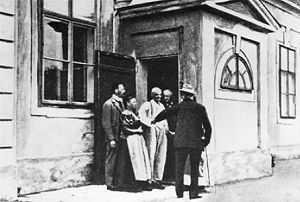 Anton
Bruckner (centre), his brother Ignaz
(entrance), housekeeper Kathi Kachelmayer
and the physicians Richard Heller
and Leopold Schrötter (back facing
the camera), and Kathi's daughter
Ludowika Kutschera (behind Dr. Schroetter
- she is barely seen) at the Kustodenstockl,
Belvedere, Vienna, 1896
Anton
Bruckner (centre), his brother Ignaz
(entrance), housekeeper Kathi Kachelmayer
and the physicians Richard Heller
and Leopold Schrötter (back facing
the camera), and Kathi's daughter
Ludowika Kutschera (behind Dr. Schroetter
- she is barely seen) at the Kustodenstockl,
Belvedere, Vienna, 1896
Almost exactly one
year later, on 9 July 1896, he had
to face another attack of pneumonia
and on 17 July the last sacraments
were administered for the third time,
but his recoup was amazing again.
However, his prayer entries from early
July onwards show signs of confusion
and difficulty in keeping track of
days and dates, relieved by clear
moments. In August (the last date
in the score of the Finale is 11 August)
mental degradation was noted and in
September Josef Schalk wrote to his
brother Franz that Bruckner’s
spirit had left him and that he got
more and more under the spell of religious
delusions.
Between start and
finish
Nothing is final unless
the composer has decided so. Bruckner’s
Ninth does not contain his final musical
signature and it remains far from
clear whether he was ultimately satisfied
with the music he had put to paper.
Then, there the moral
issue might be raised, in the sense
that we should not touch a work heavily
interrupted by sickness and finally
stopped by death. It was not completed,
Bruckner might have severely encroached
it later on (although he did not so
with the Fifth, Sixth and Seventh),
or might even have drastically changed
the overall concept he originally
had in his mind (very unlikely), provided
he would have lived long enough.
The musicologists Benjamin-Gunnar
Cohrs and John Alan Phillips have
strongly argued that straight from
the very beginning, Bruckner maintained
a broad perspective of the schematic
form, with less focus on the material
that needed to be supplemented later.
[4] From the outset he drafted all
elements on basis of the conceptual
form he already had clearly in his
mind, and their individual position
in the score in coherence with both
the preceding and subsequent sections
as well as the overall structure of
the work. In later revisions, small
or large, it therefore sufficed to
enter just symbols or markings in
shorthand. This methodology reveals
indeed that he had a very clear picture
of the work’s architecture as
a whole. In short, Bruckner knew what
he was heading for, although all his
manuscripts show that he did not have
Mozart’s congenial ability just
to write down what he had in mind,
without much alteration. Bruckner’s
manuscripts commonly betray –
like for instance Beethoven’s
– a long and difficult struggle.
Whatever the arguments
pro or contra reconstructing an unfinished,
fragmented musical score, the bare
fact is and remains that professional,
meticulous and foremost respectful,
musicological approach may produce
stunning results. And let us be fair:
no one can work on such a painstakingly
prepared project, which involves many
years of intensive labour at high
cost, without great love for Bruckner’s
music.
Bruckner's methodology
Let us look at Bruckner’s
methodology before further discussing
the torso of the Finale: [4]
| 1. Example A |
Sketch in particello
(three to four staves), ongoing
musical argumentation, partially
scarcely readable (thin and fleeting
writing). |
| 2. Example B |
Fully written-out
score in bifolio (or Bogen), notation
on staves, with on each page prefixed
entries for the instruments from
top to bottom in the correct order,
together with keys, time and (also
fixed) four bar lines (mostly
prepared by his pupil and ‘secretary’
Anton Meißner), successively
and continuously numbered. clarinets
notated in B flat and horns and
trumpets in F. |
| 3. Example C |
As above, but only
containing the principal elements
(strings, important woodwind and
brass entries, often in pencil
to facilitate later erasure and
subsequent overwriting in ink).
|
| 4.Example D |
Continuity drafts
(Satzverlaufsentwürfe) in
rudimentary design (Bruckner also
entered single melodic lines,
mostly the violin part, into the
full score formatted sheets at
hand). |
| 5. Example E |
Dates in the manuscripts
in Bruckner’s handwriting
help to determine the genesis
and progression of the composition.
Note: you will find the examples
at the end of this article. |
The final stage contained
polishing such as phrasing, articulation,
dynamics and last changes.
These were the basics
of Bruckner’s workmanship from
the Eighth symphony onwards, with
a variety of overlaps when the composer
worked his way through from section
to section, designing further particello
sketches and exchanging bifolios or
sheets.
The scoring in the
second stage comprised subsequent
bifolios (double-folded sheets) with
the first page consecutively numbered
in the upper right corner. Meißner
had prepared these pages with bar
lines, indication of instruments,
keys and clefs so that the composer
could write down the notes instantly.
When working on substantial revisions
the existing bifolios were simply
replaced by new ones. Clean score
sheets were used when existing sheets
had been severely compromised by heavy
corrections. In many cases no distinction
can be made between completed sketches
and final notation (Reinschrift).
Phillips adequately characterised
the numbered score pages (including
the continuity drafts) in their final,
although incomplete shape as an ‘emerging
autograph score’.
Deciphering Bruckner’s
sketch material is hampered by the
quality of the paper and the use of
glue and ink. Also, many sketches
are scribbled with light pencil strokes
or the handwriting obscured by the
composer’s unsteady physical
condition. Nevertheless it is astounding
that age, severe health problems and
consequentially his physical weakness
did not affect Bruckner’s capacity
to design long stretches in an accurate
and secure fashion. Philological investigation
revealed that even his serious pneumonia
in July 1896 did not deprive him of
his abilities, and at least a few
months prior to his death he was at
intervals still able to demonstrate
all his skills as a composer. His
strict and straightforward working
methods did not leave him until the
final moment that he was no longer
able to work.
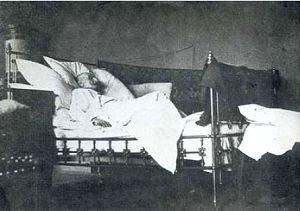 Probably
the last photograph of Anton Bruckner
(according to dr. Heller taken on
17 July 1896)
Probably
the last photograph of Anton Bruckner
(according to dr. Heller taken on
17 July 1896)
History of composition
Presenting a reconstruction
of Bruckner’s swansong is one
thing, but adequately documenting
it quite another. Phillips and Cohrs
have repeatedly emphasised the importance
of proper annotations on the nature
and the results of all relevant philological
endeavours. The proof is not in eating
the pudding (hearing the music), but
in disclosing the exact course and
particulars of the reconstruction
project. Apart from that: no one is
able to express meaningful criticism
or make relevant observations without
a solid basis first. In the same sense
it is imperative that the facts are
available to anyone who is interested,
and that the Brucknerian knows exactly
to whom this music really belongs,
apart from the equally important question
whether the direction it takes
in conformity with the composer’s
intentions.
Phillips ascertained
that for the Finale Bruckner used
a variety of six different types and
formats of paper, but mainly the upright
format with 24 systems from his publisher
Josef Eberle in Vienna (‘JE &
Co., No. 8./24 linig’). By verifying
these papers with the composer’s
entries it was fairly easy to establish
which papers had been taken first
(and last!) from the pile. Incidental
inconsistencies in Meißner’s
prefixes on the score sheets he had
prepared for his master, and the use
of different paper do not resemble
different versions Bruckner was working
on (Orel was definitely wrong here).
On the contrary, also these various
paper types appeared to be an important
factor in determining Bruckner’s
genesis and chronology of composition.
Bruckner’s remark
on a calendar shows that he started
working on the Finale on 24 May 1895.
It had been a long way, from the first
ideas written down for the opening
movement of the symphony, on 12 August
1887, two days after the completion
of the first version of the C minor
symphony. In October he got the news
that not only the conductor Hermann
Levi but also the two Schalk brothers
had rejected it, which led to a deep
mental crisis and subsequently to
the second version of the work. He
also undertook revisions on his First,
Third and Fourth symphonies, at the
same time continuing to work on the
Ninth. New works were also composed:
Helgoland, Psalm 150, Das
deutsche Lied, Träumen
und Wachen and Vexilla regis.
The first movement
of the Ninth was completed on 23 December
1893, the beginning of which must
have commenced in an early stage in
full score already. The exposition
part was repeatedly redesigned as
the composition process progressed.
Bruckner finished the Scherzo with
the final (third) Trio on 15 February
1894, and the Adagio – which
took him great pains and effort –
on 30 November.
Investigations by Samale,
Cohrs and Phillips [4] revealed the
following chronology:
| 24 May 1895 |
Start of composition. |
| 8 June 1895 |
Sketches in particello of the
first part (exposition) of the
Finale, quickly followed by further
detailing and working on the score
(sheet 1A). |
| Autumn 1895 |
Second part up to the beginning
of the fugue and completion of
the instrumentation of the first
part (exposition), including rewriting
of specific heavily overwritten
and adhered sheets. There are
indications that Bruckner decided
at this point to introduce the
idea of the fugue, as preliminary
sketches of the second part consist
of a set of variations on the
main thematic motives in its reverse
scheme, clearly leading to a nonfugato
reprise. In the composition process
the second part was finally remoulded,
with the fugue concept established.
The final scoring extended to
the very beginning of the fugue
((date in the score on bifolio
17: 12 December 1895). |
| 16 December 1895 |
Most probably the beginning
of the third stage, with drafting
the fugue and its progression
(the date is mentioned in the
score in Bruckner’s handwriting).
At this time Bruckner also decided
to introduce a new epilogue theme
of the fugue and chorale recapitulation,
including the significant triplets
from the main theme of the first
movement. The work process was
maintained until early summer
of 1896, with the entire second
part scored for strings, and incidental
markings for the wind instruments.
Sketches for the coda date from
18 to 23 May, corresponding with
the statement of Franz Bayer,
one of Bruckner’s friends,
in the Steyrer Zeitung that the
composer had (just) completed
the sketch of the Ninth’s
Finale (10 May 1896). |
| May/June 1896 |
Final instrumentation and new
parts of the exposition. At that
stage he had already reached the
coda, but sadly much of it got
lost. Drafting part of the coda
and final cadenza: 19, (Thursday)
21, (Friday) 22, (Saturday) 23
(this corresponds with May 1896).
According to Phillips, Bruckner
returned to the beginning of the
movement, presumably wrote a clean
first bifolio and divided the
contents of the second bifolio
into two new bifolios, renumbering
all subsequent bifolios by one
higher. Further detailing of the
instrumentation must have begun
soon thereafter, revising the
development section (date: 14
June 1896). |
| July 1896 |
Although Bruckner recovered
from his pneumonia and as from
mid July started to compose again,
it is quite unlikely that he felt
vigorous enough to work consistently
from mid July onwards. However,
the last date in the manuscript,
11 August, marks a very convincing
extension of the beginning of
the development section on two
bifolios (the first numbered “13a”
by Bruckner, the continuing one
yet unnumbered.) |
It is likely that Bruckner
finished the primary stage of the
instrumentation in this period, with
the main strings, woodwinds and brass
lines noted down in his customary
shorthand-writing. We can distil this
from the available bifolios (including
the continuity drafts or Satzverlaufsentwürfe)
and his method of transferring the
sketches directly to the score.
At the time of Bruckner’s
death, a total number of at least
40 bifolios containing more than 600
bars of music, must have existed (according
to Cohrs and Phillips). Both the exposition
and large portions of the development
section had been fully completed.
Bruckner completed
206 (208) fully instrumented bars
and 224 bars with strings and shorthand
notes for woodwinds and brass. Furthermore,
we have continuity drafts (Satzverlaufsentwürfe)
of 122 bars. No such sketches survived
of 111 bars, thus the music needed
to be construed from both original
(68 bars, by sequence, transposition,
1:1 repetition and adaptation) and
free material (43 bars), all
together about 17% of the Finale,
or about 4 minutes of music. This
all makes a total of 663 plus 2 optional
bars
The Facsimile Edition
also offers the closest approach to
Bruckner’s overall concept of
the Finale, and although they are
his last ‘words’ on paper,
we need to realise that they reflect
his work in progress without the possibility
to conclude it. Nothing in there can
therefore be considered as final,
not even the fully scored and instrumented
portions, with passages either boldly
overwritten or cut, pasted and glued.
Thus, we will never be able to grasp
whether he had later on revised the
Finale, or even the entire work, more
or less. We deal with what is left,
and it is of no use whatsoever to
start speculating about what is not
there. However, one should consider
that already the surviving material
contains numerous revisions and working
phases, for instance, the first theme
group survived in at least six different
phases. Hence it seems to be appropriate
to assume that Bruckner at least came
to a more or less ‘final’
structure of the piece as such.
Cohrs and Samale give
a full outline of their considerations
and decisions in their Main Features
of the New Edition by Samale and Cohrs
(SC 2004), with the inclusion
of tempi, instrumentation, dynamics,
phrasing and articulation.
Carragan
Although the American
musicologist William Carragan had
met Cohrs in 1985 and Phillips in
1996, he preferred to work on his
own, saying that his decisions would
be his own, and that he preferred
not to share his responsibilities.
Carragan conceived
his version of the Finale in 1979,
and orchestrated it in 1983, with
a minor revision in 1985. The premiere
took place in Carnegie Hall in New
York on 8 January 1984, conducted
by Moshe Atzmon. The European premiere
was launched in April 1985 in Utrecht,
the Netherlands, by the Utrecht Symphony
Orchestra conducted by Hubert Soudant.
In 1986 the symphony was performed
at St. Florian, bringing this music
almost symbolically back home.
After its New York
premiere Carragan’s edition carried
great impact in all main musical circles,
and it put the Finale as a performing
version for the first time on the
map (although Ernst Märzendorfer
had performed his edition of 670 bars
already in 1969). This even accelerated
after the first recording was released
(Oslo Philharmonic conducted by Yoav
Talmi, 1985, Chandos CD 7051-2).
Carragan's completion
was also highly admired by reputed
Bruckner scholars such as Ben Korstvedt
and Alan Crawford Howie (UK) and Dermot
Gault (Ireland), but not everyone
was enthusiastic. After the release
of that recording the well-known music
critic Dietmar Holland questioned
in Neue Musik Zeitschrift (May
1987) the real benefit of hearing
Bruckner's sketched music without
the presentation of any critical annotation
by Carragan, whereas the original
sources were not accessible (at that
time). He also noted a 'Salto mortale
in die Welt des Richard Strauss und
am Ende gar der Filmmusik Hollywoods
[...], daß einem schier die
Spucke wegbleibt'. [3]
Carragan definitely
presented his work as a completed
version and not as a reconstruction,
for performance purposes. He had studied
the manuscripts in Vienna, had photographs
of inaccessible parts at his disposal,
and was - while working his way through
the manuscripts - able to correct
most of the errors in the Orel edition
and beyond.
There were discussions
along the road, and particularly in
Europe, about Carragan's rather flexible
approach to the original score by
introducing bars of his own, and most
of all his long insertion connecting
the Finale’s second and third
theme groups in the recapitulation
that also marks the point where he
brings back the theme of the Adagio.
He was of course aware of the problem
at that time, but he felt he needed
that insertion for structural reasons,
longer than the 16 measures for which
the numbering seemed to provide. Before
applying the 16-measure straitjacket
instead he needed to be really sure
that the numbering was correct and
contemporaneous. At that time Carragan
assessed the available sources, and
noticed that the numbers on many of
the source’s bifolios were heavily
overwritten and the actual numbers
themselves were highly debatable over
a wide range. Also many of the early
numbers, and perhaps some of the later
ones too, appeared not to be contemporaneous.
However, he may not have realised
that Bruckner simply used mainly discarded
bifolios as sketch paper, sometimes
including the continuity of more than
one bifolio. It might also have helped
when he would have used Bruckner's
own metric figures.
He filled the gaps
in the song period (Gesangsperiode)
with only 8 bars, and at the end of
the exposition section he entered
8 bars into the last preserved bifolio
12C (pages 205-208 in the facsimile
edition) originating from Bruckner's
later adaptation, adding to this the
last 6 bars of 12C. He introduced
50 bars of his own at the end of the
reprise of the song period, from bar
481, although only one sheet appeared
to be missing. These 50 bars were
based on Bruckner's own material from
the exposition section, but they simply
did not sit well in their new frame.
Carragan also entered
143 bars - although partially based
on Bruckner's material - to bring
the symphony to an aurally convincing
end, but overlooking that his predecessor,
Orel, had erroneously defined a bifolio
as '21. Bg. E', which was in fact
part of the chorale reprise, with
bifolio 31 (16 bars) just missing.
Carragan also used bifolio 32 in his
edition's coda (bar 673-688), although
it was not part of the choral reprise.
However, he was the first musicologist
to recognise the importance of the
particello drafts of the coda.
So all in all, Carragan’s
edition sounds quite impressive, although
it contained about 230 bars of his
own, and paradoxically without utilising
all of the substantial material Bruckner
had left. It proved to be a hallmark
leaving a great impression on the
audience. In this respect, I only
recall the performances in the Netherlands,
on 14 April 1985 (Amsterdam, Concertgebouw),
16 April 1985 (Utrecht, Vredenburg),
and 26–31 January 1987 (Hilversum,
radio studio).
See also: http://www.opusklassiek.nl/componisten/bruckner_symphony_9_finale_wc_spcm.pdf
Nowak
In May, 1991, not until
shortly before his death, Leopold
Nowak, the great and leading spirit
behind the Kritische Bruckner Gesamtausgabe
since 1946, after he had taken over
Robert Haas’ position as director
of the precious music collection of
the Austrian National Library, entrusted
the Australian musicologist John Alan
Phillips with editing Bruckner’s
Ninth and particularly the Finale
fragment in order to have it officially
published as part of the Gesamtausgabe.
This was a critical decision for Nowak,
as he was always far from being convinced
of reconstructing and publishing the
basically fragmented Finale. And the
more so as Nowak, compared to Haas,
had through the years demonstrated
a more critical and scientifically
attitude to examining and editing
Bruckner’s creative output (Nowak
is also the author of various essays
on Bruckner’s music).
In the wake of his
death, Nowak (Herbert Vogg would be
his successor) had seriously reconsidered
his long-standing resentments, he
had made his checks and balances and
he decided that Phillips should now
go on with the project of the Ninth,
but to withhold publication until
after still missing parts had been
traced.
That was Nowak’s
basic idea, Phillips to take up the
task of revising and Orel's Sketches
and drafts for the Ninth (1934)
and not the corrected 1951 reprint,
a project that Nowak had originally
planned until after finalising the
Kritische Gesamtausgabe (Cohrs
would prepare a new annotated edition
of the first three movements). The
final outcome should be in line with
Nowak’s principal goal that all
of Bruckner's compositions be made
available in transparent and reliable
musical editions. The accompanying
critical reports were to be scientific
but nevertheless comprehensive and
suitable and attainable for use in
musical practice.
Phillips
Phillips was not the
first scholar after Orel to take up
the Finale fragment: Nicola Samale
and Giuseppe Mazzuca started their
own courageous project in 1983 already,
at the time that the subject was still
under strong taboo, and like Phillips,
also in a profound manner.
From the outset it
was clear to him that even without
Bruckner’s dedication to ‘the
dear Lord’ the work contains
the religious semantics, which creates
the music’s transcendental atmosphere
and evokes the metaphysical tendency
in most if not all interpretations.
Apart from formal and hermeneutic
considerations the term ‘absolute
music’ fails to comply with what
this symphony is really all about.
It became also clear
to Phillips that the overall structural
coherence of the Finale fragment was
not in question and that its specific
elements were based on virtually the
same melodic and structural components
as in Bruckner’s last choral
works (Psalm 150, Vexilla Regis,
Das deutsche Lied and Helgoland),
and – most important – in
the preceding three movements of the
Ninth. This symphony offers a striking
resemblance with the Fifth, both heading
toward a huge Finale, which combines
sonata, fugue and choral forms. The
Ninth’s Finale – and this
can be unquestionably distilled from
the fragments – delivers at last
(sec) the full structural stability
for the entire work, radically and
profoundly, its melodic and harmonic
ambiguities coming close to a purgatory,
and even more so after the Adagio
with its ‘farewell’ mystifications
(another good reason to abandon the
‘workshop model’ with the
Finale performed as a solitary entity).
According to Phillips,
the reconstruction of the Finale was
less a matter of dabble scholarship
and more a question of practical implementation,
i.e. performing the music, at the
same time offering new knowledge to
anyone willing to listen and to appreciate
a masterwork that was obscured and
kept from the public domain for almost
a century. This goes beyond the debate
whether it was justifiable to take
up a work that was left uncompleted.
In this particular case Bruckner did
not leave some fragments or sketches,
but a work in progress containing
long stretches in clearly defined
form, partly even scored for instruments,
with consecutive page numbering and
even clear markings in the composer’s
handwriting that specific parts in
the manuscript were considered finished
(fertig). Obvious errors could
be substituted by sketch material
– also for the coda – or
previously completed parts, and all
within the discourse and to the benefit
of the ongoing musical argument. Frankly,
this was already the result of the
work by Samale and Mazzuca, as given
in their Critical Annotations to the
Ricostruzione edition, published
by Ricordi in 1986.
Phillips edited the
following volumes (some are still
under preparation, in particular a
text book on the Finale and new transcriptions
of the surviving sketches, drafts
and discarded score bifolios of the
first and third movements):
 Facsimile edition of Bruckner’s
full autograph, MWV,
Vienna, 1996 (ISMN M-50025-133-0)
Facsimile edition of Bruckner’s
full autograph, MWV,
Vienna, 1996 (ISMN M-50025-133-0)
Accompanying documentation, MWV,
Vienna, 1999/2002 (ISMN M-50025-232-0)
Reconstruction of the autograph score,
MWV,
Vienna, 1994/99 (ISMN M-50025-211-5)
Phillips’ documentary
work was solely based on what Bruckner
had left and as far as it could be
deciphered and interpreted, with no
additions of its own, accompanied
by extensive commentary. Missing pages
remained blank in Phillips’ edition,
the composition material gets thinner
as the music progresses through the
recapitulation section. Phillips also
included the drafts for the coda.
It got its first public
performance in November 1999, by the
Vienna Symphony Orchestra conducted
by Nikolaus Harnoncourt, creating
a sensation in musical circles and
beyond, but the inevitable gaps disrupted
the musical argument, in short it
had all the virtues and disadvantages
of a typical ‘workshop’
version (526 bars or about 18 minutes
of fragmented music). It is a pity
only that Harnoncourt did not perform
the coda sketches (they were only
included in the first complete performance
of the ‘Documentation’ by
the Philharmonia Hungarica, conducted
by Benjamin- Gunnar Cohrs, in April
2001 in Dusseldorf).
The first recording
(RCA/BMG 82876 54332-2) of this Finale
fragment was made at the Salzburg
Festival in August 2002, performed
by the Vienna Philharmonic Orchestra
conducted by Harnoncourt, who also
acted as the witty narrator during
the workshop session. After the interval
the familiar three-movement version
was performed, in the new critical
edition prepared by Benjamin- Gunnar
Cohrs.
Samale and Mazzuca
This ‘completion
project’ originally started in
1983, initiated by the Italian composer
and conductor Nicola Samale, inspired
by his French colleague and music
critic Paul Gilbert Langevin.
From the very beginning,
Samale worked together with the composer
Giuseppe Mazzuca. In 1984 they studied
Bruckner’s manuscripts at the
Austrian National Library in Vienna,
whereas Samale also got hold of the
photographs of the sketch material,
which had been transferred in 1941
from the Prussian State Library to
Silezia and finally rediscovered in
1976 in the Jagiellonska Library in
Cracow. Their efforts finally led
to the critically annotated Ricostruzione
edition (1985), performing version
(after Carragan’s although
completed version) on the subject,
published by Ricordi in 1986 (Nowak
had refused its publication as part
of the Kritische Gesamtausgabe
due to the individual additions
to Bruckner’s manuscripts for
performance purposes), and subsequently
recorded by Eliahu Inbal in 1987 (Teldec
4509-91446-2) and Gennadi Rozjdestvenski
in 1988 (Japan BMG Melodyia CD BVCX38015/16).
Notwithstanding Nowak’s
refusal it cannot be denied that Samale
and Mazzuca had executed their job
very seriously. Samale punctually
calligraphed the score in accordance
with the original manuscript (including
Bruckner’s own page numbering
and metric figures) and clearly separated
the original text from the additions
by use of different font sizes. One
of the new edition’s great virtues
was the correction of many of Orel’s
mistakes. What was missing in the
lost manuscript sheets had been cautiously
supplemented with original parts from
the material that Bruckner had previously
considered but finally rejected, supplemented
with ‘raw material’ such
as sketches and drafts that were available.
Critics did not render
the Samale-Mazzuca edition a warm
welcome, as they were focusing on
the imaginative solutions the team
had adopted, just prior to the coda,
culminating in integrating and processing
the main themes of all four movements,
followed by the famous chorale theme
and merging into a cadenza composed
by Samale with the subsequent apotheosis
on an ostinato model in D, being critically
also on incidentally unstylish instrumentation,
the unsatisfying ending (instead of
a brilliant D major in the empty D
minor quint D-A) and spurs of other
unidiomatic solutions. However, the
greatest asset of the new edition
was the kind of ‘pull-down menu’
it offered, the Finale’s first
ever full panorama in a performing
version that kept the additions –
although unmistakably present –
to a minimum, with the detailed critical
annotations presented by the team.
Work still in progress
but without Mazzuca
In the next stage,
from 1986 to 1989, when Mazzuca had
lost interest in continuing the project,
Samale was joined by the Bremen based
conductor, musicologist and essayist
Benjamin-Gunnar Cohrs, which led to
two intermediate versions of the score.
Their edition was also taken to the
Netherlands, where it was performed
on 2 and 3 September 1987 by the Dutch
Radio Philharmonic Orchestra conducted
by Hubert Soudant, and broadcast on
6th September 1988.
There is also a live
recording from a concert by the Polish
National Radio Orchestra in Catowice,
on 8 October 1988, conducted by Samale,
and prepared with Cohrs’ conducting
assistance (Melodram CD MEL 989/1-2).
As we saw before, Nowak
had assigned John Alan Phillips in
May 1991 with editing Bruckner’s
Ninth and particularly the Finale
fragment anew, in order to have it
officially published as part of this
Gesamtausgabe.
Cohrs had introduced
Phillips to Samale in the early 1990’s
already, and in collaboration with
Samale, and later also consulting
Cohrs, Phillips conceived a new score,
typeset it on his computer and finally
published it in Adelaide (his hometown)
and Bremen (Cohrs’ hometown)
in 1992 in a private impression. This
edition became known as the Completed
Performing Version Samale- Phillips-Cohrs-Mazzuca
or – abbreviated – the SPCM
version, which had nothing to do with
Phillips’ edition of the fragments
only, a workshop version for the Musikwissenschaftlicher
Verlag in Vienna. The SPCM score appeared
in Phillips’ exclusive editorship
merely for copyright reasons (the
Samale/Mazzuca version was still under
Ricordi’s copyright regime at
that time, while the publisher was
not interested in the SPCM score).
The long title was
adopted to give proper credit to the
commitment of all the persons involved
in the entire project, from its very
beginning. The 1991 score (recorded
in 1993 by the Bruckner Orchestra
in Linz conducted by Kurt Eichhorn
/ Camerata CD 30CM 275-6) was subjected
to a few minor revisions by Phillips,
two of them suggested by Cohrs, in
1996, and was recorded again in 1998
(a live recording by the New Philharmonic
Orchestra of Westphalia conducted
by Johannes Wildner / Naxos 2CD 8.555933-34).
The differences between the 1991 and
1996 editions are very minor indeed.
This performing version remained valid
until 2004.
The new Critical
Edition by Samale and Cohrs (2005)
Already before 1996
both Cohrs and Samale felt uncomfortable
with several passages in the completion
and hence they both started a new
debate of how to proceed. At that
time Cohrs also started his extensive
philological work on the Ninth in
order to prepare his Critical Report
and New Critical Edition of the first
three movements for the Complete Critical
Bruckner Edition. He tried out various
changes when he had the chance to
conduct the piece himself, in Tokyo
(2001) and Gmunden (2002).
Finally, in 2003 Samale
and Cohrs asked Phillips to join them
in order to prepare an entirely new
version of the performing edition.
However, Phillips showed no further
interest in a collaboration and thus
Cohrs and Samale prepared their own
new edition of the Finale-Completion,
published in 2005 by Musikproduktion
Jürgen Höflich in Munich,
as Completed Performing Version
Samale- Phillips-Cohrs-Mazzuca (1983-1991):
New Critical Edition (1996-2004)
by Nicola Samale & Benjamin-Gunnar
Cohrs. It included also for
the very first time a full Critical
Commentary in both German and English.
The New Critical Edition
also contains the replenishment with
material from Bruckner’s own
sketches that solves two major gaps
in the second theme and the fugue.
Cohrs: ”The reconstruction of
lost score bifolios, the overall instrumentation,
the elaboration of the coda (again,
largely recovered from Bruckner´s
own sketches), tempi, dynamics and
articulation were likewise thoroughly
revised. 554 of the 665 bars of this
New Critical Edition are original
(208 bars finished, 224 bars incomplete
scoring, 122 bars of continuity drafts
and drafts). From 111 bars of replenishment
(ca. 17% of the Finale, 5.4 % of the
symphony, or approximately 4 minutes
of music), 68 were regained by repetition,
sequencing, or transposition of original
material. Only 43 bars were synthesised
without concrete proof, less than
two third of the instrumentation required
completion by the editors.” The
premiere took place in Fulham Town
Hall in Fulham, London, on 3 December
2005 by the Fulham symphony Orchestra
conducted by Marc Dooley.
It is fascinating to
experience that Cohrs, who, like Phillips,
had worked on Bruckner’s Ninth
and its sources for many years, found
a compelling argument for producing
a new score on basis of new manuscript
research and some surprise findings,
one of these relating to dynamic and
agogic detailing, which Bruckner habitually
reserved until after completion
of the entire work.
Various stages
Bruckner (1824-1896)
was already in his forties when he
composed his first ‘official’
symphony. Still about thirty years
were in front of him. One of his greatest
tragedies was that he was led to believe
that his symphonies needed ‘improvement’.
His work was his life and despite
some victories it was vehemently marginalised.
He faced one of the severest crises
after having composed the Eighth symphony.
He plagued himself in these many years
with revisions, and major part of
his symphonic output appears to us
as ‘work in progress’ (he
took up the revision of his First
symphony as far as in 1891, 25 years
after its genesis...).
We also see various
phases in the reconstruction of the
Finale of the Ninth by Phillips, Samale,
Cohrs and Mazzuca: no less than four
phases can be ascertained so far,
the most recent one already mentioned,
the Completed Performing Version
Samale-Phillips-Cohrs-Mazzuca (1983-1991):
New Critical Edition (1996-2004) by
Nicola Samale & Benjamin-Gunnar
Cohrs.
To some, this may create
additional doubts about the Finale’s
musical viability in its reconstructive
appearance, not quite appreciating
that new insights, anecdotes and papers
(like a previously unknown sketch
paper from June 1895, which was found
in 2003 in the estate of a Munich
music critic) and a healthy dosis
of rethinking and ‘scholar investment’
may direct to specific improvements.
It cannot be overlooked that the continuous
provisional status of the reconstruction
work could degrade either its importance
or its values in certain musical circles,
but it adorns musicologists who are
anxious to partially ‘overrule’
their own previous version(s) in order
to make it (even) better. It reveals
the kind of flexibility and zest needed
as an important contributing factor
to get an even more compelling result.
Fact is and remains
that the Finale’s material was
not treated with utmost care after
Bruckner’s death and that the
truncated, three-movement form quickly
gained momentum as a falsely accepted
doctrine ruled by tradition, ignorance
and indifference. Time has proven
that it took enormous effort to get
the four-movement symphony really
performed. Even today, most ‘star
conductors’ are not willing to
go beyond the lines of tradition.
Maybe they are through the years encapsulated
in the Bruckner clichés and
not able to adhere to Bruckner’s
unexpected boldness of composition
in the Finale, or they have other
doubts. Even in this domain there
is still a lot of work in progress...
and to do…
The workshop model
Conductors have different
choices in performing the Ninth: either
the three-movement or the four- movement
version, or the Te Deum as
the apotheosis, or the reconstructed
Finale as a separate entity in the
kind of workshop environment (as presented
by Nikolaus Harnoncourt).
In Bruckner’s
lifetime, major part of his music
was rejected as being ‘unplayable’.
Harnoncourt and the orchestra had
virtually the same feeling when faced
with the Finale in the Phillips edition
for the very first time. When they
had to play the music from the score
for the first time, their basic feeling
was: ”something like this cannot
be played.” The fourth movement
was new, carried no performance tradition,
appeared bold and unpolished to them.
Without defending all these encroaches
in the very past, there is at least
some notion of the reasons why Bruckner’s
music was found unplayable. It also
explains why Bruckner revised his
original concept thoroughly and vehemently,
in order to get his work performed.
Bruckner compromised
on the performance of his own
work just by saying: ”Make the
changes you like, as long as you perform
it.” However, he knew exactly
what he was doing, he did not compromise
on his scores (”I shall bequeath
my manuscripts to the Court Library
in the state as I composed.”)
Appreciating that the
Ninth’s Finale is the innovative
enfant terrible in Bruckner’s
entire output and that it will take
time to accept it at length as part
of the performance tradition, it is
understandable that the workshop model
is currently opted for, although it
does not stimulate the understanding
and appreciation of the Finale as
the inseparable part of the four-movement
entity.
Conductors should also
have a clear understanding of what
the Finale is all about. For example,
Riccardo Chailly, one of the few well-established
Bruckner conductors, missed the point
completely when he said: ”I’ve
studied it (the Finale) indeed and
have spoken to Mr. Samale, who showed
me the sketches; I have the score
of the Finale. I intended to perform
it once but then I changed my mind.
I do feel that the Finale is a very
interesting issue if it is played
completely separately from the symphony.
If it’s taken as a workshop concert
I could see the point; but to try
to sell it as the Finale of the symphony,
linked to the rest of the piece, I
think is really not right. Samale
showed me - the sketches are like
playing cards, pages without numeration
where you do not see any order and
not any feeling of shape of the composition.
There’s also the discrepancy
of the quality of music - what can
you say at the end of the Adagio?
The quality of the music is so incredibly
high; then you go back to a kind of
sketchy, scholastic, almost rhetoric
piece. It’s my idea that it should
be done in the morning of an evening
concert. You do a workshop of one
hour about the Finale, explaining
the piece, and in the evening you
perform the symphony in three movements
– that to me is the only possibility.
I think that Mazzuca and Samale did
a very good job, and I admire their
belief in what they did, because they
have been very honest and very scrupulous
– but that does not mean that
the piece should be done with the
rest of the symphony.”
Cohrs responded: ”Regarding
Bruckner's unfinished Finale, I should
add that Maestro Chailly was wrong
in his memory, since I know from my
friend and colleague Nicola Samale
about their conversation in detail.
Chailly mentioned "sketches like
playing cards"; in fact, this
refers to a set of 13x20 cm photographs
of the Cracow sketches to the entire
Ninth, which Samale took from the
Microfilm for his studying purposes.
These photos include only one sketch
page for the Finale. In fact, the
new philological research shows clearly,
that the Finale material consists
a) of various particello sketches
and drafts, b) several rejected score
bifolios, and c) the subsequently
numbered, valid score bifolios of
the emerging autograph score. Several
of the valid score bifolios, however,
were stolen by souvenir hunters from
Bruckner´s dying-chamber. It
was possible to reconstruct what remained
from the Finale´s autograph
score on a solid philological fundament.
The incomplete autograph score (not
‘the sketches’!!!) today
breaks off after ca 562 measures,
shortly before the coda, which survives
in at least further 56 measures, including
the final cadenza going back into
the tonic. From the manuscript it
is evident that Bruckner must have
completed the entire score at least
in strings some time before his death;
also the exposition (13 score bifolios)
must have been ready in full instrumentation.
Several of the final, valid score
bifolios are lost today, most likely
also including the very end of the
movement, which was originally ca
700 measures long. Therefore, Maestro
Chailly is simply wrong where he states
that the Finale consists of ‘pages
without numeration where you do not
see any order and not any feeling
of shape of the composition’.”
Of course, it is always
an easy ride for any conductor to
perform the three-movement version
for an audience feeling quite comfortable
with about 60 minutes of music, and
surely when it concerns Bruckner’s
swansong. On top of that the last
notes of the Adagio and the subsequent
almost sanctuary silence make the
flesh creep... The real Finale
as it now stands in front of us does
not need emphatic pleas but its greatness
simply speaks for itself. A workshop
environment cannot do full justice
to this phenomenon and should only
be considered in view of the musicians
and audiences getting accustomed to
Bruckner´s bold and unpolished
concept.
Bruckner's estate
Bruckner died on Sunday
11 October 1896, in the afternoon.
The next day, his lawyer, Dr. Theodor
Reisch, arrived at Bruckner’s
home in the Belvedere lodge, and ordered
in his capacity of executor of the
Last Will that all books and manuscripts
be secured and sealed to prevent arbitrary
circulation (Heller: ”The poor
man had scarcely closed his eyes,
as the authorised and unauthorised
fell upon his estate like vultures.”).
However, it took a further five days
to draft an estate report and to deliver
at least part of the manuscripts to
Reisch. All other objects were stored
in a wall-cabinet and sealed. Today,
there is still no exact inventory
description available.
In contrast with preliminary
drafts and sketches of previous works,
the compositional history of Bruckner’s
last symphony happens to be well documented
by drafts and in part already fully
scored fragments. The composer simply
did not live long enough to destroy
what he considered no longer needed!
Almost no sketch material survives
of most of the symphonies, only a
couple of discarded bifolios and pages.
We have only extant, huge materials
of the Eighth and Ninth Symphonies.
However, it may be possible that already
in Bruckner´s lifetime he gave
away discarded material for the Ninth´s
Finale at least in one case: the four
discarded score bifolios found in
the estate of Cyrill Hynais, one of
Bruckner's former pupils.
The executor failed
to hold the estate together until
all matters were properly settled.
Only the scores of main works, which
Bruckner had bequeathed to the Court
Library in Vienna went there straight
away. As a consequence, acquaintances,
friends and societies got their share
in this ‘equation at random’.
Schalk and Löwe
got the opportunity to verify the
manuscripts and other papers that
Bruckner had left, and they decided
that the less important relics –
including books – were transferred
to Bruckner’s sister, Rosalie
Hueber in Vocklabruck (they were later
acquired by Max Auer). In 1902, a
small case also containing part of
Bruckner’s correspondence was
delivered to Bruckner’s first
biographer, August Göllerich
in Linz. He would return it after
use to the St. Florian monastery.
Bruckner had already
been through all the paper piles at
the time that he was changing quarters,
from the Heßgasse to the Belvedere
lodge. He ordered Anton Meißner
to throw all the ‘superfluous’
papers into the open fire, a rigorous
act mainly affecting his early manuscripts.
It is the customary act by people
when moving to other premises, to
get rid of each and everything that
is no longer valuable, just to minimise
the hassle of toil and moil. (It appears
that Meißner kept a part to
himself and gave away various manuscripts
after Bruckner’s death).
On 18 October 1896,
Josef Schalk obtained in concert with
Reisch’ equation protocol what
was left of the manuscripts of the
Finale of the Ninth to study their
context. All other scores, drafts
and sketches were, as far as they
had not ‘disappeared’ or
given to other people, transferred
to the Court Library in Vienna (currently
the Austrian National Library), all
in accordance with Bruckner’s
Last Will.
After Josef Schalk’s
death, on 7 November 1900, the Finale’s
manuscripts went to his brother Franz.
In 1911 they were lent to Max Auer
for analysis. In 1914, four score
bifolios were transferred from Cyrill
Hynais to the Vienna City and State
Library and classified as such on
14 April 1915. Another bifolio, also
in private hands, was handed to the
Music Academy in Vienna in 1916.
In Bruckner. Versuch
eines Lebens (Berlin, 1919) by
Ernst Decsey, also one of Bruckner’s
former pupils, a total number of 75
bifolios of the Finale is mentioned
for the first time. In 1927, Amalie
Löwe, the widow of Ferdinand
(he had died on 6 January 1925), and
Rosalie Hueber (Bruckner´s sister)
sold a number of manuscript pages
of the Ninth to the Vienna City and
State Library. It was in the same
year that the Anton Bruckner Gesellschaft
was established. In 1933 followed
another sale by Amalie Löwe,
this time to the Prussian State Library
in Berlin, and in 1939 by Lili Schalk,
the widow of Franz, to the Austrian
National Library.
Due to the pressing
war situation in 1941, the archives
of the Prussian State Library were
moved to Grussau in Silezia, and sketch
material of the Finale ‘rediscovered’
in 1976 in the Jagiellonska Library
in Cracow.
Despite the various
transfers of manuscripts from private
sources to libraries, there were and
are still parts missing. They may
circulate and kept in private circles,
or may have finally disappeared in
the course of time. In January 1966,
the Austrian National Library obtained
a bifolio of the Finale from the estate
of Richard Strauss. In 1971, another
bifolio was transferred to the Austrian
National Library. A sketch from June
1895 could be retrieved in 2003 from
the estate of a Munich music critic.
The current status
of what has been collected, retrieved
and subsequently archived is as follows:
Austrian National Library, Vienna:
195 folios
Vienna City and State Library: 10
folios
Vienna Music Academy: 2 folios
City of Vienna Historical Museum:
2 folios
Jagiellonska Library, Cracow: 1 folio
In private hands (registered): 1 folio
Wrong notes
It took more or less
a lifetime to prepare the editions
covering Bruckner’s music. The
continuing story of editing the Ninth
alone dates back from 1934, when the
(partially erroneous) Orel edition
was published. Still today, seventy
years later, musicologists are working
on the project of the last symphony,
but it should be taken into account
that a significant portion of the
material came to light during several
decades.
Nevertheless, it took
more than half a century since the
publication of the Orel edition (1934)
that Nowak simply wanted Phillips
to present all the existing material,
as it was instantly clear to him after
the Orel edition was released that
it suffered from many serious flaws
(Nowak’s 1951 edition only contained
a limited number of minor corrections).
Also, the symphony’s
first three movements revealed many
– in the perspective of Werktreue
important – disparities, edited
and annotated by Benjamin-Gunnar Cohrs
in the following editions:
movements 1-3, score, new edition,
MWV,Vienna,
2000 (ISMN M-50025-214-6)
movements 1-3, critical commentary,
MWV,
Vienna, 2000 (ISBN 3- 900270-53-8)
movement 2, study volume, MWV,
Vienna, 1998 (ISMN M-50025-182-8)
(Doblinger
Verlag in Vienna published Cohrs’
performing version and Kritischer
Bericht (1998) of two earlier,
discarded trios (ISMN M-012-18489-8).
Bruckner had composed two earlier
versions of the Trio for the second
movement of the Ninth. No. 1 in F
major was composed in 1889, No. 2
in F sharp major dates from 1893.
No. 3, also in F sharp major, from
1894 is the final version we are most
familiar with).
As in so many scores
and first editions errors were not
timely and properly corrected, and
they found their way in following
editions until a new generation of
musicologists and musicians with a
more accurate opinion about Werktreue
(instead of Partiturtreue!)
made one discovery after the other.
Even those well-established scores
of Beethoven and Schubert were scrutinized,
with often astonishing results.
In the case of Bruckner’s
music the substantial discrepancies
and their huge variety called for
a critical review on scientific terms
in order to introduce authentic performance
standards. In 1929, after founding
the Internationale Bruckner-Gesellschaft
– IBG – (International Bruckner
Society) in Vienna, an immense workload
was waiting. The editing of the Ninth
started in 1934 (Orel) and is still
in progress, more than 70 years later.
It took until 2000 to dispose of a
‘clean’ score for just the
first three movements only, meaning
that yet there is only one recording
that does not contain textual errors
(the already mentioned Harnoncourt
performance / RCA/BMG 82876 54332-282876).
INTERVIEW WITH BENJAMIN-GUNNAR
COHRS
The Finale of the
Ninth is only available in one fashion:
the particellos and bifolios in Bruckner’s
own handwriting as they have been
published in the Facsimile Edition.
This is the autograph that should
tell us everything, but it does not.
First of all a number of pages is
(still) missing and so we do not know
what is in there, secondly major part
of the instrumentation is left blank
(Bruckner simply did not reach the
process of writing out the full score
in detail from start to finish) and
thirdly the movement could not be
completed anyway.
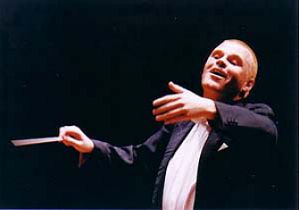 Benjamin-Gunnar
Cohrs conducting the Finale
Benjamin-Gunnar
Cohrs conducting the Finale
Well – but the
manuscript material indeed provides
a lot of information, and much MORE
information as it is the general belief.
What did survive is at about 50% of
the emerging autograph score, but
also ca 70 % of the music lost from
the missing bifolios could be recovered
from sketches, drafts, discarded earlier
versions and forensic studies –
amazing! This score must have been
preliminarily finished by Bruckner
(at least with all strings and some
sketched wind motives), due to one
simple fact: the philological studies
as in particular undertaken by John
Phillips revealed that without doubt
Bruckner renumbered the bifolios of
the score only in May/June 1896, after
he had at least sketched the coda,
and we have even a date for this as
an evidence – "14.6.96",
given on 13E/"14" (Facsimile
Edition, p. 225). This renumbering
was done, because in this phase of
the composition he had decided to
split up the very long bifolio 2F
(which increased now to 36 bars) into
a "2" and "3",
all written on the late-used E- paper
type, hence all subsequent bifolios
had to be renumbered. Most likely
his secretary Meißner may have
had the task to scratch out the old
consecutive numbers with a razor blade,
which would be overwritten then with
one number higher. We had noted something
similar in the first movement already:
Only after finishing its score for
a first time (which had 23 numbered
bifolios in autumn 1892), during a
revision in autumn 1893 Bruckner decided
to expand the bridge to the recapitulation
of the song period and to include
a new bifolio "18" (see
Critical Report, p. 50ff), which made
it necessary to renumber all subsequent
bifolios from "18" to "23"
into "19" to "24".
But – and this is the point –
I believe such a procedure of renumbering
would make sense only when the entire
score was already there!
But if this renumbering
in the Finale indeed happened in May/June
1896, it also gives us a clue to estimate
the entire length of the original
score, even if now partially lost,
at least with a high degree of certainty:
In one of the sketches for the coda,
we find the famous annotation of Bruckner
"Bogen
36. 19. Ces" (FE,
p. 45). This would read: On May 19th
Bruckner reached the Ces, the beginning
of the "Final cadenza",
as two days later clearly re-sketched
and further established (FE, p. 47:
"am 21. Donnerstag, 22. Freitag,
23. Samstag"). If we follow Bruckner’s
usual practice, he would write such
a bifolio indication precisely at
that point of the sketch where the
new bifolio (here: 36) would have
to start. (We have several other instances
in the manuscripts where he did the
same, note, for instance, the particello
sketch of the exposition, FE p. 33,
where Bruckner writes "neuer
Bog." precisely at the same spot
where the later 4C/"5" started).
But this indication was written in
May, obviously BEFORE the renumbering;
he would have had outwritten the primary
score bifolios for the coda perhaps
immediately after sketching their
content (again: this was part of his
usual compositional practice: as soon
as a music was clearly sketched, first
lay it out in score, for strings;
it could be revised later anyway)
and only then after returned to the
exposition and renumber the bifolios
subsequently. Hence the bifolio on
which the cadenza had started was
later to be a renumbered 36/"37".
But this single indication of Bruckner
in the sketch allows us now for almost
PRECISELY estimate the length of the
gap between the final surviving score
bifolio 31E/"32" and the
cadenza beginning on the lost 36/"37"!!
Four bifolios must be missing here
(32E/"33", 33E/"34",
34E/"35", 35E/"36"),
most likely all on E-paper, prepared
with 16 bars each, implying a gap
of 64 bars. Furthermore we would know
that most likely the chorale Bridge
constituting the 8-bar-Period before
the Ces-cadenza would be then the
second half of the lost 35/"36".
What we do NOT know is, where exactly
the coda would have started, of which
we have the beginning sketched (24
bars), hence we do knot know EXACTLY
how much music was between the last
bar of 31E/"32" and the
first bar of the sketch for the beginning
of the coda, and how much music was
there between the last bar of it and
the first bar of this C major chorale
fragment preparing the cadenza. We
also do NOT know whether Bruckner
himself followed strictly the 16 bar
structure of the E paper bifolios,
or whether he would have inserted
some further bar lines, as, for instance,
already on the first page of "2"E
which contains 6 instead of 4 bars.
On the other hand, this is the only
surviving E-paper with such a subdivision
at all, and the musical structure
of 31E/"32" and the cadenza
sketch would only suggest one further
of such subdivisions: the last period
on 31E/"32" ends with its
sixth bar, and we do not know precisely
whether Bruckner would have completed
it with [-7– 8] in an 8-bar-period
or not. But 36/"37" would
have started with the first bar of
a period. If we consider Bruckner
would have continued the lost music
in periods of 4, 8 and 12 bars length,
it is likely that he somewhere had
to include two bars more, if he not
decided somewhere to have 10 or 6
bars only, but this is more unlikely.
However, the little annotation "Bogen
36. Ces" provides enough information
to establish at least a hypothesis,
based on facts and some fruitful deduction,
and estimate the length of this huge
gap, with perhaps only two bars in
doubt.
Even more the length
of the very end of the coda: Bruckner
sketched a D pedal point following
the cadenza, doubtless the final tonic.
This would have started then on the
lost 37/"38". If we consider
that all previous movements had a
sort of a 'final capstone' of precisely
37 bars length, we can assume with
some certainty that this was also
planned for the Finale, following
the sketched 8 bars of tonic pedal
point some more 29 would have had
to follow, in all, bringing the score
to an end with two further lost bifolios
of 16 bars perhaps (37/"38"
and 38/"39") and one last
page of a 39/"40" with the
final five bars. So even if the final
double bar-line is not included in
the surviving material anymore, we
can assume its position and a hint
of the music at least from logical
deduction.
So regarding the full
length of the Finale, we have only
a very few question marks: 1.) Was
the missing bifolio "1"
16 or still 24 bars long? (We have
sufficient arguments for the shorter
version, however) 2.) Was the missing
bifolio "4" 16 or 18 bars
long? 3.) How long precisely was the
missing 27/"28" – 20
or 24 bars? (we have again good reason
to assume here 24 bars if we compare
this passage with the surviving sketch
for it, already containing 17 bars,
and due to the structure of the periods)
4.) Did Bruckner stuck to the 16 bar
standard length in the missing bifolio"33"
to "36", or did he include
at least two or more further bars?
5.) Was the final section really planned
to be 37 bars long? If we summarize
the answers to these questions, we
may say: 1.) 8 bars in dispute; 2.)
2 bars in dispute; 3.) perhaps 4 bars
in dispute; 4.) at least 2 bars in
dispute; 5.) certainly not 29 bars
in dispute, since the final pedal
point would have been at least longer
than the 8 bars sketched, in all ca.
47 bars in question. This would bring
the movement to a length of perhaps
not more than 673 bars (if we accept
the 24 bars version of the missing
"1").
You may now say: Well,
this all sounds very nice, but is
sheer speculation. But if we would
have no piece of music here, and instead
a person killed, with some parts of
the corpse missing, and if we would
be forensic investigators such as
in the TV series "CSI",
we would accept the following idea
– to collect all information
which is still available, bring it
together by scientific deduction,
and try to establish a hypothesis
sufficient enough to find out why
the one died, how the person had looked
like before the birds of prey have
eaten perhaps parts of his face and
arms and legs, and then try to find
the murderer... And this is indeed
all we can do – take every single
bit of information from Bruckner´s
own music, and present the results
of our examination as well established
as possible.
How did you proceed
from the point where Bruckner did
not provide full instrumentation,
such as in the continuity drafts?
(example bifolio “#”D =“5b”).
In other cases Bruckner could have
added specific voices at a later stage,
where he already writes in full score
(example: such as in bifolio 4A, page
3). There are numerous spots in the
scoring with failing instrumentation
markings, presumably because the composer
did not need reminders for later instrumentation,
in contrast with others being clearly
laid out, for instance for the viola,
in case he might overlook or just
forget later in the instrumentation
process that this specific phrase
was to be played by the viola. The
divisi markings, where for instance
celli need to play in double parts,
also served as a reminder. Summarising,
how could you fill it all in where
Bruckner did not leave adequate hints
in his manuscripts (particellos, bifolios).
Actually there are
by far more adequate hints by Bruckner
himself as one may think! Before starting
such a discussion, we need to answer
another question: "How full"
was the instrumentation intended to
be, or better: how much additions
does the music require at all? Regarding
the bifolio"#"D, which you
have mentioned, Samale and I now simply
regard it as an erroneous attempt
to re-copy 4C/"5", and don´t
share Dr. Phillips’ construction
of this as an indicated 16 bar expansion,
as explained in the Commentary of
our new edition: This idea is simply
not in line with the particello sketch
and also not with Bruckner’s
usual style, if you compare the first
part of the song period in exposition
and recapitulation in all previous
symphonies (and the first movement
of the Ninth): However, the surviving
4C/"5" indicates a finished
instrumentation with whole bar rests
in all parts except strings and 1.2.
horn (see also the first two pages
of 4A); it was renumbered in June
1896 into "5" and even marked
as "giltig" (valid) by Bruckner.
Even if Bruckner may have changed
this music any further, we have no
reason to assume that he would have
added more instruments, because the
instrumentation remained unchanged
in all previous phases of the composition.
Or take the first two pages of 7C/"8"
(FE, p. 181f) in comparison with 7B
(FE, p. 177f): In the last version
of the bifolio, Bruckner gave all
the whole bar rests with the exception
of the upper strings, and on the next
page he eliminated the first four
horns supporting the dotted motive
of the viola, sketched on 7B, 2nd
page, to make the scoring even thinner.
So we can gain much information about
the instrumentation by simply comparing
the various surviving compositional
phases.
A very important insight
about instrumentation was provided
by John Phillips during his work with
Samale in 1990/1: Bruckner would often
add melodies or motives only if the
counterpoint fabric would allow such
an addition, or if certain motives
would undergo a process of mutation.
A good example is the added counterpoint
of the solo horn at the beginning
of the Trio in the song period, which
would rhythmically compliment the
fabric of the other parts and provide
precisely the one missing element.
This section is also an example for
another significant idea: When Bruckner
repeats such material more or less
literally in the recapitulation, he
would enrich it with added instrumental
colours, as for instance can be seen
in the first movement. In this case
we have taken also the very similar
Finale of the Sixth symphony as a
model to provide a fuller instrumentation
of the Trio in the recapitulation.
On the other hand, Bruckner did not
think in terms of "instrumentation"
as we often do think about it –
simply like giving a nude person a
dress. His idea on this is more like
this: If you freeze, you would need
a scarf and a hat and gloves. So a
particular musical situation would
require a certain instrumentation.
For instance: the Crescendo
in the recapitulation, preparing the
chorale theme from C flat major /
A flat minor, is in the sketch only
one single line in the violins, plus
at the beginning a sketched self-
imitation in diminution, both making
use already of the chorale theme.
Alone from the character of the music
we have already clues for the instrumentation:
It should obviously start soft, and
build up an effective crescendo in
order to prepare a violent break-through
of D minor, as at the end of the sketch
marked "Schluß d-moll"
by Bruckner, with the heavy weight
of a first bar of a period. This is
only a first climax, because the surviving
28E/"29" brings a much more
exalted, second crescendo to prepare
the chorale plus Te Deum. But
if we imagine the D minor to be a
tutti climax, we need to find stylistically
appropriate models of how to build
up the crescendo itself. We find these
models in the main theme itself (dotted
rhythm in all strings, supporting,
resonant line in the brass) and as
well in a similar passage in the Finale
of the Eighth symphony, after the
recapitulation of the first theme
group..
To give a voice
in the score to a specific instrument
or a combination of instruments is
an important decision for any composer.
Individual instrumental colours determine
the music’s mood to a great extent.
How did you know that a specific voice
line should be given to the oboe instead
of the flute? How did you establish
that Bruckner had written a specific
line for specific brass instruments,
for instance for the horn?
In some cases it is
simply guesswork, and we don´t
know of course whether Bruckner would
have chosen the same instrument, or
not. But at least we have many clues
how Bruckner wrote for his instruments,
studying the music, finding similar
passages, if possible firstly from
the Finale itself, then from the other
three movements, then from music composed
at the same time, and also considering
the Te Deum and earlier symphonies.
Bruckner had some very particular
habits to write for his orchestra,
which were also thoroughly examined
by Dieter Michael Backes recently,
in his dissertation Die Instrumentation
und ihre Entwicklung in Anton Bruckners
Symphonien (Mainz 1993).
Take, as an example,
the instrumentation of the chorale
recapitulation (bifolio 28E/"29"),
of which we have only Bruckner’s
strings and the first trumpet with
the chorale melody: many other completers
have interpreted this as a soft reminiscence,
but the manuscript provides in the
two bars before the trumpet entry
whole bar rests in BOTH trumpet systems,
which is a typical shorthand writing
of Bruckner to indicate that all three
trumpets should later play the melody,
so he simply left out the doubling
in the lower system for writing convenience.
The string texture itself, with the
powerful Te Deum figure and
viola tremolo, is a typical forte
design, not soft, and most important
is also Bruckner’s own diminuendo
("dim."), to be found in
the eighth bar of the trumpet line,
indicating that it should be loud
earlier, but here become softer. So
we finally have simply adopted the
brass-parts from the exposition, and
in order to bring out the diminuendo
from the 9th bar onwards have thinned
out the instrumentation, reducing
the harmonic support to trombones,
double bass-tuba, and starting the
trumpet writing in three parts, leaving
out the horns. The last two bars of
the bifolio provide further information:
The melody is taken over by the 1st
oboe, the viola gives up its tremolo,
and goes with celli, double basses
suddenly rest. This suggests a change
of register and a further reduction
of the dynamics. Since it would be
untypical to have such a figure as
the strings here without harmonic
support by sustained notes, we have
supported the oboe chorale with lower
woodwinds, because in such a soft
passage certainly this can´t
be the brass anymore.
As Backes further pointed
out, Bruckner’s writing is so
characteristic that even from a single
line in the sketch we could very often
easily deduce for which instrument
it was intended. Very important here
is the ambitus of the instrument,
the lowest and highest note possible
– this already limits the choice.
But this is all basic knowledge of
instrumentation: If you double a viola,
you may use a horn, a bassoon or a
clarinet, then consider dynamics and
the colour, and make your choice.
One of the reasons for us to reconsider
the entire instrumentation, however,
was the insight, that we would have
to take in account those instruments
which Bruckner himself wrote for –
that is, not our days’ modern,
wide-bored brass instruments, for
instance, but thin, handmade Viennese
horns, the large trumpet in F, Viennese
tenor bass-trombones in E flat, Viennese
doublebass-tuba, the wooden, old Viennese
flute, the Viennese oboe, clarinet
and bassoon – instruments which
sounded totally different from ours.
You need to know about these instruments,
how they sound, where their limitations
are, and how Bruckner wrote for them,
in order to accurately write for them
in a Brucknerian way. For instance,
for the flute, Bruckner would avoid
tones above b´´´
and also the lowest register (d´is
the lowest note in the Ninth, and
it appears only in the main theme
of the first movement) which are no
problem for a modern flute. In particular
due to my own interest in period performing
practice, we have changed many passages
in our new edition, in order to bring
it in line with Bruckner’s habits,
overlooked in our earlier working
phases.
I find it amazing
that until this day no great Bruckner
conductor – apart from Nikolaus
Harnoncourt – has taken a serious
effort to perform a four-movement
version of the Ninth, as if it does
not exist. The latest news I got on
the subject was that the Bamberger
Symphoniker under the baton of Jonathan
Nott had planned a performance on
20 April using the latest SPCM edition,
but it was cancelled without any explanation.
I also understood that Nott got all
the documentation to support the reconstruction,
but it appeared to be in vain. Why
do you think it is so difficult to
get this greatest of Bruckner Finales
performed? Has it something to do
with those many doubts that still
exist? That too much in the score
is unclear, needs compromising, and
that we shall never know the truth?
In defence of Mr. Nott
I must say that recently he wrote
me an e-mail, explaining that to study
the matter thoroughly would have required
much more time as he had since he
got the materials, and he is a very
busy man; the April 2006 concert was
simply too early for him to come to
a definitive decision, as he explained.
But he remains to be interested, as
he wrote. I would also like to point
out that many at least quite well-known
conductors in fact did the completed
Ninth, as for instance Philippe Herreweghe,
Johannes Wildner, Lawrence Renes and
Günter Neuhold. But basically
you are right. The reasons are manifold.
It is perhaps impossible to overcome
those prejudices of 100 years of reception:
As much as the Mozart-Süßmayr
Requiem became a beloved part of the
standard repertoire, as much Loewe’s
campaign was effective to establish
the general belief that the symphony
is in itself complete as a torso,
even if this is against the composers
will and simply a habit. Even worse:
he also successfully established that,
against Bruckner’s wish, the
Te Deum should better NOT be
performed following the symphony,
despite that some great conductors
(even Karajan) occasionally performed
the Ninth and after a concert break
the Te Deum, which to me seems
to be at least an appropriate solution
better, and better than the torso
alone. Another point is the radical
nature of Bruckner’s music itself:
It is not easy to understand that
the pathetic Adagio should be followed
by a harsh, toccata-like 'Inferno',
postponing the final salvation until
the very last moment. There are simply
too many misunderstandings and resentments
against the music and the entire undertaking.
The performance
of the Finale as an integrated part
of Bruckner’s last ‘Gesamtkunstwerk’
is still in its infancy and needs
full recognition before a performance
tradition can hold. How do you think
this can be established in time? Great
Bruckner conductors must have studied
your score in the meantime, but there
seems nobody yet – except Harnoncourt
- to take up the baton. I asked Hartmut
Haenchen but he was not interested.
There is still a lot of opposition
against touching a musical torso and
when people do not know the real facts
behind what Bruckner left and how
the reconstruction process goes, they
are probably not going to give up
their resistance. Conductors are the
first to make it happen, to create
an electrifying event in the concert
hall, and to explain to the audience
what they are trying to accomplish.
Not in some kind of a workshop scenario,
but in the four-movement version Bruckner
had it in mind. To understand and
appreciate the real greatness of the
Finale needs the three preceding movements.
Where are they?
There is perhaps not
enough common knowledge about the
facts, but on the other hand too much
information: imagine a poor jetset-maestro
would have to study a pile of books
and scores first – the Facsimile,
the 'Documentation', the Completed
Performing Version and then to decide
what he should do. Those people even
don´t find the time to learn
new repertory, travel around the world,
do 120 concerts a year and endlessly
repeat their standard pieces. Why,
how and when should they relearn the
Ninth in four movements? What we would
need is two or three well-known, open-minded
chaps with major orchestras who would
like to do the completed Ninth in
a major capital, perhaps Harnoncourt
(if he is ever to do the Ninth again),
Claudio Abbado, Mariss Jansons, Esa
Pekka Salonen, Seiji Ozawa, Pierre
Boulez, Simon Rattle, or Paavo Järvi,
who could do the piece so successfully
that the simple fact would convince
others that it is no crime any longer
to use the Finale. This already worked
remarkably well in the case of Mahler's
Tenth: Even Michael Gielen, who only
a few years ago confessed he would
never do anything else than the first
Adagio, recently presented a fantastic
new recording of the 'Cooke et al'
completion.
But note: After I had
conducted the workshop concert on
the Finale in Tokyo in 2001 with the
Royal Flanders Philharmonic, Philippe
Herreweghe came to me and said: "You
know – the more often I hear
the piece, the more I like it."
Then he took the completed Ninth on
tour through Japan, and he did it,
I think, four times there. But the
reviews were rather conservative about
the matter, and since 2001 he never
again did the Finale at all, although
he does Bruckner a lot ... Which brings
me to the next point: The symphony
in four movements lasts ca 90 Minutes;
it would have to be programmed usually
without anything else. Bruckner concerts
are hard to sell anyway, and if then
the beloved Mozart-Concerto could
NOT happen in the first part, and
no intermission for drinks and chat,
people would not come. And if then
a quarter of the piece appears to
be 'second hand Bruckner', it may
be even more difficult to programme
it in ordinary concert life. So all
we can hope for is that the quality
of the music itself sooner or later
would make the round. If I would be
as rich as Gilbert Kaplan, who paid
orchestras in the entire world to
conduct solely his beloved Mahler
Two, I would go on tour to conduct
the completed Ninth wherever I could,
but I am not rich. And which orchestral
manager would dare to invite a no-name-conductor
for a Bruckner Nine? Unfortunately
we even were unsuccessful so far to
raise enough money to give at least
a proper performance of the completed
Ninth on period instruments with the
fantastic New Queen´s Hall Orchestra
– an idea we try to work out
now for already seven years, without
success, and we would need only ca.
75.000 Euro for a proper concert and
live CD-recording project ...
Mahler once said:
”Tradition ist Schlamperei.”
This perfectly fits the performance
tradition of Bruckner’s symphonies
in their various versions. The first
version of the Eighth – and I
think it is superior to the second
– is rarely played, as is the
first version of the Third and the
Fourth. It seems to me that when a
tradition has really established itself,
huge powers are needed to change patterns,
but it simply does not happen. This
is not really hopeful when it comes
to the Ninth’s Finale…
Don´t lose your
hope! We may not forget that the initial
versions of the Third, Fourth and
Eighth were only published 30 years
ago. Inbal’s CD recording of
them was a pioneer's work, discussed
highly controversial by the critics.
But now, the initial version of the
Third is more and more recognized
as a great, independent and coherent
argument of the piece. Even Celibidache
had planned to perform it (unfortunately
he died before this could be realised).
I think the Fourth and Eighth will
be likewise recognized sooner or later.
Now take the Finale of the Ninth –
perhaps it is simply still too early
to come to lose hope. But I have hope
– I receive so many letters and
e-mails from Bruckner-admirers in
the entire world, offering support,
asking for more performances, and
some of them even took the initiative
to write permanently to concert organisers
and conductors regarding the matter.
And I am also happy that interested
writers like yourself study the matter,
come to their conclusions and publish
their new insights. All this is very
much of help for Bruckner’s music.
How do you see 'Werktreue'
in the perspective of the reconstruction
process?
This is a totally misunderstood
concept, preserved from the late-romantic
aesthetics. The word represents the
strange idea that a performance could
come as close to a 'correct' 'interpretation'
of 'the text' – a relict from
the secularisation in the age of enlightenment,
when culture became a surrogate for
religious activity in society. This
is as much against the nature of music
as the common believe is against the
human nature, that in our entire life
we would need the-one-and-only-person
which would make all our dreams come
true. But in fact we live in a net
of relationships with various people
we continue to meet, relationships
of all kind of quality. But why don´t
we learn to simply live 'in love',
not to the-particular-one-and-all,
but as a way of life? Likewise musical
interpretation: We can and we should
learn as much we can about the nature
of the music, but basically we should
'live in music'. Reconstruction is
part of our daily musical life and
practice – in fact, every interpretation
is a reconstruction: the musician
reconstructs an experience in sound
from the music he reads on the paper.
Already the various versions of Mahler's
Tenth are basically also interpretations
of their editors and arrangers. The
reconstruction and completion of the
Bruckner Finale is precisely the same:
we try to make it possible to experience
Bruckner's own music in sound, to
make it performable. If you wish so,
this is 'werktreu'. Definitely it
is not 'werktreu' to undermine the
ideas of Bruckner himself. If we dispense
with the finale of the Ninth, why
then not as well with that of the
Seventh, for instance? Let´s
take away the finale, put the Scherzo
in the second place and end with the
Farewell to Wagner – who the
hell would need a Finale for the Seventh?
An absurd debate ...
Do you think that
your reconstruction work contributed
to a much better understanding of
the first three movements? Why?
Many processes from
the first three movements did not
come to an end yet with the end of
the Adagio. In fact, the end of the
Adagio stimulate even some new processes
continued in the Finale. This idea
was actually very important for us
– observing the motivic development
and see where it needs to be reconstructed,
in order to bring it to a sufficient
end. It is particularly fascinating
how Bruckner carefully seems to prepare
the return of the main theme from
the first movement in the Finale,
by establishing its principal motives:
Note that the motto from the beginning
of the Finale already contains the
inversion from the famous horn call
at the beginning of the symphony,
then the prominent triplet from the
main theme is used. Note that the
string figuration of the chorale theme
seems to be directly taken from the
figuration of the coda of the first
movement, again containing the triplet
core. Note how the Epilogue theme
of the Finale, first following the
fugue, then following the chorale
recapitulation, contains the ‘Non
confundar / Alleluja’ and again
the triplet feature of the main theme.
And this is only a small excerpt from
the manifold processes of development
which all aim for what already Samale
and Mazzuca had realised in their
1985 edition – the synthesis
of all main themes of the symphony.
We have a simple argument for this:
It is perfectly possible to do so,
following the structure of the themes
as used, and as predictable as the
famous idea of Nottebohm, that for
the lost part of Bach’s quadruple
fugue the main theme was intended
to be added. And, significantly, going
beyond the argument at the end of
the Eighth, because there Bruckner
only combined the head of the themes,
and not original, but in a truncated
manner, transposed into C major. But
here we can combine the themes in
their original condition! The Scherzo-theme
is certainly merely a rhythm, even
if containing the important triplet.
But if we take the augmented Adagio
theme it matches perfectly well with
the main theme of the first movement.
The Finale theme would NOT match as
in the exposition, but note that when
Bruckner re-designed it four the fugue,
he changed the first note of the third
bar from E to E flat, and this would
allow now to use it precisely in combination
with the other themes, bringing the
substantial D / E flat clash. Likewise
we have tried to bring out other resolutions
as indicated in the music. But this
is only possible because Bruckner’s
own architectural thinking was so
strong. Notice only that even the
small choral fragment, preceding the
cadenza Sketch for the coda, is nothing
else than the inversion of four bars
at the end of the exposition of the
main theme, shortly before this Choral-Bridge
to the Song period! So in particular
in the coda we have tried to tie together
things that remained to be unsolved
yet: For instance, the way how we
re-introduced the Te Deum motive
in woodwinds is very similar to how
Bruckner used it in the Development
section, serving as a model for our
coda realisation. Or take the ‘Non
confundar / Alleluja’, referring
to the trumpets in the Adagio theme.
(By the way: your quoted lines from
Dr. Heller seem in fact refer to the
slow movement, and not the Scherzo,
since I am sure Heller was simply
confused about the order of the movements:
Note that Josef Schalk, who made the
piano arrangement of the symphony,
gave the Adagio as a second movement
and the Scherzo as third. I assume
that Schalk worked from copies of
the movements which are lost today,
originally containing "Scherzo"
and "Adagio" titles only,
but not marked explicitly as "2.
Satz", "3. Satz". It
is even possible that Bruckner himself
was not entirely sure about the position
of the inner movements for some time,
since it seems that on the first page
of the Adagio autograph, the third
beam of the roman "III"
in "III. Satz" has been
added later!)
In all, to present
the symphony without Finale seems
to me like presenting a body without
its head. Not a very nice picture
indeed. The entire character of the
work is changed by accepting the Finale
– from a pathetic Adagio of Farewell
into a last struggle of life and death.
The Finale is a toccata-like "Inferno",
an apocalyptic picture of the last
judgement. Bruckner struggled hard
to achieve at least a compositional
coherence. He could not know that
the material for the Finale would
be obscured soon after his death.
Should his last battle remain to be
unacknowledged? Hence we also understand
our reconstruction as an attempt to
compensate for the respectless treatment
of Bruckner’s heritage. Imagine
that perhaps some respectless autograph
collectors may keep the lost bifolios
in their possession and hide them
from us (if not already some of the
bifolios have been destroyed immediately
after Bruckner’s death, for instance,
by the religious fanatic Meißner,
perhaps from a false understanding
of piety): In this case I have to
admit to feel an almost diabolic pleasure
that it was possible to STILL recover
the Finale to such an extent from
Bruckner’s own backup-material,
by following forensic methods and
observing a strict methodology! And
I dare to predict that even if some
or all of the lost bifolios would
once come to light again, we may already
have found at least the right music
in many instances, even if we of course
cannot have guessed everything all
right. But even if we get an idea
of the covering of only ca 80 % of
the original whole movement (and I
don´t talk about instrumentation
now, only the composition itself),
we would have regained much more of
Bruckner’s music as if 20 years
ago we could have ever dreamed of!
�Click
the images for full size graphic
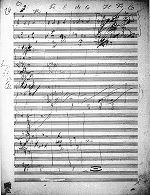 Example
A: Sketch in particello (three to
four staves), ongoing musical argumentation,
partially scarcely readable (thin
and fleeting writing). Page 45 from
the Facsimile edition of Bruckner’s
full autograph, MWV,
Vienna, 1996 (ISMN M50025- 133-0).
With kind permission of the Austrian
National Library, Vienna.
Example
A: Sketch in particello (three to
four staves), ongoing musical argumentation,
partially scarcely readable (thin
and fleeting writing). Page 45 from
the Facsimile edition of Bruckner’s
full autograph, MWV,
Vienna, 1996 (ISMN M50025- 133-0).
With kind permission of the Austrian
National Library, Vienna.
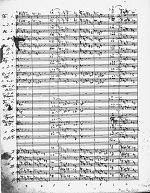 Example
B: Fully written-out score in bifolio
(or Bogen), notation on staves, with
on each page prefixed entries for
the instruments from top to bottom
in the correct order, together with
keys, time and (also fixed) four bar
lines (mostly prepared by his pupil
and ‘secretary’ Anton Meißner),
successively and continuously numbered.
clarinets notated in B flat and horns
and trumpets in F. Page 110 from the
Facsimile edition of Bruckner’s
full autograph, MWV,
Vienna, 1996 (ISMN M-50025-133-0).
With kind permission of the Austrian
National Library, Vienna.
Example
B: Fully written-out score in bifolio
(or Bogen), notation on staves, with
on each page prefixed entries for
the instruments from top to bottom
in the correct order, together with
keys, time and (also fixed) four bar
lines (mostly prepared by his pupil
and ‘secretary’ Anton Meißner),
successively and continuously numbered.
clarinets notated in B flat and horns
and trumpets in F. Page 110 from the
Facsimile edition of Bruckner’s
full autograph, MWV,
Vienna, 1996 (ISMN M-50025-133-0).
With kind permission of the Austrian
National Library, Vienna.
�
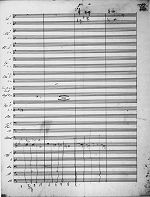 Example
C: As above, but only containing the
principal elements (strings, important
woodwind and brass entries, often
in pencil to facilitate later erasure
and subsequent overwriting in ink).
Page 231 from the Facsimile edition
of Bruckner’s full autograph,
MWV,
Vienna, 1996 (ISMN M-50025-133-0).
With kind permission of the Austrian
National Library, Vienna.
Example
C: As above, but only containing the
principal elements (strings, important
woodwind and brass entries, often
in pencil to facilitate later erasure
and subsequent overwriting in ink).
Page 231 from the Facsimile edition
of Bruckner’s full autograph,
MWV,
Vienna, 1996 (ISMN M-50025-133-0).
With kind permission of the Austrian
National Library, Vienna.
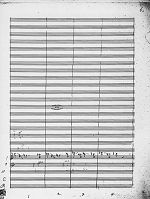 Example
D: Continuity draft (Satzverlaufsentwurf)
in rudimentary design (Bruckner also
entered single melodic lines, mostly
the violin part, into the full score
formatted sheets at hand). Page 167
from the Facsimile edition of Bruckner’s
full autograph, MWV,
Vienna, 1996 (ISMN M-50025-133-0).
With kind permission of the Austrian
National Library, Vienna.
Example
D: Continuity draft (Satzverlaufsentwurf)
in rudimentary design (Bruckner also
entered single melodic lines, mostly
the violin part, into the full score
formatted sheets at hand). Page 167
from the Facsimile edition of Bruckner’s
full autograph, MWV,
Vienna, 1996 (ISMN M-50025-133-0).
With kind permission of the Austrian
National Library, Vienna.
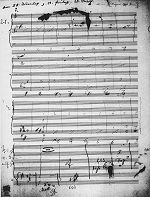 Example E: Dates in
the manuscript help to determine the
genenis and progression of the composition.
Page 47 from the Facsimile edition
of Bruckner’s full autograph,
MWV,
Vienna, 1996 (ISMN M-50025-133-0).
With kind permission of the Austrian
National Library, Vienna.
Example E: Dates in
the manuscript help to determine the
genenis and progression of the composition.
Page 47 from the Facsimile edition
of Bruckner’s full autograph,
MWV,
Vienna, 1996 (ISMN M-50025-133-0).
With kind permission of the Austrian
National Library, Vienna.
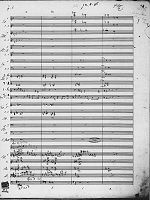 Example
F: Dates in the manuscript help to
determine the genesis and progression
of the composition. Page 225 from
the Facsimile edition of Bruckner’s
full autograph, MWV,
Vienna, 1996 (ISMN M-50025-133-0).
With kind permission of the Austrian
National Library, Vienna.
Example
F: Dates in the manuscript help to
determine the genesis and progression
of the composition. Page 225 from
the Facsimile edition of Bruckner’s
full autograph, MWV,
Vienna, 1996 (ISMN M-50025-133-0).
With kind permission of the Austrian
National Library, Vienna.
Publications by
Benjamin-Gunnar Cohrs on Bruckner's
Ninth symphony (Finale):
�
..
Essay 1 (pdf) http://www.opusklassiek.nl/componisten/bruckner_symphony_9_finale_sc041.pdf
..
Illustrations (pdf) http://www.opusklassiek.nl/componisten/bruckner_symphony_9_finale_mus1.pdf
..
Tables (pdf) http://www.opusklassiek.nl/componisten/bruckner_symphony_9_finale_tabs.pdf
..
Essay 2 (pdf) http://www.opusklassiek.nl/componisten/bruckner_symphony_9_finale_wc_spcm.pdf
.. Forum
http://www.tamino-klassikforum.at/thread.php?threadid=1223&threadview=0&hilight=&hilightuser=0&page=1
Important links:
.. Tamino Klassik Forum
http://www.tamino-klassikforum.at/
.. Musikproduktion Jürgen
Höflich, Munich http://www.musikmph.de/musical_scores/information/information.htm
.. Musikwissenschaftlicher
Verlag, Vienna http://www.mwv.at/english/index.htm
.. Doblinger Music Publishers,
Vienna http://www.doblinger-musikverlag.at/
.. Anton Bruckner discography
http://www.abruckner.com
.. Anton Bruckner Institute,
Linz http://www.oeaw.ac.at/mufo/abil.html
..Austrian National Library
http://www.onb.ac.at/index_eng.htm
.. The New Queen's Hall
Orchestra http://www.nqho.com/
Selected literature:
[1] Max Auer/August Göllerich:
Anton Bruckner. Ein Lebens- und Schaffensbild,
volume IV/3, Regensburg 1928-36. John
Alan Phillips: Study score, Vienna
1994.
[2] Robert Hirschfeld:
Anton Bruckner. Neunte Symphonie.
Uraufführung in Wien. Vienna
1903. Max Auer: Anton Bruckner. Sein
Leben und Werk. Zurich/Leipzig/Vienna
1923.
[3] Benjamin-Gunnar Cohrs
& John Alan Phillips: Übersicht
der Aufführungs-Versionen des
Finale- Fragments in Bruckners Neunte
im Fegefeuer der Rezeption. Musik-Konzepte
120/121/122, Munich 2003.
[4] Benjamin-Gunnar Cohrs
& John Alan Phillips: Einführung
in die erhaltenen Quellen zum Finale
in Bruckners Neunte im Fegefeuer der
Rezeption. Musik-Konzepte 120/121/122,
Munich 2003.
[5] Elisabeth Maier: Verborgene
Persönlichkeit. Anton Bruckner
in seinen privaten Aufzeichnungen
(Anton Bruckner. Dokumente & Studien
11). Musikwissenschaftlicher Verlag,
Vienna 2001 (2 Volumes).
[6] Dieter Michael Backes:
Die Instrumentation und ihre Entwicklung
in Anton Bruckners Symphonien. Mainz
1993.
Anton Bruckner Symposium:
Publications of the Anton Bruckner
Institut Linz [Reference: Musikwissenschaftlicher
Verlag]:
Bruckner Symposium Linz
1977. »Anton Bruckner zwischen
Wagnis und Sicherheit«, Linz
1978.
Bruckner Symposium Linz
1980: »Die Fassungen«,
Linz 1981.
Bruckner Symposium Linz
1981: »Die Österreichische
Symphonie nach Anton Bruckner«,
Linz 1983.
�Klassieke Muziek, Opera
& Operette, Ballet pagina 33 van
34
Bruckner Symposium Linz
1982: »Bruckner-Interpretation«,
Linz 1983.
Bruckner Symposium Linz
1983: »Johannes Brahms und Anton
Bruckner«, Linz 1985.
Bruckner Symposium Budapest
1983-84, Linz 1985.
Bruckner Symposium Linz
1984: »Bruckner, Wagner und
die Neudeutschen in Österreich«,
Linz 1986.
Bruckner Symposium Linz
1985: »Anton Bruckner und die
Kirchenmusik«, Linz 1988.
Bruckner Symposium Rom
1986, »Anton Bruckner e la musica
sacra«, Rom 1987.
Bruckner Symposium Linz
1986 »Bruckner, Liszt, Mahler
und die Moderne«, Linz 1989.
Bruckner Symposium Linz
1987: »Bruckner und die Musik
der Romantik«, Linz 1989.
Bruckner Symposium Linz
1988: »Anton Bruckner als Schüler
und Lehrer«, Linz und Wien 1992.
Bruckner Symposium Linz
1989: »Orchestermusik im 19.
Jahrhundert«, Linz und Wien
1992.
Bruckner Symposium Linz
1990: »Musikstadt Linz-Musikland
Oberösterreich«, Linz und
Wien 1993.
Bruckner Symposium Linz
1991: »Bruckner-Rezeption«,
Linz und Wien 1994.
Bruckner Symposium Linz
1992: »Anton Bruckner -Persönlichkeit
und Werk«, Linz und Wien 1995.
Bruckner Symposium Linz
1993: »Zur Frage einer Osterreichischen
Symphonik«, Linz und Wien 1996.
Bruckner Symposium Linz
1994: »Bruckner-Freunde - Bruckner-Kenner«,
Linz und Wien 1997.
Bruckner Symposium Linz
1995: »Zum Schaffensprozess
in den Künsten«, Linz und
Wien 1997.
Bruckner Symposium Linz
1996: »Fassungen - Bearbeitungen
- Vollendungen«, Linz und Wien
1998.
Bruckner Symposium Linz
1997: »Bruckner- Vorbilder und
Traditionen«, Linz und Wien
1999.
Bruckner Symposium Linz
1998: »Zur Problematik von Künstlerbildern
im 19. Jahrhundert«, Linz und
Wien 2000.
Bruckner Symposium Linz
2000: »Die materielle und soziale
Situation des Künstler«,
Linz 2002.
Bruckner-Tagung Wien 1999,
Wien 2000
Selected publications
of Musikwissenschaftlicher Verlag,
Vienna:
Cohrs, B.-G. (Hrsg.):
Anton Bruckner, IX. Symphonie d-moll,
Scherzo er Trio, Studienband zum
2. Satz, Wien 1998.
Anton Bruckner, IX.
Symphonie d-moll (1. Satz -Scherzo
er Trio -Adagio), kritische Neuausgabe
unter Berücksichtigung der Arbeiten
von Alfred Orel und Leopold Nowak,
Partitur und Stimmen,Wien 2000.
Anton Bruckner, IX.
Symphonie d-moll (1. Satz - Scherzo
- Trio - Adagio), kritischer Bericht
zur Neuausgabe, Wien 2001.
Grasberger, R.:Bruckner-Stätten
in Osterreich. Mit einem Anhang.-
Bruckners Auslandreisen (ABIL
Informationen 5), Wien 2001. Harrandt,
A. und Schneider, O. (Hrsg.): Anton
Bruckner, Briefe 1852-1886, Wien 1998.
Anton Bruckner, Briefe
1887-1896, Wien 2002.
Phillips, J. A. (Hrsg.):
Anton Bruckner, IX. Symphonie d-moll,
Finale (unvollendet), Rekonstruktion
der Autograph-Partitur nach den erhaltenen
Quellen, Studienpartitur, Wien 1994/99.
Anton Bruckner, IX.
Symphonie d-moll, Finale (unvollendet),
Rekonstruktion der Autograph-Partitur
nach den erhaltenen Quellen, Dokumentation
des Fragments, Partitur einschl. Kommentar
& Stimmen, Wien 1999/2001.
Anton Bruckner, IX.
Symphonie d-moll, Finale (unvollendet),
Faksimile-Ausgabe sämtlicher
autographen Notenseiten, Wien 1996.
Anton Bruckner, IX.
Symphonie d-moll, Textband, Wien
(published after 2003).
Anton Bruckner, IX.
Symphonie d-moll, 1. Satz, Studienband,
Wien (published after 2003).
Anton Bruckner, IX.
Symphonie d-moll, Adagio, Studienband,
Wien (published after 2003).
Anton Bruckner, IX.
Symphonie d-moll, Finale, Studienband,
Wien (published after 2003).
Schönzeler, H. H.:
Zu Bruckners IX. Symphonie. Die
Krakauer Skizzen. Eine Bestandsaufnahme,
Wien 1987.
Anton Bruckner,
Auswahl-Bibliographie (1982-2002)
This article first appeared
in Klassieke Muziek, Opera & Operette,
Ballet pagina 1 van 34
www.opusklassiek.nl























