The enterprising Australian Eloquence continues to mine the riches
of the Decca back catalogue. This two-disc set is a reissue of
three separate LPs dating from the late 1970s, whose contents
for the most part have never made it to CD. SXL 6788 contained
the Birthday Hansel, Canticle V, Gloriana
Lute Song and Scottish Folksongs; SXL 6793 contained the rest
of the Folksongs presented here. The choral works originally appeared
on SXL 6847 alongside Janet Baker’s recording of Phaedra
and Britten’s Prelude and Fugue.
The Pears/Ellis partnership was one that flourished late in the tenor’s
career, as Britten’s last illness and inability to play the
piano left Pears bereft of a regular recital partner. Pears
also appeared with Murray Perahia and Graham Johnson, among
others, around this time. In his characteristically perceptive
booklet notes (taken from the original LP) that doyen
of Britten scholars Donald Mitchell persuades us that Britten’s
apparent late fascination with the voice/harp combination was
not only motivated by the necessity of writing new music for
the duo but in fact represented an interest that went back
throughout his career.
Music by composers other than Britten also featured in recitals by
Pears and Ellis. Schubert’s Harfenspieler Songs (appropriately
enough) featured in recitals at Aldeburgh and elsewhere; there
were arrangements by Britten of music by Purcell, Croft, Bach,
Ravel and others; and new music composed for the duo by Lennox
Berkeley, Arne Nordheim and Elizabeth Maconchy. Sadly none of
these made it to disc, although recordings do exist in the archives
of the Britten-Pears Library at Aldeburgh.
I am second to none in my admiration of Pears, but I have to say
that these recordings do not always represent his artistry at
its most compelling. Pears was 65 when these recordings were
made and we are all too aware of the effects of time on his
voice. He was also recording Stravinsky’s Oedipus Rex
with Solti around the same time so it may be that the sessions
had taken their toll! The late Britten works such as Canticle
V or A Birthday Hansel have a certain dry grittiness
built into the music for which the tenor’s desiccated tone is
not inappropriate; Britten always followed the changing characteristics
of Pears’s voice to perfection and reflected this in the music.
Pears’s upper register remains as haunting as ever, so that
in the high tessitura of The Salley Gardens, for instance,
he brings a seamless legato and honeyed sweetness to his singing
that is all the more touching for being largely absent elsewhere.
The Second Lute Song from Gloriana is equally haunting
in its portrayal of regret for the passing of time, even if
Pears’s actual vocal quality is singularly unflattering.
As for the Folksong arrangements, some work better than others on
the harp. The arrangements originally made for guitar, for instance,
have transferred effectively to the new medium (I will give
my love an apple, The Sailor-boy, Master Kilby,
The Soldier and the Sailor) where the guitar figuration
is mirrored effectively in that for the harp. Some of the Irish
ballads such as The Last Rose of Summer and The Minstrel
Boy also work well, Britten’s imagination perhaps being
fired by the bardic connotations of many of the songs. However
several of the arrangements originally written for piano do
not lend themselves terribly convincingly to the harp. Britten’s
legendary legato touch is needed here and there (O Waly,
Waly) if the music is not to sound disjointed and dry.
The songs also really need a more seductive tone than Pears was able
to command at this stage in his career.
Those looking to hear Pears at his best in the Folksongs should seek
out his earlier discs of piano arrangements with Britten as
his matchless accompanist.
Osian Ellis commissioned the Suite for Harp and is the work’s dedicatee.
As we might expect he gives a thoroughly idiomatic account of
the music. He later recorded it for Meridian - with another
Britten veteran, John Shirley-Quirk, singing some folk song
arrangements - but the earlier account is marginally more incisive.
In addition to his singing career Pears also took to directing a
small vocal group of professional singers, naming it The Wilbye
Consort after the illustrious madrigalist. The group performed
and recorded works by the Elizabethans in addition to more contemporary
works; Britten’s Sacred and Profane was premiered by
the group in 1975 and is a remarkable achievement by the terminally
ill composer. Here Britten cocks a snook at death; the grim
humour of the music is remarkable. The four earlier choral works
are beautifully sung and make a good contrast with the acerbities
of Sacred and Profane.
Sound is full and resonant for all items although occasionally I
felt Pears’s voice was too closely miked to give a realistic impression;
this unfortunately also serves to emphasise his vocal frailties.
Nevertheless, a worthwhile reissue which fans of Britten - and
Pears - will want to snap up. Presentation as usual for Australian
Eloquence is first rate. Although no texts and translations are
provided the diction throughout is so clear that this is not an
issue.
Ewan McCormick
























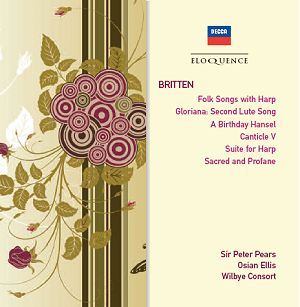

 Peter Pears (tenor) Osian Ellis (harp)
