Editorial Board
MusicWeb International
Founding Editor Rob Barnett Editor in Chief
John Quinn Contributing Editor Ralph Moore Webmaster
David Barker Postmaster
Jonathan Woolf MusicWeb Founder Len Mullenger
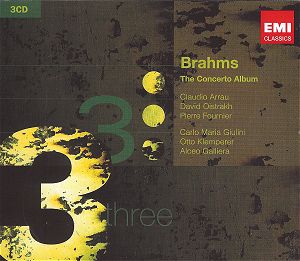
Johannes BRAHMS(1833-1897) The Concerto Album
CD 1
Piano Concerto No.1 in D minor, op.15 (1859) [51:28] Tragic Overture op.81 (1880) [13:11]
CD 2
Piano Concerto No.2 in B flat, op.83 (1881) [50:32] Variations on a Theme by Haydn op.56a (1873) [18:43]
CD 3
Violin Concerto in D, op.77 (1879) [40:43]
Double Concerto in A minor, op.102 (1887) [32:56] Claudio Arrau
(piano); David Oistrakh (violin); Pierre Fournier (cello);
Philharmonia Orchestra/Carlo Maria Giulini (op.15,
op.81, op.83, op.56a); Orchestre de la Radiodiffusion Française/Otto
Klemperer (op.77); Philharmonia Orchestra/Alceo Galliera
(op.102)
rec. No.1 Studio, Abbey Road, London, 21-23 April 1960 (op.15);
Kingsway Hall, London, 12 October and 12 November 1962 (op.81);
No.1 Studio, Abbey Road, London, 21-22 April 1962 (op.83);
Kingsway Hall, London, 25-26 January 1961 (op.56a); Salle
Wagram, Paris, 17-19 June 1960 (op.77); Kingsway Hall, London,
29 February and 2-3 March 1956 (op.102) EMI CLASSICS
5094212 [64:39 + 69:15 + 73:39]
At first glance this is a 3-disc set that
aims to do, in the words of the well-known slogan for wood
preservative, “exactly what it says on the tin.”
It is undeniably a neat and economical
way to collect Brahms’s concertante works, along with some
useful orchestral fillers.
The set is, one imagines, aimed at new
collectors – even though it takes a considerable leap of
faith to imagine that said novices would (1) venture into
buying all the concertos at once without dipping an
exploratory toe into the water first, and (2) eschew today’s
heavily-hyped glamorous soloist/conductor teams in favour
of artists recorded almost half a century ago, some now only
dimly recalled. No letters of complaint, please, from the
five remaining members of the Alceo Galliera Appreciation
Society.
Convincing proof that those responsible
for putting this set together were aware of a potential problem
in frightening off classical music newbies may be found on
the outside of the box where, avoiding any mention of when
the recordings were originally made, some very small lettering
advises that the dates are “as stated in the booklet”.
But perhaps the marketing men have aimed
this set at the wrong target altogether. More knowledgeable
collectors will, after all, be aware that these recordings
share in common not just the composer but also the characteristic
input of the man who caused every single one of them to be
set down for posterity in the first place – Walter Legge.
Of all producers active in the 1950s and
1960s, Legge has, arguably, left the longest lasting legacy. His
consummate talent for matching artists both with each other
and with appropriate repertoire helped create a body of work
that is probably just as much appreciated today as it was
fifty years ago.
In many ways, too, these recordings’ characteristically
warm and smooth sound adds to the impression that these are
essentially well-upholstered, “comfortable” performances,
more likely to reinforce feelings of contentment and well-being
than to challenge any musical preconceptions.
Arrau’s survey of the two piano concertos
is very fine and was in no way superseded by his later recordings
with Haitink. His low-key entry after Giulini’s lowering
introduction to the first concerto is, indeed, so discreet
and delicate that I actually played it again to confirm that
he hadn’t in fact missed the first note altogether! There
is some exquisitely beautiful playing here as Arrau gives
the impression of spontaneously thinking his way into the
music for the first time, an approach that pays particular
dividends in an especially rapt account of the central Adagio. His
distinctively light touch means, too, that the finale becomes
playful rather than, as is so often the case, merely forceful.
Although recorded two years later, the
second concerto embodies a very similar approach and it is
clear that, when it comes to Brahms, Arrau and Giulini see
very much eye to eye. While that may mean that the last
element of creative tension may be missing from their partnership,
many listeners will consider the resultant artistic gains
as more than adequate compensation. Giulini’s delicate,
dreamy opening of the first movement sets the tone, though
neither he nor Arrau shrinks from more declamatory passages. Once
again, the slow movement makes an especially strong impression,
assisted by a brief but telling contribution from cellist
Raymond Clark.
David Oistrakh has something worth saying
about the Brahms violin concerto in virtually every one of
his many studio and live recordings and, partnered with Klemperer
in Paris - and so perhaps unsurprisingly - chooses on this
occasion to emphasise the work’s innate strength and power. Personally,
I prefer the greater vivacity and spontaneity he demonstrated
just three years later in a live concert at the Royal Festival
Hall with the Moscow Philharmonic Orchestra under Kondrashin
(BBC Legends BBCL 4197-2), but the more severe Paris account
holds up well and is a perfectly valid approach to the work
on its own terms.
Oistrakh also has the rare distinction
of having two accounts of the same work – Brahms’s
too infrequently heard Double Concerto – in EMI’s “Great
Recordings of the Century” series (3457582 - see review). One
of them (supposedly Oistrakh’s favourite of his four recordings)
is that with cellist Pierre Fournier, now included in this
new set of
discs. With an elegance of approach typical of Fournier
and very well played, it certainly fits the overall tone
of this reissue better than its GROC rival, the justly famous
1969 Oistrakh/Rostropovich/Szell recording (EMI 5669022). And
though I do miss the sheer seat-of-the-pants excitement generated
by the latter, I can understand why, on this occasion, the
Oistrakh/Fournier/Galliera version was selected instead.
In his orchestral fillers, Giulini also
exhibits an exquisite eye for detail and emphasises – especially
in the Haydn variations – a number of often overlooked felicities
in the score. Once again, downplaying the music’s more dramatic
elements fits well into the overall artistic conception on
which this collection appears to be based.
The Philharmonia (predictably) and the
Orchestre de la Radiodiffusion Française (a pleasant surprise)
are both in excellent form throughout and the digitally remastered
sound (though one man’s “warmth” can certainly be another
man’s “tubbiness”) is representative of analogue recording
at its best.
Erik Levi’s notes offer a sound introduction
to the music but, in a rare glitch for EMI proofreaders,
the Piano Concerto No.2’s Allegro appassionato becomes
an Adagio appassionato – a careless lapse on an otherwise
extremely well thought out and produced reissue.
Rob Maynard
Please support our advertisers below by clicking on the logos for further information.

























 Claudio Arrau
(piano); David Oistrakh (violin); Pierre Fournier (cello);
Philharmonia Orchestra/Carlo Maria Giulini (op.15,
op.81, op.83, op.56a); Orchestre de la Radiodiffusion Française/Otto
Klemperer (op.77); Philharmonia Orchestra/Alceo Galliera
(op.102)
Claudio Arrau
(piano); David Oistrakh (violin); Pierre Fournier (cello);
Philharmonia Orchestra/Carlo Maria Giulini (op.15,
op.81, op.83, op.56a); Orchestre de la Radiodiffusion Française/Otto
Klemperer (op.77); Philharmonia Orchestra/Alceo Galliera
(op.102) 
