This
is quite a tricky one - first the positives. As anyone who
knows the audio CDs based on this same production will, I
hope, agree, this is one of the best sung and best played
Wozzecks on the market. The casting – of which more later
– is uniformly strong, with many of the singers very experienced
in these parts. The conducting is glorious, with Barenboim
not afraid to take an expansively Romantic view of the score
yet not lose sight of the forward-looking elements, particularly
the orchestration.
Now
for some negatives. Stage director Patrice Chéreau became
famous (notorious?) for his deconstructed centenary Ring at
Bayreuth, and he may ruffle a few feathers with his approach
here. He takes a broadly Brechtian view of the opera, which
is valid in this tortured Expressionist masterpiece where
too naturalistic a staging can jar. However, there is a middle
ground, as proved by Adolf Dresen’s Vienna staging for Claudio
Abbado in 1987, where the sets and costumes are basically
realistic but within a small stage ‘picture’, a sort of mini-cinema
within the proscenium which allows for speedy changes of locale.
In Chéreau’s production, we have a bare stage for most of
the time, punctuated occasionally by a series of platforms
and various shaped frames that give geometric outlines of
buildings, rooms. This is fine for certain scenes, but in
others Chéreau has simply ignored Berg’s explicit instructions.
A
few examples: Wozzeck is not shaving the Captain in the opening
scene; rather they are on an open set and the Captain is prowling
round a stationary Wozzeck as an animal stalking its prey.
This is fine for one aspect of the opera, that of Wozzeck
as a hapless, doomed victim of the society around him. Unfortunately
it doesn’t show how he is a dogsbody abused by his military
superiors. In the following scene, Wozzeck and Andres are
not cutting wood in the fields, but sweeping the stage floor
with large janitors’ mops. Again, fine for showing the underclasses
at work, but it completely undermines the fear and superstition
Wozzeck feels with the location and makes a mockery of his
mention of toadstools talking to him etc. The production is
full of these jarring inconsistencies, and is definitely at
its best when we just have a bare stage and effective lighting,
as in the scene of Marie’s murder or the scene in the soldiers’
barracks. Chéreau can’t resist messing with Berg’s ending,
which should have the child (here looking too old) running
off to join the other children to see Marie’s body. Chéreau
instead has the children running off, the child correctly
waiting a while, and then making his way down towards the
audience in a follow spot and exiting through one of the theatre
doors! As I say, Brechtian in its alienation but missing a
whole dimension of climactic emotional intensity.
I
could go on, and indeed it’s worth adding that much of it
works well, but I wish he had simply left the stage bare throughout
but for a few essential props, and gone then for a faithful
rendition of Berg’s instructions, rather as Deborah Warner
did for Opera North a few seasons ago. That way, it can be
interiorized as a drama of the mind, letting the music then
unleash its potency. Here, those jarring staging effects keep
reminding us we are witnessing actors in a production, presumably
Chéreau’s intention, but only fitfully effective.
Musically
things are much more enjoyable. Grundheber was the
Wozzeck of the 1980s and 1990s, and he makes the character
completely sympathetic and believable, even though he is in
slightly better voice for the earlier Abbado. Waltraud Meier
is also in good voice, but a little husky and perhaps a bit
too icy and aggressive in places, though her red costume and
bovver boots don’t help in this regard. Hildegard Behrens
elicits more pity from us in the Abbado, as well as looking
more sluttish and pathetic. Graham Clark is as callous as
one could get as the Captain, and Gunter von Kannen’s Doctor
radiates evil. Chorus work is excellent, imaginative and disciplined,
especially so in the tavern scene.
Barenboim
and the orchestra are probably the real stars here, and unlike
most DVDs, we don’t get to see them, which for me is the best
way. In Abbado’s Vienna set, every interlude is covered by
a tiresome cut to the pit, which defeats the object of Berg’s
intentions. Mind you, Chéreau spoils them too, sometimes choreographing
on-stage action, sometimes trundling on the set frames, and
occasionally bringing down a curtain as Berg asks for.
So,
a mixed bag overall. Ultimately I prefer the Dresen/Abbado
approach, and that version is also superbly sung and played,
though picture and sound are not as good as Barenboim’s. Fans
of the opera could also try the ultimate realism of the film
version brilliantly conducted by Bruno Maderna from 1970 (Arthaus)
well worth seeking out for Toni Blankenheim’s central portrayal.
There are no extras on this Warner release, which is always
a pity, especially with a short opera, but the booklet includes
a very good overview and synopsis.
Tony Haywood
























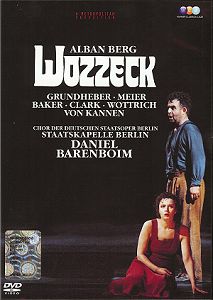

 Wozzeck (baritone)
– Franz Grundheber; Marie (soprano) – Waltraud Meier; Drum Major
(tenor) – Mark Baker; Andres (tenor) – Endrik Wottrich; Captain
(tenor) – Graham Clark ; Doctor (bass) – Gunter von Kannen; Idiot
(tenor) – Peter Menzel; Margret (mezzo) – Dalia Schaechter
Wozzeck (baritone)
– Franz Grundheber; Marie (soprano) – Waltraud Meier; Drum Major
(tenor) – Mark Baker; Andres (tenor) – Endrik Wottrich; Captain
(tenor) – Graham Clark ; Doctor (bass) – Gunter von Kannen; Idiot
(tenor) – Peter Menzel; Margret (mezzo) – Dalia Schaechter [97:00]
