Editorial Board
MusicWeb International
Founding Editor Rob Barnett Editor in Chief
John Quinn Contributing Editor Ralph Moore Webmaster
David Barker Postmaster
Jonathan Woolf MusicWeb Founder Len Mullenger
Gioachino ROSSINI (1792-1868) Ciro in Babilonia - drama with chorus in
two acts (1812) Baldassare.
King of the Assyrians in Babylon - Riccardo Botta - (ten);
Ciro, King of Persia, disguised as an ambassador
- Anna Rita Gemmabella (contralto); Amira, wife of Ciro,
prisoner of Baldassare - Luisa Islam-Ali-Zade (mezzo); Argene,
her confidante - Maria Soulis (mezzo); Zambri, a Babylonian
prince - Woitek Gierlach (bass); Arbace, captain of Baldassare's
army - Giorgio Trucco (ten); Daniele, a prophet - Giovanni
Bellavia (bass-baritone)
ARS Brunensis Chamber Choir
Württemberg Philharmonic Orchestra/Antonino Fogliani (conductor;
harpsichord)
rec. live, 16, 22, 24 July 2004, Kursaal Bad Wildbad, Germany,
Rossini in Wildbad Festival. NAXOS OPERA
CLASSICS 8.660203-04 [61.50 + 70.09]
Rossini
first began to make an impact as a composer with five
one-act farsa for the small Teatro San Moise in Venice.
The first of those to be staged was La Cambiale
Di Matrimonio, premiered
at the theatre on 30 November 1810 when Rossini was 19 years
old. It was another year after that premiere before
Rossini’s next opera, the two-act farse L’equivico
stravagante,was staged at his hometown
of Bologna. During this period Rossini earned
a sparse living as a coach at the Academia dei Concordi in
Bologna and by
conducting works of other composers in various theatres.
In the carnival season of 1810-11 he had directed from the
harpsichord at Ferrara and composed an alternative aria for
the star tenor. With his name gaining prominence this introduction
to the theatre probably explained his being invited to present
an opera during Lent 1812 after the premiere of his second
Teatro San Moise farse, L’Inganno
Felice. It would be his first real opportunity,
apart from a student work, to compose for a more serious
subject in conventional style.
However, the influence of the Catholic Church on the lyric
theatre in Italy restricted the performance of opera during
Lent. This did not however prevent wealthy art lovers, including
cardinals and princes from commissioning lavish musical works
in their own palaces. In the period of Handel and Alessandro
Scarlatti the operatic element in the music was evident.
This was acceptable so long as the subject matter was biblical
and despite the audience being receptive to the sensuality
of the often-convoluted plots. After some difficulties over
libretti Rossini settled on a subject: Ciro in
Babilonia (Cyrus in Babylon). The Biblical
aspects of the story are clear from its subtitle La Caduta
di Baldassare (The
Fall of Belshazzar).
The
story, which has Greek origins, also occurs in Chapter 5
of the Old Testament Book of Daniel. Belshazzar, King of
Babylon, lusts after his prisoner Amira, wife of Ciro, King
of Persia who he has defeated in battle. In attempting to
rescue his wife Ciro is captured and imprisoned. Belshazzar’s
feast is interrupted by thunder, lightning and the appearance
of a mysterious message on the wall. The prophet Daniel interprets
the words as a sign of God’s wrath and Belshazzar’s astrologers
advise him to sacrifice the prisoners and their child. Before
the sentence can be carried out news arrives of the defeat
of Babylon by the Persians and Ciro becomes King and is acclaimed.
Although Ciro in Babilonia was announced as a drama with chorus,
or oratorio, to facilitate its performance in Lent, it is
essentially Rossini’s early
attempt at opera seria. As Ferrara had not seen L’Inganno Felice the composer re-used its overture
with minor amendments. The celebratory chorus of the Babylonians
is appropriately jolly as is that for some of the other serious
situations in the work; in this respect it is no different
to works by Donizetti or early Verdi. But the music also
has its sophisticated moments and the composer did not hesitate
to draw on parts of it for inclusion in his mature and orchestrally
sophisticated Naples opera seria such as Mose in
Egitto, his Lenten work of 1818 and which like Ciro had
to have a biblical theme. Rossini had a major difficulty
in accommodating the second soprano who was to sing Argene.
He later condemned her as being impossibly ugly but also
a poor singer. After investigation he discovered that she
could sing the B flat above middle C and he wrote the aria Che
disprezza gl’infelici (CD 2 tr.13) for her on that single
note.
This
recording is of the revised edition from manuscripts of the
period edited by Urs Schaffer 1984 but in a new version for Rossini
in Wildbad by Antonino Fogliani. In listening to the
work the variation in sophistication is frequently obvious.
It also shows many signs of the works to come such as echoes
of Tancredi,
which followed in February 1813 at Venice’s premiere theatre,
La Fenice. This work and L’Italiana in Algeri, three
months later, set Rossini apart from the proliferation of
contemporary competitors and ensured his future as an operatic
composer. On the rostrum Antonino Fogliani has to wrestle
with an audience tendency to clap, albeit politely rather
than raucously, after every set-piece. This does not help
dramatic continuity; nor does the somewhat underpowered chorus
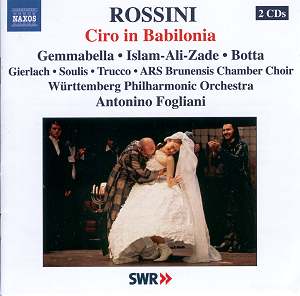
or the voices being set too far back. The picture on the
booklet indicates a staged performance. If this was so, the
absence of stage noise is welcome. The solo singing is varied.
Anna
Rita Gemmabella’s Ciro is the pick of the bunch. She sang
the minor part of Carlotta in the Naxos recording of Torvaldo
e Dorliska also from Bad Wildbad, where I found her
singing vocally distinctive. Here, her flexible contralto
is heard to good effect with strong characterisation overcoming
the stop-start caused by the applause (CD 2 tr.11). As Zambiri,
the young bass Woitek Gierlach, a name new
to me but who featured on Naxos’s recording of Meyerbeer’s Semiramidefrom Bad
Wildbad, sings strongly and with sonority, albeit with
a rather Slavic glottal production. As Baldassare
Riccardo Botta sings strongly, having a pleasing mid-voice
tone, but he sounds rather tight at the top. Giorgio Trucco
is over-parted as Arbace whilst Luisa Islam-Ali-Zade is a
little fluttery as Amira.
Although
I cannot give this readily available version of Ciro
in Babilonia the warm welcome I gave to the Naxos Torvaldo
e Dorliska, the performance serves as an introduction
to this early Rossini work which has many pointers to his
later opera seria. The booklet has an excellent introductory
essay, a similarly skilled track-related synopsis and track
listing although CD 2 tr. 2 should show the scena as involving
Ciro not Tamira who has no part in the opera. For those interested
in another recorded performance, my American friend, and
bel canto expert Lew Schneider, speaks highly of a 1988 recording
from Savona issued on the Agora label in 1998 (AGO79.2) and
previously on Akademia (2CDAK 105). This features Ernesto
Palacio as Baldassare and Daniela Dessy Ceriani as Amira who,
Lew tells me, ‘steals the show’. Conducted by Riccardo Rizzi
this is, we think, the only other recording prior to this
Naxos issue which may well of course be more readily available.
Robert J Farr
Please support our advertisers below by clicking on the logos for further information.

























 Baldassare.
King of the Assyrians in Babylon - Riccardo Botta - (ten);
Ciro, King of Persia, disguised as an ambassador
- Anna Rita Gemmabella (contralto); Amira, wife of Ciro,
prisoner of Baldassare - Luisa Islam-Ali-Zade (mezzo); Argene,
her confidante - Maria Soulis (mezzo); Zambri, a Babylonian
prince - Woitek Gierlach (bass); Arbace, captain of Baldassare's
army - Giorgio Trucco (ten); Daniele, a prophet - Giovanni
Bellavia (bass-baritone)
Baldassare.
King of the Assyrians in Babylon - Riccardo Botta - (ten);
Ciro, King of Persia, disguised as an ambassador
- Anna Rita Gemmabella (contralto); Amira, wife of Ciro,
prisoner of Baldassare - Luisa Islam-Ali-Zade (mezzo); Argene,
her confidante - Maria Soulis (mezzo); Zambri, a Babylonian
prince - Woitek Gierlach (bass); Arbace, captain of Baldassare's
army - Giorgio Trucco (ten); Daniele, a prophet - Giovanni
Bellavia (bass-baritone)