Pergolesi’s Messa di S. Emidio (Missa Romana)
is one of his two authentic masses; there are in fact seven others
attributed to him. Both of his surviving masses consist of just
a Kyrie and a Gloria. The CD booklet for this recording
describes the format as a Missa Brevis type, though there
is nothing brief about this mass; it is pretty substantial.
This Pergolesi mass
was originally performed in 1732 at a service of dedication
when St. Emygdius (San Emidio) was adopted as one of the patron
saints of Naples. Pergolesi subsequently added further choirs
to the piece, to make it even grander. In 1734 it was performed
in Rome at San Lorenzo in Lucina; Pergolesi was brought to Rome
especially for the performance. A contemporary description of
the mass describes it as terrifying. It may be relevant that
San Emidio protected against earthquakes.
This new disc from
Rinaldo Alessandrini and Concerto Italiano would seem to record
the Roman version of the mass but this is unclear from the CD
booklet. Pergolesi created versions of the mass for soli and
choir, two choirs and four choirs but listening to the disc
- and given the numbers in the chorus - we would seem to have
a recording of the version for two choirs. Here is it is performed
by a vocal ensemble of ten and an instrumental ensemble of nineteen.
The mass opens with
a wonderfully dramatic coup, held voices coming in one after
another building to a climax, all over a lively rushing orchestra.
Pergolesi repeats the effect in the Gloria and this pretty
much defines the mass. As performed by Concerto Italiano it
is certainly thrilling. For the remainder, Pergolesi keeps changing
the musical textures between sections, though the very small
choral forces used by Alessandrini mean that it is sometimes
difficult to differentiate between solo passages and choral.
This differentiation is probably necessary as Pergolesi writes
some solos in a very elaborate, quasi-operatic manner.
Alessandrini’s speeds
are on the brisk side, though his instrumentalists follow him
implicitly and create an exciting and lively performance. The
singers are very impressive in the way they articulate the faster
sections, though there are one or two moments when it might
have been better if Alessandrini had eased up his tempi. The
solo soprano’s rather operatic moments are performed creditably
rather than with stunning bravura. But generally this is a vivid
performance of a fascinating work.
Naïve have paired
the Pergolesi with Alessandro Scarlatti’s Missa per il
Santissimio Natale. This Christmas mass was written
in 1707 when Scarlatti was maestro di cappella at the Basilica
of Santa Maria Maggiore in Rome. Scarlatti’s handling of the
double chorus is strictly traditional, with the two choirs used
as two blocks of sound. In fact, this is pretty much the way
Pergolesi handles his chorus as well; in many way’s Pergolesi’s
mass was rather old-fashioned for the time.
Scarlatti’s innovation
is to give the orchestra an independent part, not doubling the
choirs, giving the piece a striking richness. Also the violins
are treated independently, which in effect creates a third choir.
Scarlatti uses a ritornello played by the violins to link the
various sections of the mass; this ritornello appears five times
throughout the work.
My comments on the
Pergolesi would apply equally well to the Scarlatti. Alessandrini’s
speeds are quite fast, but the performance lively and vivid.
Neither of these pieces
would be a perfect masterpiece. But Concerto Italiano’s performances
are vibrant and involving, the perfect way to get to know these
charming and inventive works.
Robert Hugill












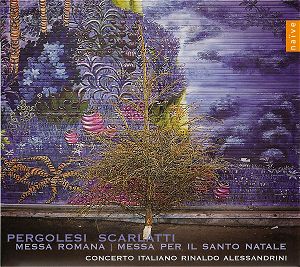

 Concerto Italiano/Rinaldo
Alessandrini
Concerto Italiano/Rinaldo
Alessandrini