This recording of Brahms 2 was my introduction to the work. Not
because I date back to 1929 or thereabouts but because the somewhat
odd selection of LPs in my school music room had no Brahms concertos
of any description. But it did have these ancient 78s and they
knocked me for six.
Sometimes
the recording that introduces you to a masterpiece remains your
benchmark for life. I daresay this recording caused my preference
for a free-flowing Brahms 2 over a majestic one or – heaven
help us – a “public monument” one. But I must say I experienced
no particular thrill of recognition, or sense of homecoming,
on hearing it again. It’s a swift performance, knocking several
inches of girth from the composer’s usual tubby image. But there
nevertheless seems plenty of time for warmth and affection,
from Coates even more than from Rubinstein, I sometimes thought.
If individual phrases have not stuck in my mind, I do wonder
if such an approach, structurally cogent as it is, really leaves
much space for memorable shaping of the phrases. Both artists
are more ones for speeding up than for slowing down. I could
have done without the hell-for-leather scamper through the final
pages.
I
don’t have any of Rubinstein’s later recordings, but I have
an off-the-air version that is probably fairly typical of the
many that must exist in radio archives around the world, made
with André Cluytens in Turin (4 May 1962). Bootleg versions
have appeared, I believe. In all truth, it is only in the third
movement that the later performance is substantially slower:
|
|
I
|
II
|
III
|
IV
|
TT
|
|
1929/Coates
|
14:35
|
08:14
|
09:20
|
07:59
|
40:07
|
|
1962/Cluytens
|
16:10
|
08:46
|
12:15
|
08:45
|
45:58
|
On
this showing Cluytens, too, was a free-flowing Brahmsian, and
for much of the time I was left thinking how similar it all was
in spite of the 33 years that had passed. It is true that a few
passages that appeared positively manic in the first movement
in 1929 manage not do so in 1962 thanks to the extra space Rubinstein
allows himself but a good deal of the old impetuousness remains.
Even in the third movement, after Cluytens has presided over a
leisurely but not dragging exposition of the famous cello solo,
Rubinstein seems more inclined to move on than to lose himself
in rapt meditation. A good deal of pleasure is to be had from
Rubinstein’s Brahms 2, early or late, but it was and remained
a slightly reductive take on the work.
After
a purposeful opening from Barbirolli, Rubinstein’s first solo
passage in the Tchaikovsky relaxes the tempo ever so slightly
to allow a touch of elegance. Tempi are pretty fast throughout
but the result, unlike the manic Horowitz/Toscanini version, is
light and scintillating. For once the main theme of the first
movement Allegro is accented properly. Slight divergences in phrasing
between pianist and orchestra suggest that Barbirolli would have
been glad to dig into the music more, but Rubinstein seems unwilling
to find more than charm and joi-de-vivre in it. According
to its lights, the performance is brilliantly successful, but
it is a little disconcerting to find a Tchaikovsky concerto yielding
no more passion than one by Saint-Saëns.
Here
again, I have only an off-the-air version as evidence of Rubinstein’s
later views on this work. This, too, is from Turin, conducted
by Pietro Argento (17 May 1968). The differences are greater than
they appear from the timings:
|
|
I
|
II
|
III
|
TT
|
|
1932/Barbirolli
|
17:52
|
06:59
|
06:13
|
31:05
|
|
1966/Argento
|
19:40
|
07:39
|
07:18
|
34:37
|
The
trouble is, this same Turin orchestra which produced passably
professional results for Cluytens comes near to scuppering the
proceedings with Argento on the rostrum. Rubinstein appears to
be employing a much wider range of tempo than before, particularly
in the first movement. But when, following an intolerably humdrum
presentation of the second theme by the wind band, the great man
enters at a notably slower tempo, giving an exquisite lesson in
phrasing, is this really his 1966 interpretation or his reaction
to the situation in which he found himself, an attempt to restore
beauty to a performance that risked falling flat?
In
spite of everything, there are signs that Rubinstein’s interpretation
of this concerto had evolved and had become more interesting than
before. However, this is a matter which I can only address via
his “official” recordings, or a live version more suitably accompanied.
In
certain works – much Chopin of course, but not only Chopin – Rubinstein
was the complete interpreter, revealing the depths below the surface
elegance. In particular, I would point to his stereo versions
of the Chopin Nocturnes. In Brahms and Tchaikovsky his desire
to give pleasure seems to shield him from the depths others have
found. But Rubinstein is always Rubinstein and it is difficult
to look the other way when he is playing.
Mark
Obert-Thorn, the producer, mentions the difficulties presented
by the Brahms. The results of his wrestlings sound as good as
we may reasonably expect for the venerable age of the recording,
but it is true that the Tchaikovsky sounds more than three years
more recent. Curious, too, that in those three years the use of
portamento by the LSO strings had diminished remarkably.
Christopher
Howell
see
also Review
by Rob Maynard
























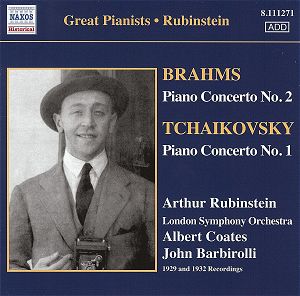
 Arthur Rubinstein
(piano)
Arthur Rubinstein
(piano) 
