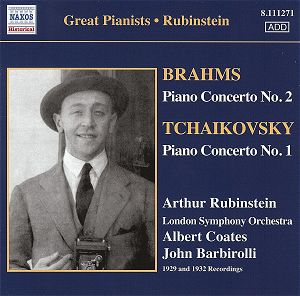
I’ve just been watching the 1947 Hollywood film Carnegie Hall
which, in spite of a mawkishly sentimental plot, features
a mouth-watering line-up of cameo performances from Bruno Walter,
Lily Pons, Gregor Piatigorsky, Risë Stevens, Artur Rodzinski,
Jan Peerce, Ezio Pinza, Jascha Heifetz, Fritz Reiner, Leopold
Stokowski – and Arthur Rubinstein.
Rubinstein,
playing Chopin’s A-flat polonaise and De Falla’s Ritual
Fire Dance, makes one of the strongest cinematic and musical
impressions. Ramrod-backed, poker-faced and gazing from time
to time into some ethereal middle distance, he is the very
embodiment of the pianist as aristocratic artist.
That
image – carefully cultivated by his management and reaching
its eventual apotheosis in a prestigious 94-CD Arthur Rubinstein
Collection (“106 hours covering his entire recording career,
fully remastered and packaged together in a unique, specially
designed box”) – is one of two that remain in the public
consciousness today. The other is, of course, that of the
bon vivant and inveterate womaniser who, at the age of 83,
began an affair with a young woman 60 years his junior.
But
focusing exclusively on Rubinstein as a Grand Old Man of the
piano is to overlook an earlier phase of his career when,
if not exactly an enfant terrible, he frequently demonstrated
a greater degree of flexibility, spontaneity and sheer joie
de vivre than was sometimes later the case.
The
two concertos presented here are cases in point.
The
Brahms, Rubinstein’s first recording of any concerto, emerges,
in particular, with a distinctive celerity and lightness of
touch. The speeds in three of the four movements are notably
faster than those of his immediate contemporaries – let alone
those of most performers today. Thus, the first movement clocks
in at 14:35, compared to 15:53 (Schnabel, 1935), 16:04 (Backhaus,
1939) and 16:15 (Horowitz, 1940) and the same picture emerges
from both the Andante and the concluding Allegretto
grazioso. Only in the second movement Allegro appassionato
does Rubinstein adopt a tempo comparable to that of his
contemporaries (though not to that of post war soloists who
have frequently tended to adopt a broader - if not, indeed,
a more ponderous - style).
This
whole approach is, to modern ears, a novel and striking one
that successfully offers an alternative viewpoint on a very
familiar work. It is sad, therefore, that the original recording
was not one of the best: Rubinstein later recalled how he
was positioned way off at the back of the stage and the frequently
acclaimed acoustics of Kingsway Hall seem, on this occasion
at least and in spite of all Mark Obert-Thorn’s heroic efforts
at restoration, to have been ineffectively reproduced on disc.
The
opening of the state-of-the-art Abbey Road studios in 1931
meant, however, that Rubinstein’s June 1932 recording of Tchaikovsky’s
first concerto could be recorded in far superior and more
immediate sound. Again, its abiding characteristic is innate
elegance and sensitivity, coupled with a marked fleetness
of foot. Rubinstein’s opening movement, for instance, clocks
in at 17:52 – nearly two minutes less than Solomon’s acclaimed
(and similarly un-barnstorming) 1929 recording with Hamilton
Harty and the Hallé Orchestra – and, although the differentials
in the other two movements are not as marked, the overall
timings for the complete concerto come in at 31:05 for the
Pole and 33:17 for the Briton.
Of
course, the improved Abbey Road sound also allows us to hear
the orchestra more clearly and my initial impression was that
Barbirolli’s accompaniment is a little anonymous and bland:
why, for goodness sake, was Albert Coates, still highly regarded
even today for his fiery interpretations of Russian music,
not employed as he had been for the Brahms? But, on repeated
listening, it becomes clear that Barbirolli’s approach is
far more of a piece with Rubinstein’s overall conception of
the work and that he was, indeed, the correct choice.
This
is certainly an important and worthwhile addition to Naxos Historical’s
“Great Pianists” CDs. All the other performers and their recordings
mentioned above are to be found among earlier releases in the
series and it is now a particular pleasure to see Arthur Rubinstein
joining them as a worthy member of this particular pianistic pantheon.
Rob Maynard