"Acclaimed as
one of THE GREATEST OPERA RECORDINGS
OF ALL TIME", says a sticker on
the back cover of this issue. Words
like ‘greatest’, ‘classic’ and legendary’
are over-used in discussions of recordings
from the past but in this case they
are justified. I remember a rapturous
review in Gramophone back in
1973 and having almost ten years earlier
bought the ‘classic’ Beecham recording
and being something of a sceptic, I
decided that the praise was excessive.
It can’t be that good, I decided. But
when I eventually got to hear the Karajan
I realized that the reviewer – Edward
Greenfield I believe – wasn’t so wide
of the mark. I have returned to it on
several occasions through the years
and each time I have had the feeling
that this one is special. Still it is
to some other versions I have turned
most frequently and also bought when
they were reissued on CD: Beecham of
course, with los Angeles and Björling,
Serafin with Tebaldi and Bergonzi and
also Thomas Schippers with the young
Mirella Freni and Nicolai Gedda. I have
also found a lot to admire in the Cetra
recording from the early 1950s, conducted
by Santini and with Rosanna Carteri
and Ferruccio Tagliavini – the latter
the closest to Beniamino Gigli in voice
as well as style. Erich Leinsdorf on
RCA with Anna Moffo and Richard Tucker,
though not quite competitive, shouldn’t
be overlooked either.
La bohème
is in a way a collective opera and the
sum of the parts is often more important
than the individual achievements but
it is around Mimi and Rodolfo the drama
circulates and those two roles are essential.
Of all the Mimis mentioned above there
are two that stand out as ideally fair,
warm, frail and innocent: Victoria de
los Angeles and Mirella Freni. All the
others have there good moments and all
are first class singers with classy
voices but none of them can challenge
my two favourites. A good Rodolfo has
to be youthful, ardent, warm and sensitive,
besides tossing off the high C in Che
gelida manina with brilliance and
elegance. Björling fulfils most
of these requirements even though he
is a bit stiff; Bergonzi is slightly
less brilliant but is on the other hand
more flexible; Tagliavini is almost
as perfect but from Gigli he also inherited
that tear in the voice that makes him
more melodramatic; Gedda has all these
attributes in abundance and intelligence
and taste to match but is more Nordically
cool than Italianate hot-blooded – a
criticism that sometimes has been levelled
against Björling as well; Pavarotti,
finally, has sometimes been accused
of just skimming the surface of his
characters. In every other respect he
qualifies with knobs and on this recording
he is uncommonly human and sensitive.
In many ways this is perhaps his best
contribution to a complete opera on
records. What I personally can feel
as a drawback is that his tone sometimes
becomes coarse and glaring but he compensates
that with plainly heavenly soft singing,
without being lachrymose.
From the above analysis
we can generate a shortlist, consisting
of Beecham, Schippers and Karajan. I
regret to have to exclude Serafin, since
his reading is one of the finest and
Tebaldi possibly the most glorious Mimi,
but she is no weak, pneumonic seamstress,
she is more the managing director of
the dressmaker’s workshop where Mimi
might work. Otherwise Serafin has a
supporting cast to challenge most of
the other sets: Bastianini, Siepi and
Corena versus Merrill, Tozzi and Corena
for Beecham as Marcello, Colline and
Benoit/Alcindoro. Karajan has Panerai,
Ghiaurov and Michel Sénéchal
– the latter’s tenor just as expressive
as Corena’s bass – and Gianni Maffeo
is by far the best Schaunard. Moreover
Elizabeth Harwood is match for any of
the other Musettas. Schippers has a
good all-Italian supporting cast but
they are not quite up to the competition.
This leaves us with
Beecham and Karajan. The Beecham recording
was arranged on very short notice with
a pick-up orchestra in New York, when
HMV/RCA realized that the right singers
happened to be available. Everything
is not impeccable and the recording
– in mono only – wasn’t among the best
even when it was new. Karajan in his
then regular Berlin venue, the Jesus-Christus-Kirche,
had his well-trimmed Berlin Philharmonic
and a technical all star staff: Ray
Minshull, James Mallison, Gordon Parry,
James Lock and Colin Moorfoot – who
beats that? His is also a stupendous
recording with tremendous power and
wide dynamics when the BPO lets loose
but also the softest possible silken
strings and delicate woodwind in the
many lyrical passages, everything registered
with the utmost sensitivity.
All right. This seems
to indicate that Karajan wins hands
down, but what about the conducting?
More than one critical eyebrow was raised
when the Beecham set was released more
than fifty years ago. Eccentric, impossibly
slow, was heard from one camp while
the opposite side maintained for the
first time all the beauty and sensualism
in the score was brought out and Beecham
himself stated that this was what the
composer wanted; he had discussed these
matters with Puccini himself. Karajan,
it should be said at once, is no sprinter
either and in many places he indulges
in the sentiment so intensely that the
music almost comes to a stand still,
most obviously so in the third act where
Donde lieta usci is heart-rending
almost beyond the limit and the final
pages of the act even slower – but so
wonderfully tense. This is magical conducting
and the maestro is here the puppet-master
who knows exactly which strings to pull
and how much. The most remarkable is
that in spite of so tight reins the
soloists manage – or are allowed – to
create real characters. Panerai – since
many years a favourite of Karajan’s
– is a slightly boisterous but flexible
Marcello: the opening scene with Pavarotti
sets the tone for the whole performance.
Mirella Freni, so lovely on the Schippers
set ten years earlier, is just as fine
here and Pavarotti was always at his
best when singing opposite the friend
of his childhood. He is so warm and
caring in the first act and in the third
and fourth he surpasses anything I have
heard of him on records.
There are some sound
effects to heighten the atmosphere:
Benoit of course knocks when he comes
and slams the door when leaving and
in the fencing scene in the last act
we hear how the combatants move back
and forth across the stage. The realism
is stunning.
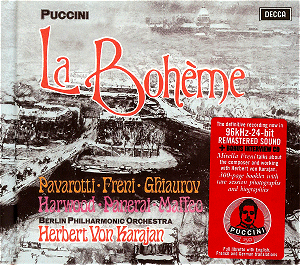
This recording is released
in 96kHz-24-bit remastered sound to
celebrate the 150th anniversary
of Puccini. It is also a centenary tribute
to Herbert von Karajan and the presentation
is certainly luxurious. The two discs
come in a 300+ pages hardback book with
articles about the work, this recording,
Puccini, Karajan, James Lock on recording
with Karajan, an obituary on Pavarotti,
Pavarotti on singing La Bohème,
a long essay by James Jolly on Mirella
Freni and Mirella Freni on working with
Karajan, which consists of extracts
from the bonus CD where Mirella Freni
talks to Catherine Bott. There are also
biographies on the other singers, synopsis
and libretto and the book is lavishly
illustrated with session photos. A real
deluxe issue in other words.
For once the text on
the back cover sticker is no hype. This
is one of the greatest opera recordings
of all times.
Göran Forsling













 Berliner Philharmoniker/Herbert von Karajan